
In which city was Albert Speer born in 1905?
Show answer
Mannheim
He came from a wealthy family of architects and grew up in Heidelberg.
11 questions · History
Albert Speer, born in Mannheim in 1905, was Hitler's architect and later his armaments minister and after the war the most skilful narrator of his own innocence. The young architect joined the Nazi Party in 1931 and caught Hitler's eye with his stage designs. For the Nuremberg rallies he created the “cathedral of light” from 130 anti-aircraft searchlights, and in 1938/39 he built the New Reich Chancellery in Berlin. With Hitler he planned to rebuild Berlin as the world capital “Germania”; Jewish tenants were evicted from their flats to make way for it. In 1942, after Fritz Todt's death, he took over the armaments ministry. He increased production despite the bombing, with millions of forced labourers and concentration camp prisoners working in murderous conditions. At the Nuremberg trial he presented himself as an apolitical technocrat who accepted responsibility but claimed to have known nothing. That saved him from the gallows: he was sentenced to 20 years in prison. After his release from Spandau his memoirs became a bestseller in 1969. The legend of the “good Nazi” lasted for decades; historians have since shown how much Speer knew about the mass murder and how deeply he was involved in the crimes. He died in London in 1981 while on a trip.
Practise for freePurFact brings every card back right before you would forget it. That's how knowledge sticks.
Mannheim
He came from a wealthy family of architects and grew up in Heidelberg.
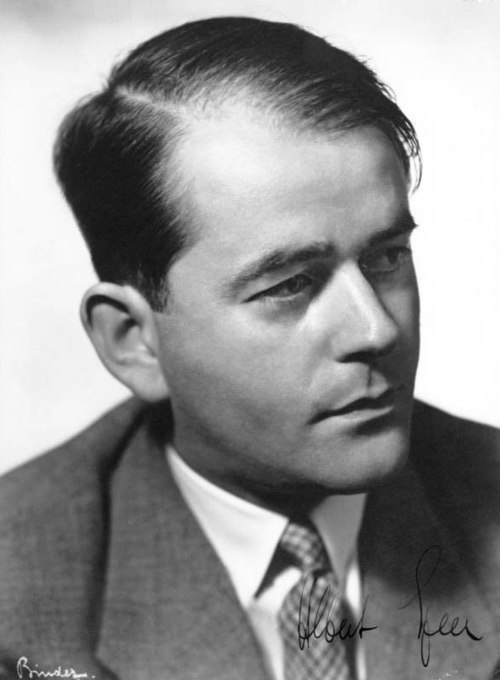
Foto: Atelier Binder (Bundesarchiv, Bild 146II-277) · CC BY-SA 3.0 de · Wikimedia Commons
Albert Speer
Portrait by the Berlin studio Atelier Binder.
architect
He studied in Karlsruhe, Munich and Berlin and worked as assistant to Heinrich Tessenow.
the cathedral of light
The columns of light reached several kilometres into the sky and turned the rally into a pseudo-religious spectacle.
the New Reich Chancellery
Visitors had to walk more than 200 metres through halls and galleries to reach Hitler's study; they were meant to feel small.
💡 Did you know? The ruin was cleared after 1945; its marble is said to have been used in the Soviet War Memorial in Treptow, among other places.
Germania
Its centrepiece was to be a domed hall for 180,000 people. From 1939 thousands of Jewish tenants were evicted from their flats for the plans.
the Armaments Ministry
Under him armaments production peaked in 1944: despite the Allied air raids.
forced labourers
In the underground plant Mittelbau-Dora near Nordhausen, where the V-2 rocket was built, thousands of prisoners died.
20 years
He served the full sentence in Spandau prison and was released in 1966.
Inside the Third Reich
The book became a worldwide success and long shaped the image of the seduced technocrat; the publisher Wolf Jobst Siedler and Joachim Fest helped shape it.
London
He had come for an interview with the BBC and suffered a stroke there.
Home · All topics · Legal notice · Privacy · Terms · Contact