
Where was Albrecht Dürer born in 1471?
Show answer
Nuremberg
His father was a goldsmith who had emigrated from Hungary.
💡 Did you know? Dürer's father was a goldsmith from Hungary: the precision of that craft shaped the son.
18 questions · Art
Albrecht Dürer is born in Nuremberg in 1471, the son of a goldsmith who had emigrated from Hungary. From his father he learns the fineness of handcraft, then switches to painting. As a young man he travels to Italy and encounters the art of the Renaissance there: a key experience that shapes him deeply. Dürer becomes the bridge between the Italian Renaissance and German art north of the Alps. Dürer's greatest mastery lies in printmaking. With engraving and woodcut he creates works of astonishing fineness that can be reproduced and make him famous across Europe. Prints such as "Knight, Death and the Devil", "St Jerome in His Study" and the enigmatic "Melencolia I" are regarded as peaks of art. Especially modern is the way he looks at himself: Dürer paints a series of self-portraits in which he presents himself with a self-confidence no artist had shown before: in the "Self-Portrait with Fur-Trimmed Robe" even in a pose otherwise reserved for images of Christ. He signs his works with a famous monogram of the interlocked letters A and D. Dürer dies in 1528 in his home city of Nuremberg. He leaves behind not only pictures but also theoretical writings on proportion and perspective. Did you know that his woodcut of a rhinoceros shaped the European image of that animal for almost three hundred years: even though Dürer himself had never seen a real rhinoceros? Dürer combined German thoroughness with Italian art theory. Famous are his ‘Self-Portrait with Fur-Trimmed Robe’, the exotic ‘The Rhinoceros’, ‘Adam and Eve’ and ‘The Four Apostles’. Among his master engravings are ‘Melencolia I’, ‘Knight, Death, and the Devil’ and ‘St. Jerome in His Study’; add to them the ‘Adoration of the Magi’, the ‘Feast of the Rosary’, the ‘Self-Portrait’ at twenty-six and illustrations for ‘Ship of Fools’.
Practise for freePurFact brings every card back right before you would forget it. That's how knowledge sticks.
Nuremberg
His father was a goldsmith who had emigrated from Hungary.
💡 Did you know? Dürer's father was a goldsmith from Hungary: the precision of that craft shaped the son.
Renaissance (north of the Alps)
He was the bridge between Italian and German art.
💡 Did you know? Dürer travelled to Italy twice and brought Renaissance ideas of proportion and perspective back to Germany.
printmaking
With engraving and woodcut Dürer was the first to reach a mass audience; his prints were sold across Europe.
💡 Did you know? His printable sheets made him famous across Europe.
the AD monogram
Dürer signed almost all his works with the interlocked „AD.“
💡 Did you know? The monogram grew so valuable that it was forged even in Dürer's lifetime: he brought a lawsuit against it in Venice.
self-confident self-portraits
Dürer painted himself several times, as a self-assured artist, not a mere craftsman.
💡 Did you know? In the "Self-Portrait with Fur-Trimmed Robe" he adopts a pose otherwise reserved for Christ.
Nuremberg
He also left writings on proportion and perspective.
💡 Did you know? Dürer also left theoretical books on proportion and fortification; he was artist and scholar at once.

Foto: Albrecht Dürer · CC0 · Wikimedia Commons
The Rhinoceros
A 1515 woodcut: it shaped the European image of the rhinoceros for almost 300 years.
💡 Did you know? Dürer had never seen a rhinoceros and drew it from a description: the woodcut shaped Europe's image of the animal for 300 years.
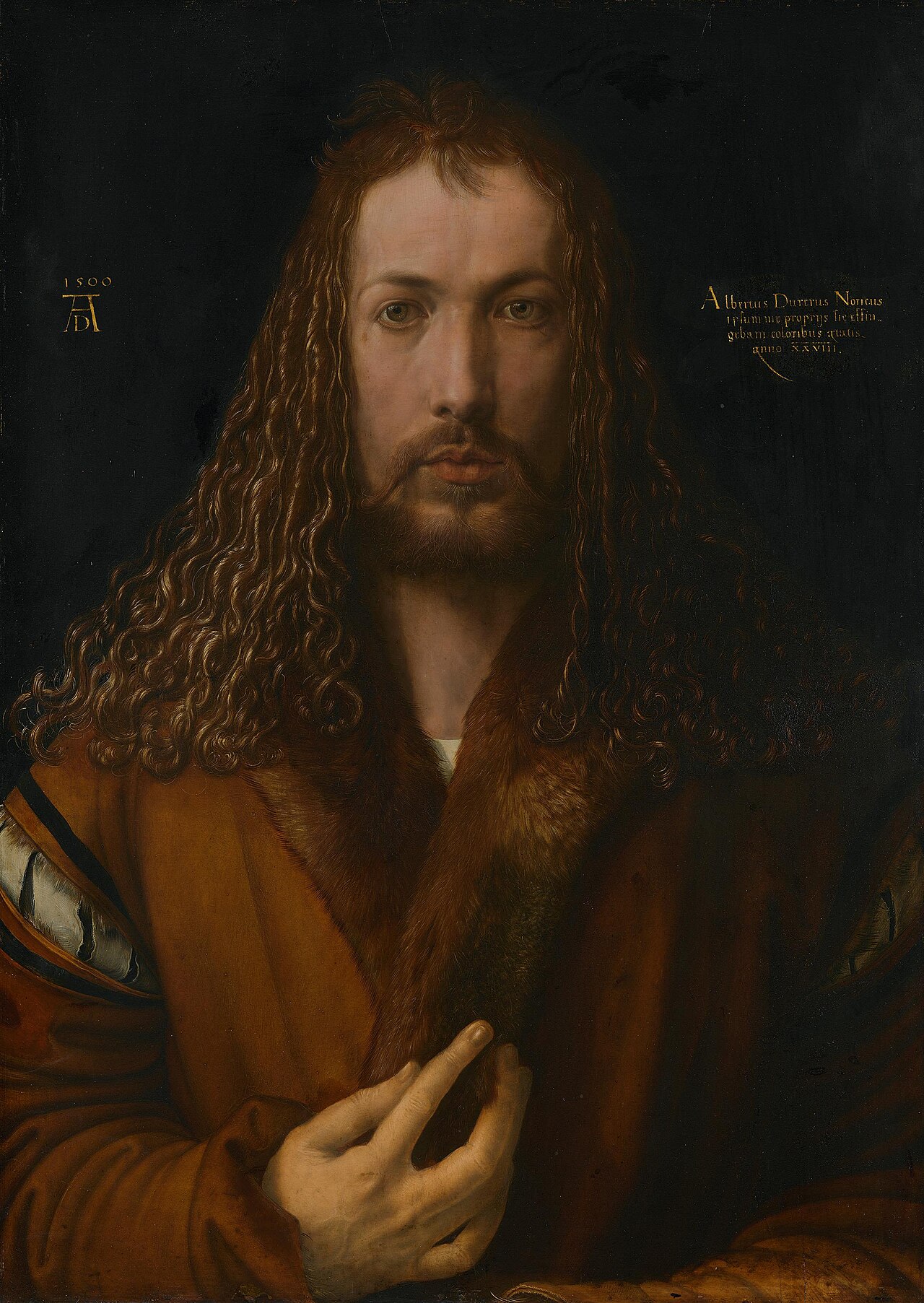
Foto: Albrecht Dürer · Public domain · Wikimedia Commons
Self-Portrait with Fur-Trimmed Robe
A 1500 self-portrait in a frontal, almost Christ-like pose.
💡 Did you know? Dürer depicted himself frontally and symmetrically as usually only Christ was shown: a bold self-confidence for 1500.

Foto: Albrecht Dürer · Public domain · Wikimedia Commons
Melencolia I
A famous 1514 engraving, full of enigmatic symbols.
💡 Did you know? The enigmatic engraving contains a „magic square“ whose bottom row spells out the year 1514.

Foto: Albrecht Dürer · Public domain · Wikimedia Commons
The Four Apostles
Painted around 1526.
💡 Did you know? Dürer gave the two-panel painting to his home city of Nuremberg as a kind of legacy.

Foto: Albrecht Dürer · Public domain · Wikimedia Commons
Adam and Eve
Painted around 1507.
💡 Did you know? Dürer combined Italian ideal proportion with northern attention to detail: each animal carries symbolic meaning.

Public domain · Wikimedia Commons
Ship of Fools
Painted around 1494.
💡 Did you know? The young Dürer created the woodcuts for Sebastian Brant's bestseller „The Ship of Fools.“
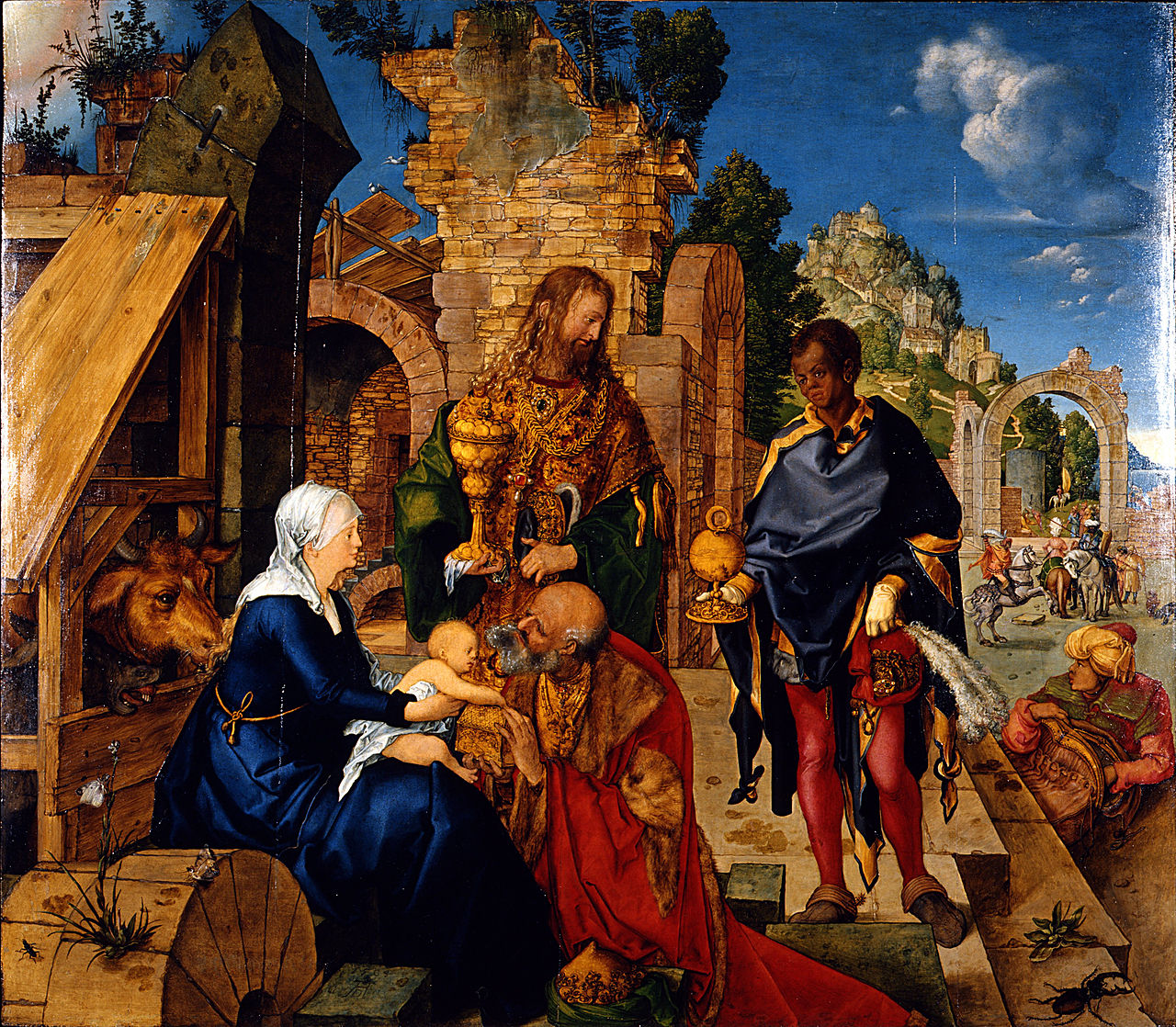
Foto: Albrecht Dürer · Public domain · Wikimedia Commons
Adoration of the Magi
Painted around 1504.
💡 Did you know? In this painting Dürer shows off his newly learned command of perspective and Italian colour.

Foto: Albrecht Dürer · CC0 · Wikimedia Commons
Knight, Death, and the Devil
A masterly engraving of 1513.
💡 Did you know? The knight rides on unswayed past Death and the Devil: one of Dürer's three celebrated „master engravings.“

Foto: Albrecht Dürer · Public domain · Wikimedia Commons
Feast of the Rosary
Painted around 1506.
💡 Did you know? Dürer painted the altarpiece in Venice to prove to the Italians that a German too could paint in colour.

Foto: Albrecht Dürer · CC0 · Wikimedia Commons
St. Jerome in His Study
Painted around 1514.
💡 Did you know? The second „master engraving“ shows cosy scholarly calm: the counterpart to the restless „Melencolia.“

Foto: Albrecht Dürer · Public domain · Wikimedia Commons
Self-Portrait
Painted around 1498.
💡 Did you know? Before an open window landscape Dürer presents himself as a worldly, fashionably dressed gentleman.

Foto: Albrecht Dürer · Public domain · Wikimedia Commons
Albrecht Dürer
Albrecht Dürer (1471 to 1528) was the greatest artist of the German Renaissance, famous as a painter and a supreme master of printmaking.
💡 Did you know? Dürer was the first German artist of European fame: his prints made him known and wealthy across Europe already in his lifetime.
Home · All topics · Legal notice · Privacy · Terms · Contact