
Which musical era does Antonín Dvořák belong to?
Show answer
Romanticism
Alongside Smetana he is the leading figure of Czech national music.
💡 Did you know? Dvořák combined classical symphonic writing with the folk melodies of his Bohemian homeland.
13 questions · Music
Antonín Dvořák was born in 1841 in Nelahozeves on the Vltava, a village north of Prague; his father was a butcher and innkeeper who initially expected his son to take over the trade. But Antonín insisted on music, scraped by for years as a viola player and organist in Prague, and composed at night. His breakthrough came thanks to a prominent champion: Johannes Brahms spotted the Czech's talent on a stipend jury, recommended him to his publisher Simrock and the 'Slavonic Dances' (1878) commissioned as a result made Dvořák famous across Europe overnight. Dvořák became the voice of Bohemia: he lifted the melodies and rhythms of his homeland into the grand symphonic forms: into symphonies, chamber music and operas like 'Rusalka', whose 'Song to the Moon' won worldwide fame. In 1892 the butcher's son took the great leap across the Atlantic: for a princely salary he became director of the National Conservatory in New York. Out of his wonder at the New World (and his homesickness for the old) came his Ninth Symphony, 'From the New World', still one of the most performed orchestral works of all; its Largo theme echoes the spirituals Dvořák came to love in America. His famous Cello Concerto in B minor also dates from the American years. But homesickness won: in 1895 Dvořák returned to Prague, became director of the Prague Conservatory and was revered by his nation as a hero. Did you know that Dvořák had two great passions besides music? Railways and pigeons. In New York he swapped locomotives for ocean liners, whose departures he studied down at the harbour. He died in Prague in 1904 and lies buried at the Vyšehrad cemetery, the pantheon of the Czech nation.
Practise for freePurFact brings every card back right before you would forget it. That's how knowledge sticks.
Romanticism
Alongside Smetana he is the leading figure of Czech national music.
💡 Did you know? Dvořák combined classical symphonic writing with the folk melodies of his Bohemian homeland.
Bohemia
Born in 1841 in Nelahozeves on the Vltava; his father was a butcher and innkeeper.
💡 Did you know? Dvořák was the son of a butcher and innkeeper and was meant to learn the butcher's trade.
From the New World
Its Largo theme echoes the spirituals Dvořák came to love in America.
💡 Did you know? Dvořák wrote the „New World“ Symphony in the USA; a recording of it was even taken to the Moon by the Apollo 11 crew.
the National Conservatory
For a princely salary: many times his Prague earnings.
💡 Did you know? He urged his American students to build a national music from spirituals and Indigenous melodies.
Slavonic Dances
Commissioned by the publisher Simrock, modelled on Brahms's Hungarian Dances.
💡 Did you know? Modelled on Brahms's „Hungarian Dances“, Dvořák wrote his „Slavonic Dances“: they made him internationally famous overnight.
Johannes Brahms
Brahms recommended the unknown Czech to his publisher Simrock: the start of a lifelong friendship.
💡 Did you know? Brahms discovered Dvořák, recommended him to his publisher and even offered him money: a generous friendship between composers.
Rusalka
Its 'Song to the Moon' is one of the most famous opera arias in the world.
💡 Did you know? The water nymph's aria to the moon („Song to the Moon“) from „Rusalka“ is one of the most beloved soprano arias of all.
B minor
Written in New York in 1894 to 1895; Brahms sighed that had he known such a cello concerto was possible, he'd have written one himself.
💡 Did you know? Dvořák's Cello Concerto in B minor is considered the finest ever written: Brahms is said to have regretted not thinking of it himself.
railways and pigeons
In New York he studied the departures of ocean liners at the harbour instead of locomotives.
💡 Did you know? He knew the Prague train timetables by heart.
homesickness
He became director of the Prague Conservatory and was revered as a national hero.
💡 Did you know? Despite fame and a good salary in New York, Dvořák was plagued by homesickness for Bohemia: especially for his beloved pigeons and railways.
Vyšehrad (Prague)
The pantheon of the Czech nation: he died in Prague in 1904.
💡 Did you know? Dvořák is buried in the Vyšehrad cemetery of honour in Prague: among other great sons of the Czech nation.

Foto: Unknown author · Public domain · Wikimedia Commons
Antonín Dvořák
Antonín Dvořák was a Czech Romantic composer who combined his homeland's folk melodies with classical symphonic writing: famous for the „New World“ Symphony.
💡 Did you know? He was a passionate railway enthusiast, said to have known the locomotives at Prague station better than some engine drivers.
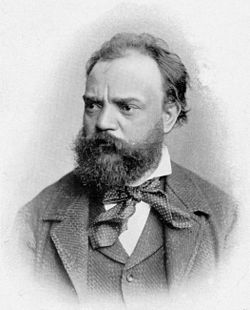
Foto: Unknown author · Public domain · Wikimedia Commons
From the New World (Symphony No. 9)
Dvořák wrote the Ninth in the USA; the Largo with its cor anglais melody sounds like a song of homesickness.
💡 Did you know? The Largo's melody later became popular as the song ‘Goin’ Home’.
Home · All topics · Legal notice · Privacy · Terms · Contact