✍️
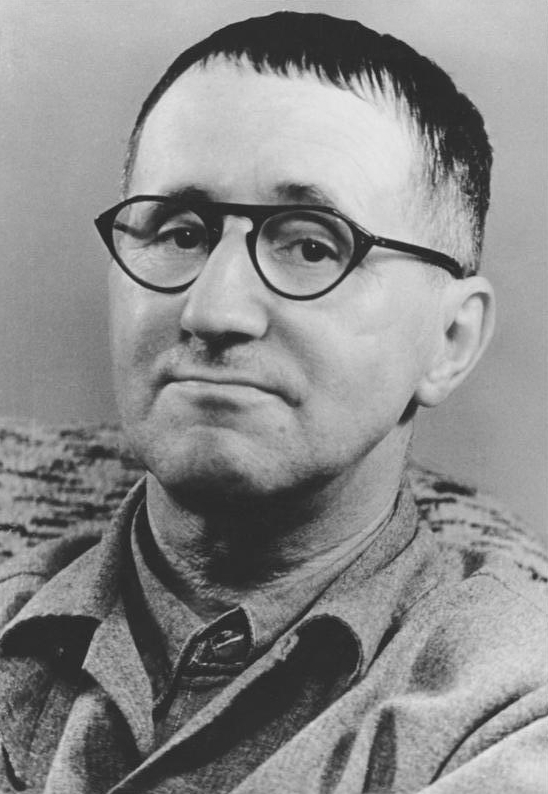
Bertolt Brecht
13 questions · Literature
Bertolt Brecht, born in Augsburg in 1898, revolutionised twentieth-century theatre and remained a provocateur throughout: cigar, leather jacket, cool gaze. In 1920s Berlin he landed the Weimar Republic's greatest stage success with 'The Threepenny Opera' (1928, music by Kurt Weill): the beggars' opera around the gangster Macheath (its 'Ballad of Mack the Knife' became a world hit) mocks bourgeois morality: 'Food comes first, then morals.'
Brecht's true revolution was theoretical: 'epic theatre' is meant not to enchant but to force the audience to think. His tool is the alienation effect: songs, banners, exposed staging tear up the illusion so the spectator judges instead of empathising. The day after the Reichstag fire in 1933, the Marxist fled Germany: Prague, Vienna, Denmark, Finland, Moscow, California: 'changing countries more often than shoes', as his poem 'To Those Born Later' puts it. The great plays were written in exile: 'Life of Galileo', 'Mother Courage and Her Children'; the cart of the canteen woman who lives off the war and sacrifices all her children to it became one of the century's defining images: 'The Good Person of Szechwan' and 'The Caucasian Chalk Circle'.
In 1947 Brecht was questioned in the USA by the House Un-American Activities Committee: the next day he left the country. From 1949 he built up the 'Berliner Ensemble' in East Berlin with his wife, the actress Helene Weigel, making his theatre world-famous. He died in Berlin in 1956.
Did you know that after the crushed workers' uprising of 17 June 1953 Brecht left the GDR regime a poisonous poem? 'The Solution' asks whether it would not be simpler for 'the government to dissolve the people and elect another'; it was published only after his death.
Practise for free
PurFact brings every card back right before you would forget it. That's how knowledge sticks.