
In which year was Blaise Pascal born?
Show answer
1623
He was seen as a mathematical prodigy.
💡 Did you know? Pascal was a prodigy: at 16 he wrote an important treatise on geometry.
10 questions · Science
Blaise Pascal, born in France in 1623, was a child prodigy: as a teenager he wrote an important treatise on conic sections. At just 19 he built a mechanical calculator for his father, a tax official: the "Pascaline", one of the first in the world that could add and subtract. Together with Pierre de Fermat, Pascal laid the foundations of probability theory in an exchange of letters about games of chance: today indispensable for insurance, statistics and physics. Named after him is also "Pascal's triangle", a pyramid of numbers full of astonishing patterns. In physics he studied air pressure and the vacuum and formulated a law on how pressure spreads through fluids. The SI unit of pressure, the pascal, bears his name. Yet at 31, after a formative experience, Pascal turned almost entirely away from calculation and towards religion and philosophy. In his "Pensées" (Thoughts) he formulated the famous "Pascal's Wager": it is reasonable to believe in God, since the possible gain is infinite and the possible loss small. Sickly from childhood, Pascal died as early as 1662, aged only 39: yet left behind a body of work that shaped mathematics, physics and philosophy alike.
Practise for freePurFact brings every card back right before you would forget it. That's how knowledge sticks.
1623
He was seen as a mathematical prodigy.
💡 Did you know? Pascal was a prodigy: at 16 he wrote an important treatise on geometry.
Pascaline
One of the first in the world.
💡 Did you know? At just 19, Pascal built a mechanical calculator to ease his father's tax accounting.
probability theory
From letters about games of chance.
💡 Did you know? Probability theory grew out of Pascal's correspondence with Fermat about games of chance.
Pascal's triangle
Full of astonishing patterns.
💡 Did you know? „Pascal's triangle“ hides countless mathematical patterns: though it was known long before Pascal.
pascal
SI unit, symbol Pa.
💡 Did you know? The unit of pressure, the pascal, is named after him: air pressure is about 100,000 pascals.
Pascal's Wager
Believing in God is the reasonable bet.
💡 Did you know? Pascal's „wager“ argues it is more rational to believe in God, because the potential gain is infinite.
39 years
He was sickly all his life.
💡 Did you know? Pascal died at just 39: after a life marked by illness and religious struggle.
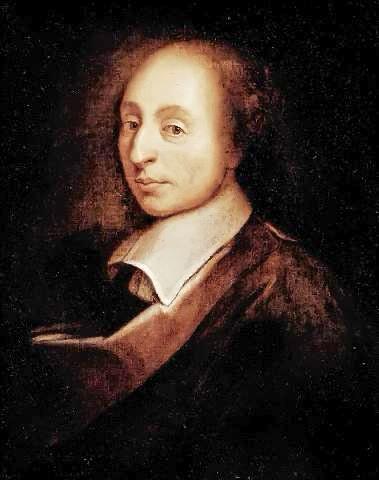
Foto: unknown; a copy of the painting of François II Quesnel, which was made for Gérard Edelinck in 1691. · Public domain · Wikimedia Commons
Blaise Pascal
Blaise Pascal was a French mathematician, physicist and philosopher who, among other things, co-founded probability theory.
💡 Did you know? At just 19 he built one of the first mechanical calculators in the world.
Clermont-Ferrand, France
Born: 19 June 1623 in Clermont-Ferrand, France
Mathematics, physics & philosophy
Home · All topics · Legal notice · Privacy · Terms · Contact