
Which epoch does Caravaggio represent?
Show answer
Baroque
He worked around 1600, mainly in Rome.
💡 Did you know? Caravaggio revolutionised painting around 1600 so profoundly that Baroque art is almost divided into „before“ and „after“ him.
19 questions · Art
Michelangelo Merisi da Caravaggio is born in 1571 and, after his birthplace in Lombardy, simply calls himself "Caravaggio". As a young man he comes to Rome, where at first he lives poor and unknown. But soon influential churchmen recognise his genius, and Caravaggio revolutionises painting like almost no one else. His great invention is an extreme chiaroscuro: out of deep, almost black darkness he makes figures emerge as if lit by a glaring spotlight. This technique gives his pictures a shocking immediacy. Equally new is his realism: Caravaggio paints saints and biblical figures with the faces of ordinary people from the street, with dirty feet and wrinkles. For some contemporaries this was a scandal. But Caravaggio is not only an exceptional painter; he is also a hot-tempered, violent man. He is repeatedly caught up in quarrels, carries a sword and lands in prison several times. In 1606 he kills a man in a brawl in Rome and has to flee the city. On the run, with a death sentence hanging over him, he keeps painting feverishly. Caravaggio dies in 1610 under unclear circumstances, only 38, on his way back to Rome. His dramatic style influences a whole generation of painters across Europe, the "Caravaggisti". Did you know that he painted his own face into several pictures: in "David with the Head of Goliath" even as the severed, dead head of the giant? Caravaggio revolutionised painting with dramatic light and unflinching realism. In the church of San Luigi dei Francesi hangs ‘The Calling of Saint Matthew’; add to it violent masterpieces like ‘Judith Beheading Holofernes’, ‘The Beheading of Saint John the Baptist’, ‘David with the Head of Goliath’ and ‘Death of the Virgin’. His early years show ‘Bacchus’, ‘Self-Portrait as Bacchus’, ‘Amor Vincit Omnia’, ‘Medusa’, ‘The Fortune Teller’, ‘The Cardsharps’ and the startling ‘Supper at Emmaus’.
Practise for freePurFact brings every card back right before you would forget it. That's how knowledge sticks.
Baroque
He worked around 1600, mainly in Rome.
💡 Did you know? Caravaggio revolutionised painting around 1600 so profoundly that Baroque art is almost divided into „before“ and „after“ him.
chiaroscuro
Figures emerge from darkness as if lit by a spotlight.
💡 Did you know? His figures emerge from deep black into harsh light; this extreme form of chiaroscuro is called tenebrism.
stark realism
Caravaggio painted saints with dirty feet and everyday faces: his models came from the street, not an ideal world.
💡 Did you know? For some contemporaries this was a scandal.
violence and flight
With a death sentence hanging over him, he fled Rome and kept painting.
💡 Did you know? In 1606 Caravaggio killed a man and fled across half of Italy with a death sentence over his head.
Caravaggisti
His style influenced a whole generation across Europe.
💡 Did you know? From Rome to Utrecht whole schools of painters imitated his dramatic handling of light.
at 38 (1610)
Caravaggio died in 1610 aged just 38 under still-unexplained circumstances on a Tuscan beach.
💡 Did you know? He painted his own face as the severed head of Goliath.

Foto: Gleb Simonov · CC0 · Wikimedia Commons
The Calling of Saint Matthew
Painted around 1609.
💡 Did you know? A shaft of light follows Christ's pointing hand: its gesture echoes Michelangelo's „Creation of Adam.“
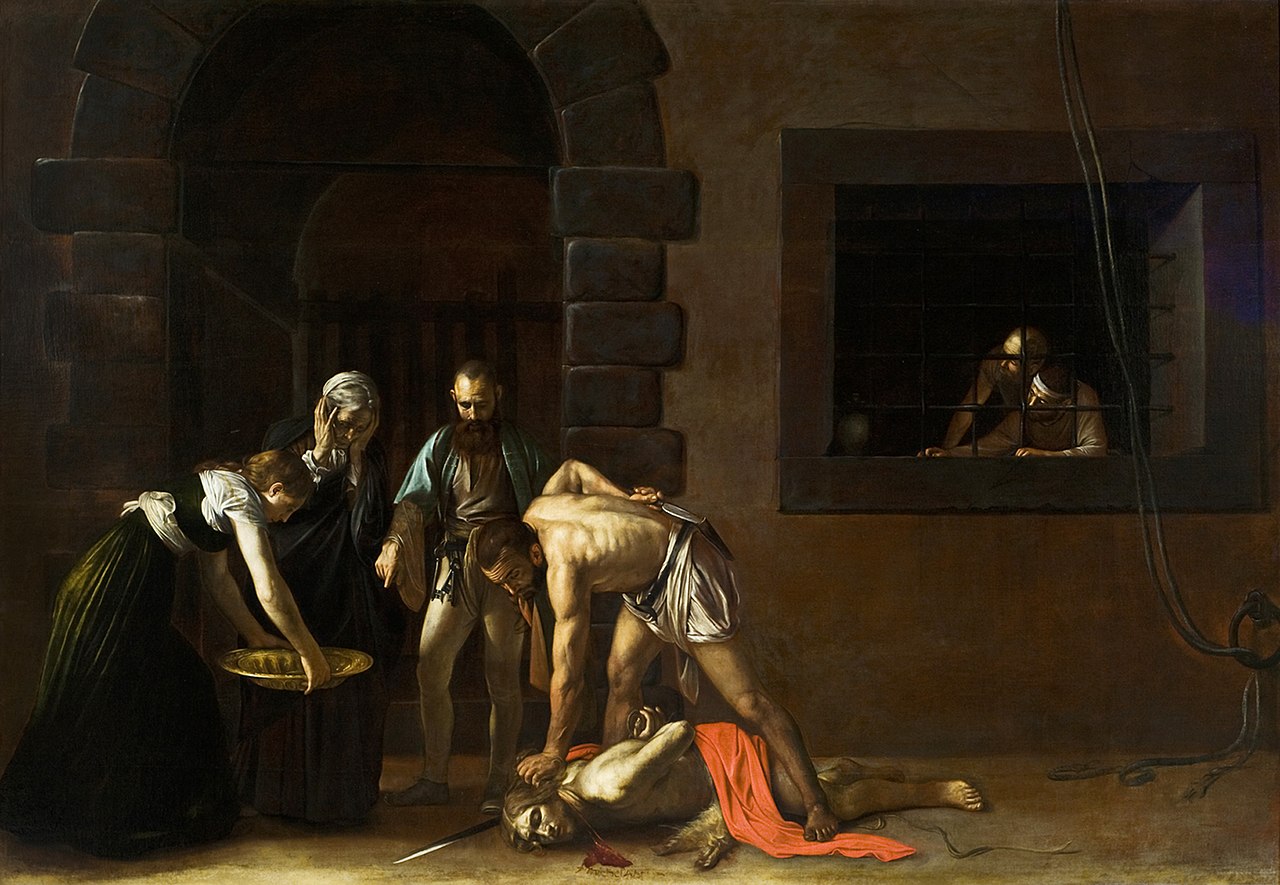
Foto: Caravaggio · Public domain · Wikimedia Commons
The Beheading of Saint John the Baptist
Painted around 1608.
💡 Did you know? It is the only picture Caravaggio ever signed: fittingly with his name in the painted blood.

Foto: Caravaggio · Public domain · Wikimedia Commons
Supper at Emmaus
Painted around 1601.
💡 Did you know? At the moment the disciples recognise Christ, a bowl of fruit tips dramatically half over the table's edge.

Foto: Caravaggio · CC BY-SA 4.0 · Wikimedia Commons
Judith Beheading Holofernes
Around 1599: a stark, dramatically lit scene of violence.
💡 Did you know? Caravaggio shows the very instant of the cut without mercy: the blood spurts in jets.

Foto: Caravaggio · Public domain · Wikimedia Commons
Amor Vincit Omnia
Painted around 1601.
💡 Did you know? A cheekily grinning Cupid tramples symbols of art, war and science: „Love conquers all.“

Foto: Caravaggio · Public domain · Wikimedia Commons
Medusa
Painted around 1597.
💡 Did you know? Painted on a round jousting shield, it shows Medusa's head at the moment of death, with Caravaggio's own features.

Foto: Caravaggio · Public domain · Wikimedia Commons
Self-Portrait as Bacchus
Painted around 1595.
💡 Did you know? The „sick Bacchus“ with his sallow skin was probably made while Caravaggio himself was seriously ill.

Foto: Caravaggio · Public domain · Wikimedia Commons
Death of the Virgin
Painted around 1603.
💡 Did you know? A drowned woman is said to have served as the model for the dead Virgin: the patron rejected the painting.

Foto: Caravaggio · Public domain · Wikimedia Commons
Bacchus
Painted around 1598.
💡 Did you know? The wine god offers the viewer a cup: look closely and a tiny self-portrait is reflected in the wine.

Foto: Masur · Public domain · Wikimedia Commons
The Fortune Teller
Painted around 1594.
💡 Did you know? As the fortune-teller reads the young man's future, she quietly slips the ring from his finger.

Foto: Caravaggio · Public domain · Wikimedia Commons
David with the Head of Goliath
Caravaggio painted his own face as the head of Goliath.
💡 Did you know? The severed head of Goliath bears Caravaggio's own features: a painted confession of guilt.

Foto: Caravaggio · Public domain · Wikimedia Commons
The Cardsharps
Painted around 1596.
💡 Did you know? A cheat secretly draws a card from his belt: the painting made the young Caravaggio famous.

Foto: Ottavio Leoni · Public domain · Wikimedia Commons
Caravaggio
Caravaggio (1571 to 1610) was an Italian Baroque painter who revolutionised art with radical realism and dramatic chiaroscuro.
💡 Did you know? Caravaggio was as brilliant as he was hot-tempered: Roman police records list countless brawls before he became a murderer and fugitive.
Home · All topics · Legal notice · Privacy · Terms · Contact