PurFact

Caspar David Friedrich

19 questions · Art

Caspar David Friedrich is born in 1774 in Greifswald on the Baltic coast, into a strict, Protestant family. His childhood is overshadowed by grief: several siblings die young, and a brother, according to tradition, drowns while ice-skating as he saves the young Caspar David's life. This early closeness to death deeply shapes his later art. Friedrich becomes the most important painter of German Romanticism. His landscapes are not mere views of nature but images of the soul, full of longing, solitude and devotion. Fog-shrouded mountains, bare winter trees, Gothic ruins and vast, silent seas become emblems in his work for humanity's small place before infinite nature and for the yearning for the divine. His most famous picture is the "Wanderer above the Sea of Fog": a man stands with his back to the viewer on a rock, gazing into a sea of fog and mountain peaks. This figure seen from behind, seeming to invite the viewer to look into the distance with him, has become the very emblem of Romanticism. Celebrated in his lifetime, Friedrich falls out of fashion in his final years and dies in 1840, impoverished and almost forgotten. Only in the 20th century is he rediscovered as one of the greatest landscape painters. Did you know that the "Wanderer above the Sea of Fog" is today one of the most quoted paintings in the world, appearing on countless book covers, posters and parodies? Friedrich’s quiet, sublime landscapes made him the epitome of Romantic painting: above all the ‘Wanderer above the Sea of Fog’. Solitary figures seen from behind and vast horizons mark ‘Chalk Cliffs at Ruegen’, ‘The Monk by the Sea’, ‘Two men contemplating the Moon’ and the ‘Solitary Tree’. Add to them ‘The Abbey in the Oakwood’, the icy ‘The Sea of Ice’, ‘The Stages of Life’, ‘Mountain Landscape with Rainbow’, the ‘Altarpiece Tetschen’, ‘Sunset’ and ‘Tree with Crows’.

Practise for free

PurFact brings every card back right before you would forget it. That's how knowledge sticks.

All questions with answers

Which country was Caspar David Friedrich from?

Show answer

Germany

Caspar David Friedrich came from Greifswald on the Baltic and worked chiefly in Dresden.

💡 Did you know? The Baltic Sea and the chalk cliffs of Rügen recur again and again in his paintings.

Of which epoch is Friedrich the most important painter?

Show answer

Romanticism

Friedrich is regarded as the greatest landscape painter of German Romanticism.

💡 Did you know? His paintings were controversial in his lifetime: some accused him of worshipping landscape „like an altar.“

What are Friedrich's nature paintings more than mere views?

Show answer

mood landscapes

Fog, ruins and vast seas are emblems in his work.

💡 Did you know? Friedrich rarely painted from nature; in the studio he assembled sketches into soulful mood-landscapes.

What is the name of Friedrich's most famous painting?

Show answer

Wanderer above the Sea of Fog

„Wanderer above the Sea of Fog“ shows a man from behind on a crag above surging mist: the icon of Romanticism.

💡 Did you know? The figure seen from behind has become the emblem of Romanticism.

Which motif is typical of Friedrich?

Show answer

the figure seen from behind

It invites the viewer to look along.

💡 Did you know? The figure seen from behind invites the viewer to gaze into the distance alongside it: Friedrich's trademark.

How did Friedrich fare at the end of his life?

Show answer

impoverished, almost forgotten (1840)

Only in the 20th century was he rediscovered.

💡 Did you know? Friedrich died in 1840 impoverished and almost forgotten; only around 1900 was he rediscovered.

Wanderer above the Sea of Fog

Foto: Caspar David Friedrich · Public domain · Wikimedia Commons

Which famous work is shown here?

Show answer

Wanderer above the Sea of Fog

Around 1818: one of the most quoted paintings in the world.

💡 Did you know? No other painting so embodies Romanticism, to this day it is parodied and quoted endlessly.

The Abbey in the Oakwood

Foto: Caspar David Friedrich · Public domain · Wikimedia Commons

What is this work called?

Show answer

The Abbey in the Oakwood

Painted around 1809.

💡 Did you know? Bare oaks and a ruined abbey in the snow: Friedrich painted death as part of a greater cycle.

The Sea of Ice

Foto: Caspar David Friedrich · Public domain · Wikimedia Commons

What is this painting called?

Show answer

The Sea of Ice

Around 1823/24: a ship crushed by ice floes, an emblem of futility.

💡 Did you know? Heaped ice floes crush a ship: a bleak image of humankind foundering against nature.

Chalk Cliffs at Ruegen

Foto: Caspar David Friedrich · Public domain · Wikimedia Commons

Which famous work is shown here?

Show answer

Chalk Cliffs at Ruegen

Painted around 1818.

💡 Did you know? The painting probably dates from Friedrich's honeymoon to the white chalk cliffs of the Baltic island of Rügen.

The Monk by the Sea

Foto: Caspar David Friedrich · Public domain · Wikimedia Commons

What is this work called?

Show answer

The Monk by the Sea

Painted around 1800.

💡 Did you know? A tiny figure before an immense sky and sea: contemporaries found the radical emptiness unsettling.

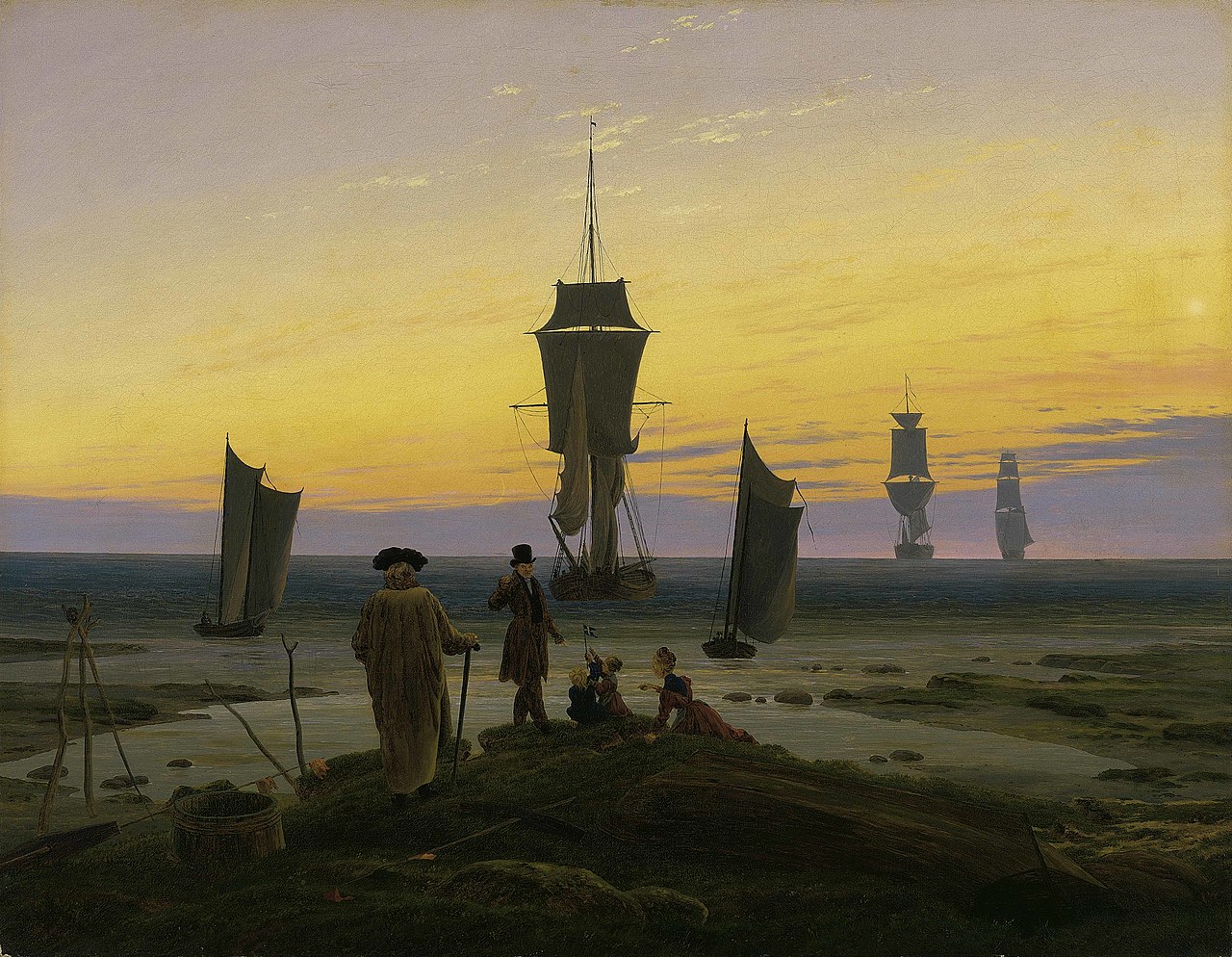
The Stages of Life

Foto: Caspar David Friedrich · Public domain · Wikimedia Commons

What is this painting called?

Show answer

The Stages of Life

Painted around 1834.

💡 Did you know? Five ships at varying distances mirror five people on the shore: a parable of the ages of life.

Two men contemplating the Moon

Foto: Caspar David Friedrich · Public domain · Wikimedia Commons

Which famous work is shown here?

Show answer

Two men contemplating the Moon

Painted around 1819.

💡 Did you know? Supposedly Friedrich and a pupil contemplating the moon: a motif he painted several times.

Mountain Landscape with Rainbow

Foto: Caspar David Friedrich · Public domain · Wikimedia Commons

What is this work called?

Show answer

Mountain Landscape with Rainbow

Painted around 1809.

💡 Did you know? The rainbow appears by night: physically impossible, but meant as a sign of hope.

Altarpiece Tetschen

Foto: Caspar David Friedrich · Public domain · Wikimedia Commons

What is this painting called?

Show answer

Altarpiece Tetschen

Painted around 1807.

💡 Did you know? A landscape used as an altarpiece sparked an art controversy: could nature take the place of holy figures?

Solitary Tree

Foto: Shonagon · Public domain · Wikimedia Commons

Which famous work is shown here?

Show answer

Solitary Tree

Painted around 1822.

💡 Did you know? The old, lightning-scarred oak stands as an emblem of steadfastness amid the vastness.

Sunset

Foto: Caspar David Friedrich · Public domain · Wikimedia Commons

What is this work called?

Show answer

Sunset

Painted around 1837.

💡 Did you know? Against the last light of day the figures turn into black silhouettes.

Tree with Crows

Foto: Caspar David Friedrich · Public domain · Wikimedia Commons

What is this painting called?

Show answer

Tree with Crows

Painted around 1822.

💡 Did you know? A crooked, bare oak and crows: Friedrich charges even a single tree with a premonition of death.

Caspar David Friedrich

Foto: Johann Karl Bähr · Public domain · Wikimedia Commons

Which artist is shown here?

Show answer

Caspar David Friedrich

Caspar David Friedrich (1774 to 1840) was the foremost painter of German Romanticism, famous for his atmospheric landscapes and figures seen from behind.

💡 Did you know? Overlooked in his lifetime, Friedrich was later appropriated by the Nazis: which long burdened his reputation after 1945.

How PurFact works

Practise for free

More on this topic

Art: all topics →