✍️
Dante Alighieri
12 questions · Literature
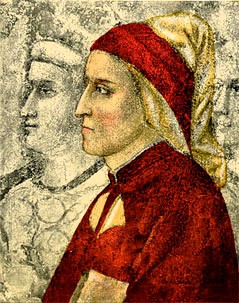
Dante Alighieri, born in Florence in 1265, met a girl named Beatrice when he was nine and that barely real encounter became the poetic power source of his life. Beatrice died young, but in Dante's poetry she ascends to heavenly guide. Young Dante was also a citizen body and soul: he fought in battle, sat on the city council, became a prior of Florence. Then party politics between Guelph factions crushed him: in 1302 he was condemned in absentia and banished from Florence: return would have meant death by fire. He never saw his native city again.
In exile (now knowing 'how salty tastes another's bread') Dante wrote the work that made him immortal: the 'Divine Comedy' (Divina Commedia). In one hundred cantos the poet himself journeys through the three realms of the afterlife: 'Inferno', 'Purgatorio', 'Paradiso': down through the nine circles of Hell with punishments graded by sin, up the mountain of Purgatory, until Beatrice leads him through Paradise to the vision of God. Through Hell and Purgatory his guide is his revered Virgil. Over the gate of Hell stands the work's most famous line: 'Abandon all hope, ye who enter here!' Revolutionary was the language: Dante wrote not in Latin but in Tuscan Italian and thereby made the dialect the foundation of the Italian literary language. Italians call him simply 'il Sommo Poeta', the supreme poet, and the three-line stanza of the work, the terza rima, is his invention.
Dante died in 1321 in Ravenna, where he lies buried to this day: Florence has begged for centuries, in vain, for his bones.
Did you know that 'comedy' merely means the story ends well? The epithet 'divine' was added by posterity: reputedly by Boccaccio.
Practise for free
PurFact brings every card back right before you would forget it. That's how knowledge sticks.