PurFact

Dinosaurs: The Most Famous

16 questions · Nature

More than 66 million years ago the dinosaurs ruled the Earth: from house-sized long-necks to feathered predators the size of a turkey. For over 150 million years, across the Triassic, Jurassic and Cretaceous, they evolved an astonishing variety of forms before an asteroid impact ended their reign. This flagship gathers the most famous prehistoric giants (the three-horned Triceratops, the plated Stegosaurus, the armoured Ankylosaurus, the sail-backed Spinosaurus and, of course, the king, Tyrannosaurus rex) plus Velociraptor, Brachiosaurus, Diplodocus, Allosaurus, Parasaurolophus, Pachycephalosaurus, Iguanodon, Carnotaurus, Dilophosaurus, and the archaic Pteranodon and Archaeopteryx. In this pack you see a picture of a prehistoric animal and name it. Every species comes with background: how big it was, what it ate, when it lived and the story behind it, including the popular myths from films like Jurassic Park. All images are public domain or freely licensed (life reconstructions from Wikimedia Commons). Once these stars feel familiar, the themed packs (Predators, Herbivores & Long-necks, Flying & Marine Reptiles) hold many more species for you.

Practise for free

PurFact brings every card back right before you would forget it. That's how knowledge sticks.

8 of 16 questions with answers

Which prehistoric animal is this?

Prehistoric animal

Foto: Durbed · CC BY-SA 3.0 · Wikimedia Commons

Show answer

Tyrannosaurus rex

Probably the most famous predator of all: up to 13 metres long, with a massive skull and banana-sized teeth. It lived at the end of the Cretaceous in what is now North America.

💡 Did you know? Despite its huge body, its arms were tiny: barely longer than a human arm.

Prehistoric animal

Foto: Creator: Dmitry Bogdanov · CC BY 3.0 · Wikimedia Commons

Show answer

Triceratops

A bulky plant-eater with three horns and a large bony neck frill. It lived at the same time as T. rex and was one of its possible prey.

💡 Did you know? Its skull, up to 2.5 metres long, is among the largest of any land animal.

Prehistoric animal

Foto: Durbed · CC BY-SA 3.0 · Wikimedia Commons

Show answer

Stegosaurus

Unmistakable for the two rows of large bony plates along its back and the spikes on its tail. This plant-eater lived in the Jurassic of North America.

💡 Did you know? Its brain was only about the size of a walnut: tiny for a nine-metre animal.

Prehistoric animal

Foto: Fred Wierum · CC BY-SA 4.0 · Wikimedia Commons

Show answer

Velociraptor

A small, agile hunter with a sickle-shaped claw on each hind foot. In reality it was only about the size of a turkey and wore feathers.

💡 Did you know? The ‘raptors’ in Jurassic Park are shown far too large and without feathers.

Prehistoric animal

Foto: Dmitry Bogdanov · Public domain · Wikimedia Commons

Show answer

Brachiosaurus

A giant long-neck whose front legs were longer than its hind legs: so its neck rose steeply upward like a giraffe's.

💡 Did you know? With its high-held head it could browse leaves more than twelve metres up.

Prehistoric animal

Foto: ДиБгд at Russian Wikipedia · Public domain · Wikimedia Commons

Show answer

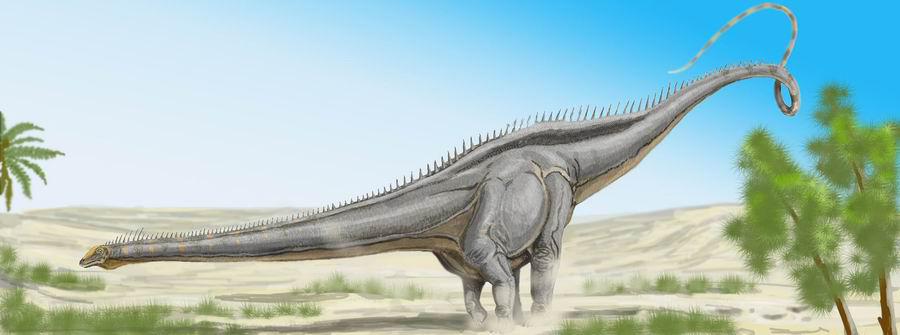
Diplodocus

One of the longest dinosaurs ever: a slender long-neck with an extremely long neck and whip-like tail, up to 27 metres long.

💡 Did you know? It may have been able to crack its tail like a whip: faster than the speed of sound.

Prehistoric animal

Foto: User:Mariolanzas · CC BY-SA 4.0 · Wikimedia Commons

Show answer

Spinosaurus

A colossal predator with a sail of back spines and a crocodile-like snout. It lived partly in water and hunted fish.

💡 Did you know? It was probably even longer than Tyrannosaurus rex.

Prehistoric animal

Foto: Emily Willoughby (e.deinonychus@gmail.com, http://emilywilloughby.com) · CC BY-SA 3.0 · Wikimedia Commons

Show answer

Ankylosaurus

A living tank: its back and head were covered in bony plates, and its tail ended in a heavy bony club for defence.

💡 Did you know? A blow from its tail club could break an attacker's bones.

🔒 The other 8 questions are part of PurFact Pro.

Open in PurFact

How PurFact works

Practise for free

More on this topic

Nature: all topics →