
What is Munch's world-famous painting called?
Show answer
The Scream
„The Scream“ shows a figure clutching its ears beneath a blood-red sky: an emblem of modern anxiety.
💡 Did you know? It was stolen from museums twice and reappeared both times.
14 questions · Art
Edvard Munch is born in 1863 in Norway, into a family marked by death: his mother and his beloved sister die young of tuberculosis, his father is strict and melancholy. "Illness, madness and death were the black angels that stood at my cradle," Munch later writes. This early experience of loss and fear becomes the heart of his art. Munch does not want to depict the outer world but to make inner feelings visible: fear, loneliness, jealousy, love and death. He thus becomes one of the most important pioneers of Expressionism. His pictures are filled with a trembling, psychological tension, and his colours and sweeping lines carry the emotion directly outward. His world-famous work is "The Scream": a sexless figure holds its hands to its head under a flaming red sky and lets out a silent scream. Munch described how he experienced the scream himself, as an overwhelming fear that seemed to pass through all of nature. The picture is today one of the best-known icons in all of art. Munch lives for a long time in seclusion, wrestling with psychological crises, but finds more calm in old age. He dies in 1944 in Norway and bequeaths his vast body of work to his home city of Oslo. Did you know that "The Scream" was stolen from museums twice and reappeared both times? Munch is famous above all for ‘The Scream’, the icon of modern anxiety. Yet his ‘Frieze of Life’ holds far more: the menacing ‘Vampire’, the sombre ‘Melancholy’, the moving ‘The Sick Child’, ‘Dance of Life’, ‘The Kiss’ and the burning ‘Jealousy’.
Practise for freePurFact brings every card back right before you would forget it. That's how knowledge sticks.
The Scream
„The Scream“ shows a figure clutching its ears beneath a blood-red sky: an emblem of modern anxiety.
💡 Did you know? It was stolen from museums twice and reappeared both times.
inner feelings (fear, death)
Munch sought to paint not the outer world but inner states like fear, loneliness and death.
💡 Did you know? „I do not paint what I see, but what I saw,“ said Munch.
Expressionism
With his emotionally charged pictures, Munch is considered the most important forerunner of Expressionism.
💡 Did you know? A Munch exhibition in Berlin in 1892 was so shocking that it was closed early: a scandal that made him famous.
Norway
He bequeathed his work to his home city of Oslo.
💡 Did you know? Munch grew up in Norway, then still united with Sweden; illness and death marked his whole family.
the early death of his mother and sister
Munch's mother and favourite sister died young of tuberculosis: death became the core theme of his art.
💡 Did you know? „Illness, madness and death were the black angels at my cradle,“ Munch wrote.
1944
Munch died in 1944 in Nazi-occupied Norway and bequeathed his vast body of work to the city of Oslo.
💡 Did you know? The Nazis had removed Munch's art as „degenerate“ from German museums: though he was long world-famous.
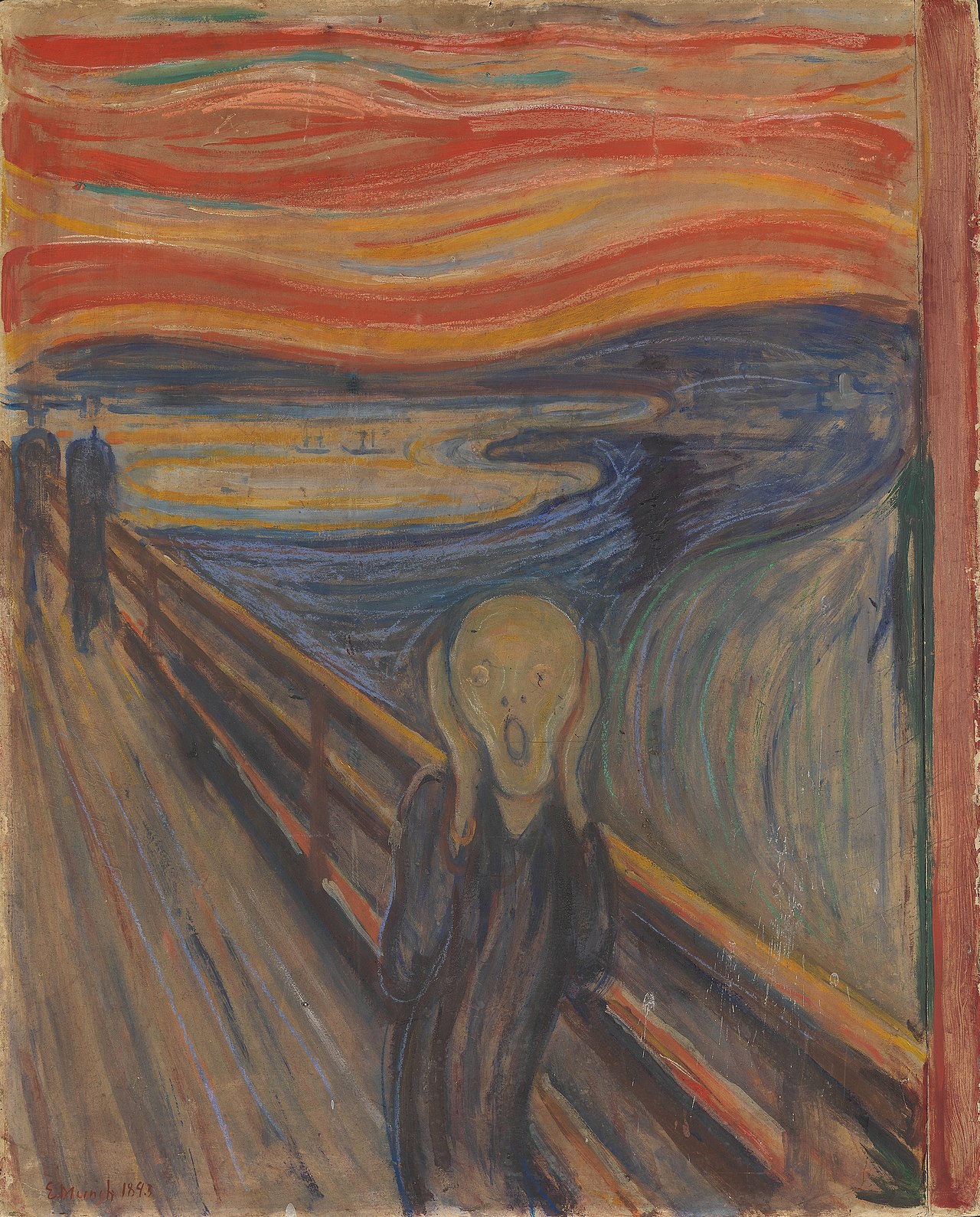
Foto: Edvard Munch · Public domain · Wikimedia Commons
The Scream
Around 1893: one of the best-known icons in all of art.
💡 Did you know? Munch made several versions; one sold in 2012 for about 120 million dollars, and two were spectacularly stolen.

Foto: Edvard Munch · Public domain · Wikimedia Commons
Vampire
Painted around 1893.
💡 Did you know? The picture actually shows a woman comforting a man; it was a critic who dubbed it „Vampire.“

Foto: Edvard Munch · Public domain · Wikimedia Commons
Melancholy
Painted around 1891.
💡 Did you know? A brooding figure on the shore: Munch made melancholy itself the subject of the picture.

Foto: Edvard Munch · Public domain · Wikimedia Commons
The Sick Child
After the early death of his sister: a deeply personal picture.
💡 Did you know? Munch painted the motif of his dying sister again and again for over 40 years: a lifelong trauma.

Foto: Edvard Munch · Public domain · Wikimedia Commons
Dance of Life
Painted around 2000.
💡 Did you know? Three female figures (in white, red and black) embody innocence, passion and death.

Foto: Edvard Munch · Public domain · Wikimedia Commons
The Kiss
Painted around 1897.
💡 Did you know? The faces of the lovers merge into a single surface: closeness to the point of dissolution.

Foto: Edvard Munch · Public domain · Wikimedia Commons
Jealousy
Painted around 1895.
💡 Did you know? In the foreground a pale, tormented face: Munch worked through his own stormy love affairs.

Foto: Anders Beer Wilse · Public domain · Wikimedia Commons
Edvard Munch
Edvard Munch (1863 to 1944) was a Norwegian painter and forerunner of Expressionism, whose „The Scream“ is one of the best-known images in the world.
💡 Did you know? Munch left the city of Oslo over 1,000 paintings and 15,000 prints: now in the purpose-built Munch Museum.
Home · All topics · Legal notice · Privacy · Terms · Contact