Foto: Diego Velázquez · Public domain · Wikimedia Commons
Show answer
Las Meninas
Diego Velázquez (1656) shows the Spanish princess with her entourage and the painter himself at the easel. A masterpiece about gaze and perspective.
💡 Did you know? In the mirror at the back appear the royal couple: we seem to stand in their place.
Foto: Raphael · Public domain · Wikimedia Commons
Which famous fresco is this?
Show answer
The School of Athens
Raphael's fresco in the Vatican (c. 1510) gathers the great thinkers of antiquity, with Plato and Aristotle at the centre.
💡 Did you know? Raphael gave some philosophers the faces of contemporaries: Plato, for instance, resembles Leonardo da Vinci.
Foto: Caspar David Friedrich · Public domain · Wikimedia Commons
Show answer
Wanderer above the Sea of Fog
Caspar David Friedrich (c. 1818) shows a man from behind on a rocky peak above rolling fog: an emblem of Romanticism.
💡 Did you know? The figure seen from behind invites the viewer to see the scene through his eyes.
Foto: Claude Monet · Public domain · Wikimedia Commons
Show answer
Impression, Sunrise
Claude Monet's view of the harbour of Le Havre (1872) gave a whole movement its name: Impressionism.
💡 Did you know? A critic mockingly called it a mere 'impression' and the name stuck.
Foto: Sandro Botticelli · Public domain · Wikimedia Commons
Show answer
Primavera
Sandro Botticelli's 'Spring' (c. 1480) shows mythological figures in a blossoming grove: a highlight of the Florentine Renaissance.
💡 Did you know? Botanists have identified around 200 real plant species in the painting.
Foto: Hieronymus Bosch · Public domain · Wikimedia Commons
Which famous triptych is this?
Show answer
The Garden of Earthly Delights
Hieronymus Bosch's triptych (c. 1500) shows paradise, a teeming garden of delights in the centre, and a nightmarish hell.
💡 Did you know? In the hell panel a little melody is notated on a figure's backside and is played today.
Foto: El_Tres_de_Mayo,_by_Francisco_de_Goya,_from_Prado_in_Google_Earth.jpg : Francisc · Public domain · Wikimedia Commons
Show answer
The Third of May 1808
Francisco de Goya (1814) shows the execution of Spanish rebels by Napoleonic troops; an early anti-war painting.
💡 Did you know? It is regarded as a model for later works such as Picasso's 'Guernica'.
Foto: Francisco Goya · Public domain · Wikimedia Commons
Show answer
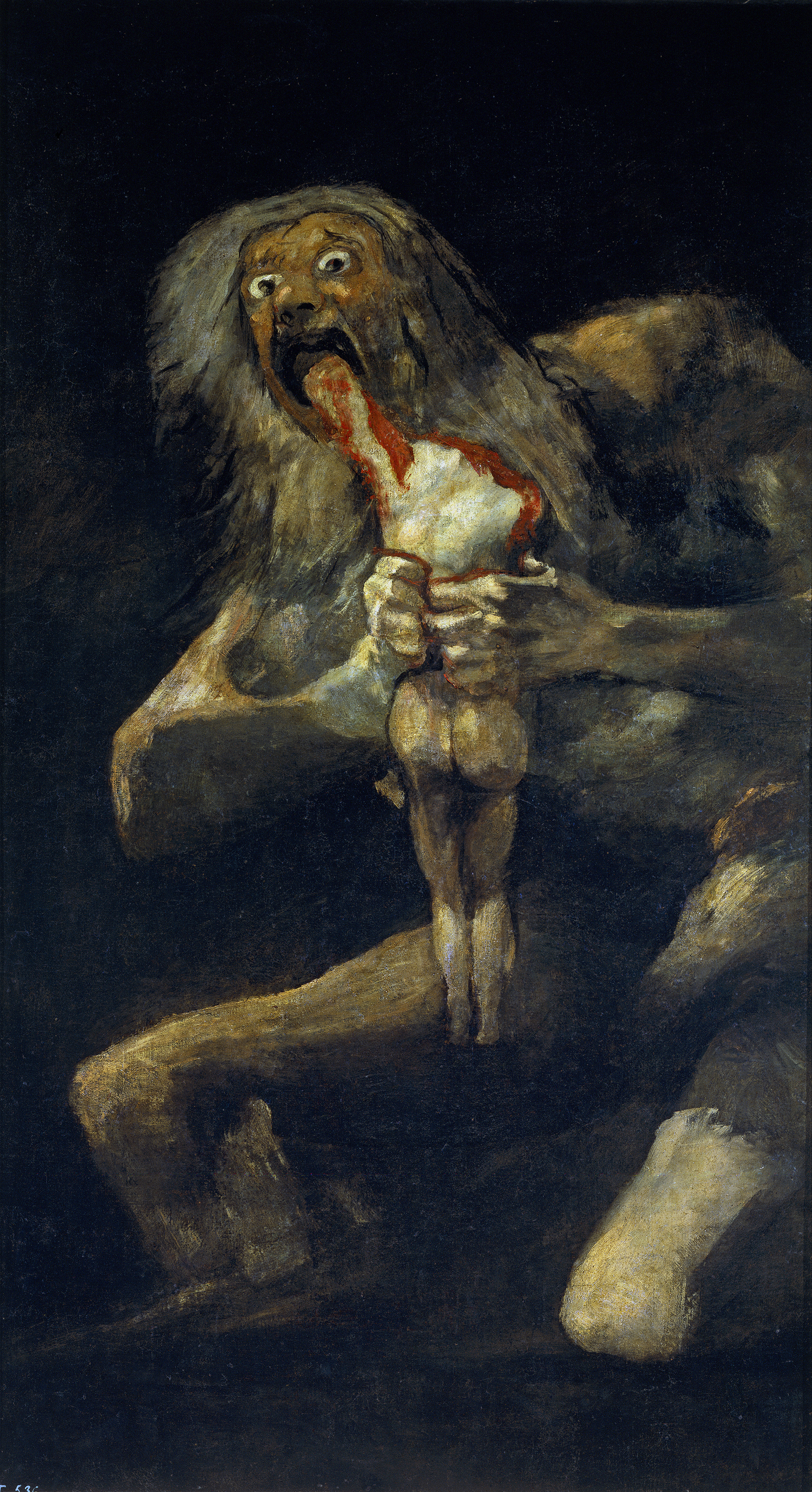
Saturn Devouring His Son
One of Goya's dark 'Black Paintings' (c. 1820): the titan Saturn devouring his child out of fear of being overthrown.
💡 Did you know? Goya painted it straight onto the walls of his house; only later was it transferred to canvas.