
Which country was Goya from?
Show answer
Spain
He became first court painter of the Spanish king.
💡 Did you know? Goya rose from provincial painter to first court painter of the Spanish king: yet remained a sharp critic of power.
19 questions · Art
Francisco de Goya is born in 1746 in a village in northern Spain and works his way up from provincial painter to first court painter of the Spanish king. In this role he portrays high society and the royal family: often with an astonishingly honest, almost unmasking eye that barely conceals the vanity and weakness of the powerful. In mid-life a blow of fate strikes him: a serious illness leaves Goya completely deaf around 1793. Cut off from the world of sound, his art turns inward and grows darker. In print series such as the "Caprichos" he lashes out at superstition, folly and social ills: famous is the plate "The Sleep of Reason Produces Monsters". Then war breaks over Spain. Napoleon's troops occupy the country, and a cruel struggle for freedom follows. Goya records the horror as no painter before him: "The Third of May 1808" shows defenceless people before the guns of a faceless firing squad; an image that shaped the indictment of war for all time. As an old, embittered man, Goya paints the walls of his house with the nightmarish "Black Paintings", among them the disturbing "Saturn Devouring His Son". In 1828 he dies in exile in France. Goya stands with one foot in the old age of court painting and the other in modernity. Did you know that many regard him as the first truly modern painter: a bridge between the old masters and the art of the 20th century? Goya was court painter and merciless chronicler at once. He painted the daring pair ‘La maja desnuda’ and ‘The Clothed Maja’, as well as the revealing group portrait ‘Charles IV of Spain and His Family’. As an accuser of war he created ‘The Third of May 1808’, ‘The Second of May 1808’ and the etching series ‘The Disasters of War’. From his dark late years come the ‘Black Paintings’ with ‘Saturn Devouring His Son’, ‘The Dog’ and ‘Witches’ Sabbath’; the ‘Caprichos’ contain the famous ‘The Sleep of Reason Produces Monsters’.
Practise for freePurFact brings every card back right before you would forget it. That's how knowledge sticks.
Spain
He became first court painter of the Spanish king.
💡 Did you know? Goya rose from provincial painter to first court painter of the Spanish king: yet remained a sharp critic of power.
he became deaf
Around 1793 a severe illness left Goya completely deaf: his art grew darker and more inward afterwards.
💡 Did you know? Afterwards his art grew darker and turned inward.
The Third of May 1808
It shows defenceless people before a faceless firing squad.
💡 Did you know? „The Third of May 1808“ shows Spanish rebels shot by Napoleon's troops; an archetype of the anti-war painting that influenced Picasso among others.
Los Caprichos
In the 80 etchings of the „Caprichos,“ Goya mocked the superstition, clergy and nobility of the Spanish old order.
💡 Did you know? Famous is the plate "The Sleep of Reason Produces Monsters".
Black Paintings
These include the disturbing "Saturn Devouring His Son".
💡 Did you know? The old, deaf Goya painted the „Black Paintings“ straight onto the walls of his house, for himself alone, never exhibited.
first modern painter
He died in 1828 in exile in France.
💡 Did you know? With his free, unvarnished manner, Goya is seen by many as the bridge from the Old Masters to modern art.

Foto: Francisco Goya · Public domain · Wikimedia Commons
La maja desnuda
Painted around 1795.
💡 Did you know? The frank nude brought Goya before the Spanish Inquisition: the sitter's identity stayed a secret.
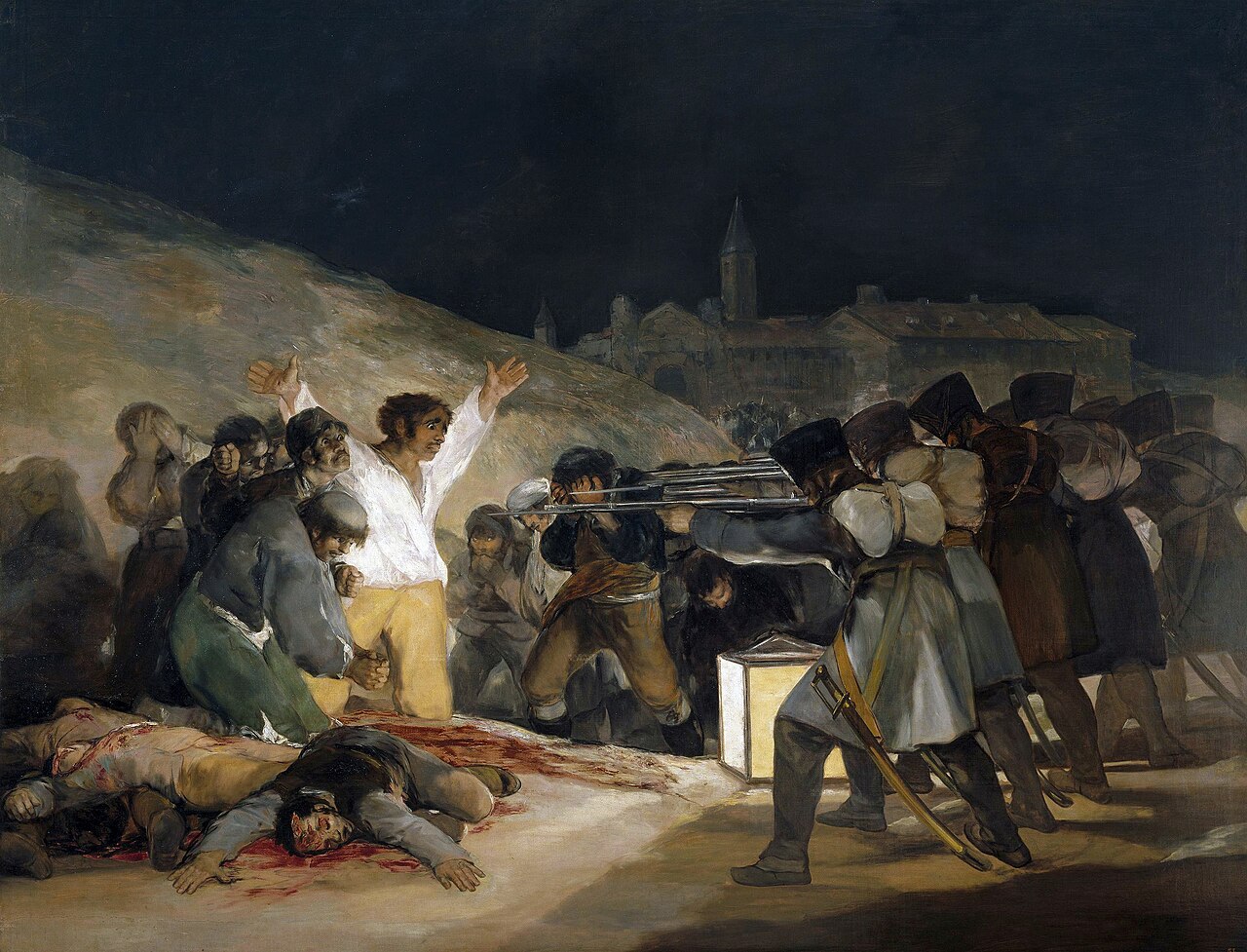
Foto: Francisco Goya · Public domain · Wikimedia Commons
The Third of May 1808
Around 1814: one of the most famous indictments of war.
💡 Did you know? The man with raised arms in the white shirt became an icon of the innocent victim.

Foto: Francisco Goya · Public domain · Wikimedia Commons
Saturn Devouring His Son
From the "Black Paintings": a disturbing nightmare image.
💡 Did you know? The most disturbing of the „Black Paintings“ shows the god devouring his own child for fear of being overthrown.

Foto: Francisco Goya · Public domain · Wikimedia Commons
Charles IV of Spain and His Family
Painted around 1800.
💡 Did you know? Goya painted the royal family mercilessly unflattering: some see hidden mockery in it.

Foto: Francisco de Goya · Public domain · Wikimedia Commons
Black Paintings
Painted around 1820.
💡 Did you know? Only after Goya's death were the 14 wall paintings removed and transferred to canvas.

Foto: Francisco Goya · Public domain · Wikimedia Commons
The Clothed Maja
Painted around 1800.
💡 Did you know? Goya painted the same pose twice: clothed and nude; one supposedly hung hidden behind the other.

Foto: Francisco Goya · Public domain · Wikimedia Commons
The Disasters of War
Painted around 1810.
💡 Did you know? The unsparing prints of the horrors of war were published only 35 years after Goya's death.

Foto: Francisco Goya y Lucientes (Spain, Fuendetodos, 1746-1828) · Public domain · Wikimedia Commons
Caprichos
Painted around 1799.
💡 Did you know? For fear of the Inquisition, Goya withdrew the series from sale shortly after it appeared.

Foto: Francisco Goya · Public domain · Wikimedia Commons
The Second of May 1808
Painted around 1814.
💡 Did you know? The picture shows Madrid's street battle against Napoleon's Mameluke cavalry: the prelude to „The Third of May.“

Foto: Francisco Goya · Public domain · Wikimedia Commons
The Sleep of Reason Produces Monsters
Painted around 1797.
💡 Did you know? The most famous plate of the „Caprichos“: when reason sleeps, owls and bats awaken.

Foto: Francisco Goya · Public domain · Wikimedia Commons
The Dog
Painted around 1819.
💡 Did you know? A tiny dog's head before a vast emptiness: the most enigmatic „Black Painting,“ hailed by modernism as proto-abstract.

Foto: Francisco Goya · Public domain · Wikimedia Commons
Witches' Sabbath
Painted around 1820.
💡 Did you know? A goat as the devil amid shrieking witches: Goya's bitter reckoning with superstition.

Foto: Vicente López Portaña · Public domain · Wikimedia Commons
Francisco de Goya
Francisco de Goya (1746 to 1828) was a Spanish painter and printmaker who went from court painter to unsparing chronicler of war and the darkness of the human soul.
💡 Did you know? Goya straddles two worlds: courtly grand portraits and dark nightmare images; to many he is both the last Old Master and the first modern artist.
Home · All topics · Legal notice · Privacy · Terms · Contact