
Which painting technique did Seurat develop?
Show answer
Pointillism
Seurat placed pure dots of colour close together that only merge into forms and tones in the viewer's eye.
💡 Did you know? The dots merge only in the viewer's eye.
18 questions · Art
Georges Seurat is born in 1859 in Paris, into a wealthy family that allows him a carefree life for art. He is a serious, systematic, almost scientific mind: quite unlike the spontaneous Impressionists. Seurat wants to put painting on a firm, provable foundation and for this studies the latest theories of colour and perception. From these studies he develops a wholly new technique: "Pointillism" (also called "Divisionism"). Instead of mixing colours on the palette, Seurat places countless tiny dots of pure colour side by side on the canvas. Only in the viewer's eye do they merge into glowing hues. It is painstaking, patient work: on a single large picture he often paints for a year or two. His principal work is "A Sunday Afternoon on the Island of La Grande Jatte": a huge picture of Parisian day-trippers by the riverside, built up from millions of little dots, still and solemn like a mural. It is regarded as an icon of modern art and founds "Neo-Impressionism". Seurat dies quite suddenly in 1891, at just 31, of a sudden infection. His body of work therefore comprises only a few large paintings: yet his influence on modern art is enormous. Did you know that a single one of his large pictures is made up of literally hundreds of thousands of hand-placed dots of colour? Seurat invented Pointillism: pictures built from countless dots of colour. His masterpiece is ‘A Sunday Afternoon on the Island of La Grande Jatte’, preceded by ‘Bathers at Asnières’. To pleasure he devoted ‘The Circus’, ‘The Circus Parade’, ‘Le Chahut’ and ‘Young Woman Powdering Herself’; landscape and city appear in ‘The Eiffel Tower’, ‘The Channel of Gravelines’, ‘Banlieue’, ‘Bridge of Courbevoie’ and ‘The Forest at Pontaubert’.
Practise for freePurFact brings every card back right before you would forget it. That's how knowledge sticks.
Pointillism
Seurat placed pure dots of colour close together that only merge into forms and tones in the viewer's eye.
💡 Did you know? The dots merge only in the viewer's eye.
colour theory / science
Seurat based his painting on the scientific colour theories of his day: art as an almost exact method.
💡 Did you know? He himself called his technique „Divisionism“: the breaking of colour into pure components.
La Grande Jatte
It founded Neo-Impressionism.
💡 Did you know? „La Grande Jatte“ took Seurat two years and over 60 preparatory studies: applied dot by dot.
countless individual dots
Seurat's large pictures came about extremely slowly, built from countless tiny dots of colour.
💡 Did you know? „La Grande Jatte“ is roughly two by three metres: a sea of millions of individual dots.
Paris
Seurat worked in Paris and became the leader of a new movement, Neo-Impressionism.
💡 Did you know? Despite his short life, Seurat gathered a whole group of followers around him.
at 31 (1891)
He therefore left only a few large paintings.
💡 Did you know? Seurat died suddenly at only 31: probably of an infection; many of his works were left unfinished.

Foto: Georges Seurat · Public domain · Wikimedia Commons
A Sunday Afternoon on the Island of La Grande Jatte
Around 1884/86: made of millions of dots, an icon of modernity.
💡 Did you know? Parisians of all classes stroll by the Seine: look closely and everything is made of tiny dots of colour.
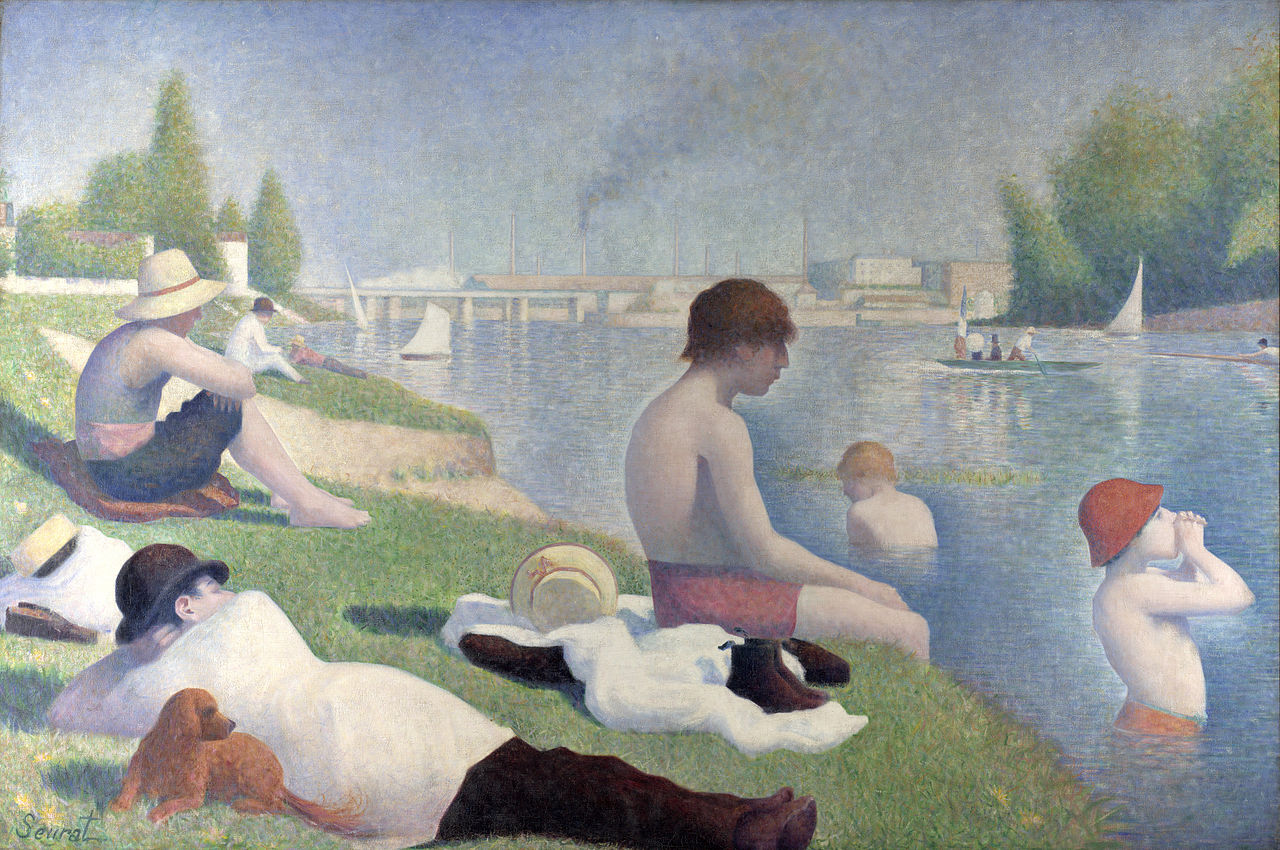
Foto: Georges Seurat · Public domain · Wikimedia Commons
Bathers at Asnières
Painted around 1884.
💡 Did you know? Seurat's first major work shows workers bathing: before his full dot technique.

Foto: Georges Seurat · Public domain · Wikimedia Commons
The Circus
Painted around 1891.
💡 Did you know? Seurat's last, unfinished picture: a circus scene full of upward-striving, cheerful lines.

Foto: Georges Seurat · Public domain · Wikimedia Commons
Young Woman Powdering Herself
Painted around 1889.
💡 Did you know? Seurat portrayed his secret lover applying powder: his family learned of her only after his death.

Foto: Georges Seurat · Public domain · Wikimedia Commons
Le Chahut
Painted around 1889.
💡 Did you know? Dancers kick up their legs in the can-can: Seurat sought gaiety even in rising lines.

Foto: Georges Seurat · Public domain · Wikimedia Commons
The Circus Parade
Painted around 1887.
💡 Did you know? A mysteriously still circus parade under artificial evening light.

Foto: Georges Seurat · Public domain · Wikimedia Commons
The Eiffel Tower
Painted around 1889.
💡 Did you know? Seurat painted the tower while it was still being built: an early monument to modernity in dots of colour.

Foto: Seurat, Georges (1859 - 1891): Artist (French) Details on Google Art Project · Public domain · Wikimedia Commons
The Channel of Gravelines
Painted around 1890.
💡 Did you know? On the coast at the canal Seurat found the quiet, clear order he loved.

Foto: Georges Seurat · Public domain · Wikimedia Commons
Banlieue
Painted around 1881.
💡 Did you know? Even the bleak suburbs of Paris became a subject for Seurat.

Foto: Georges Seurat · Public domain · Wikimedia Commons
Bridge of Courbevoie
Painted around 1880.
💡 Did you know? A calm river landscape in finely tuned, dotted tones.

Foto: Georges Seurat · Public domain · Wikimedia Commons
The Forest at Pontaubert
Painted around 1881.
💡 Did you know? An early landscape in which Seurat was already experimenting with breaking up light.

Foto: Unidentified photographer · Public domain · Wikimedia Commons
Georges Seurat
Georges Seurat (1859 to 1891) was a French painter and founder of Pointillism, who built pictures from countless pure dots of colour.
💡 Did you know? Seurat died at only 31: in his short life he made only a few, but revolutionary, large paintings.
Home · All topics · Legal notice · Privacy · Terms · Contact