Foto: Bedřich Meinhard · Public domain · Wikimedia Commons
Show answer
Baden-Württemberg
The arms show three black lions on gold: the lions of the Hohenstaufen. In the greater version a stag (for Württemberg) and a griffin (for Baden) support the shield.
💡 Did you know? Six crowns above the shield stand for the historic territories that merged in 1952 into the only German state ever created by referendum.
Public domain · Wikimedia Commons
Show answer
Bavaria
The greater state arms combine five fields: the Palatine lion, the Franconian rake, the lion of the Palatine counts of Bavaria, Swabia's three black lions, and the white-and-blue lozenges at the centre.
💡 Did you know? The lozenges have been a Bavarian emblem since the 13th century; their number is not fixed, only the order of the colours.
Public domain · Wikimedia Commons
Show answer
Berlin
The arms show the Berlin bear in black on white, topped by a golden mural crown with five leaves marking the city.
💡 Did you know? The bear is probably a pun on the city's name: though linguistically »Berlin« likely derives from a Slavic word for swamp, not from the animal.
Foto: Unknown author · Public domain · Wikimedia Commons
Show answer
Brandenburg
The arms show the Red Eagle on white, with golden claws and beak and clover-stalk ornaments on its wings.
💡 Did you know? The red eagle is an old emblem of the March of Brandenburg and still appears in the arms of several neighbouring regions.
Foto: David Liuzzo · Public domain · Wikimedia Commons
Show answer
Bremen
Bremen's arms show a silver key on red: the key of Saint Peter, to whom Bremen Cathedral is dedicated.
💡 Did you know? The key appears all over the city: on manhole covers, flags, and even on local coffee and beer labels.
Foto: Freie und Hansestadt Hamburg · Public domain · Wikimedia Commons
Show answer
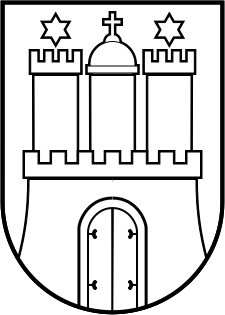
Hamburg
The arms show a white castle on red: three towers, the middle one crowned by a cross for the cathedral, the outer two each topped by a six-pointed star.
💡 Did you know? The castle recalls the Hammaburg, the settlement Hamburg grew from; the gate is deliberately shown without a portcullis: an open gate, ready for trade.
Public domain · Wikimedia Commons
Show answer
Hesse
The arms show the »coloured lion«: a lion striped red and white (silver) on blue, crowned and armed in blue.
💡 Did you know? The lion's stripes gave the state flag its colours: red and white, in the same order as in the heraldic beast's coat.
Public domain · Wikimedia Commons
Show answer
Mecklenburg-Vorpommern
The arms combine four fields: the bull's head twice for Mecklenburg, the griffin for Pomerania and the Brandenburg eagle for formerly Brandenburg territory.
💡 Did you know? The black bull's head with nose ring and crown has been a Mecklenburg emblem since the 13th century: locally it is simply called the »ox head«.
Foto: Gustav Völker · Public domain · Wikimedia Commons
Show answer
Lower Saxony
The arms show the white Saxon Steed on red: the same leaping horse found as a weathervane on many northern German houses.
💡 Did you know? Legend traces the steed to Duke Widukind; historians see it rather as a late-medieval emblem of the House of Welf.
Public domain · Wikimedia Commons
Show answer
North Rhine-Westphalia
The arms tell how the state came about: the Rhine as a silver wavy band, the Westphalian steed, and the red rose of Lippe.
💡 Did you know? Almost the same animal in two states: both horses face left, but the Westphalian one rears upright while Lower Saxony's steed is leaping.
Public domain · Wikimedia Commons
Show answer
Rhineland-Palatinate
The arms unite the state's three historic parts: the wheel of Mainz, the cross of Trier and the Palatine lion.
💡 Did you know? Above the shield sits a golden crown of vine leaves: an emblem no other German state carries, recalling the region's wine country.
Public domain · Wikimedia Commons
Show answer
Saarland
The arms are quartered and show the emblems of the historic territories: the Nassau lion, the cross of Trier, the Lorraine eagle and the Palatine lion.
💡 Did you know? The four fields recall that Saarland only came into being in 1920: assembled from parts of quite different historic domains.
Public domain · Wikimedia Commons
Show answer
Saxony
The arms show nine bars of black and gold, crossed diagonally by the green crancelin, a wreath of rue.
💡 Did you know? The crancelin was added in the 13th century: legend says it marked that the House of Wettin gained the land by inheritance rather than war.
Public domain · Wikimedia Commons
Show answer
Saxony-Anhalt
The shield is divided: the black-and-gold bars with the crancelin for Saxony on one side, the Ascanian bear on a wall for Anhalt on the other.
💡 Did you know? The walking bear with its collar stands for the House of Ascania, which also produced the first margraves of Brandenburg.
Public domain · Wikimedia Commons
Show answer
Schleswig-Holstein
The shield is divided: Schleswig's two blue lions on gold on one side, Holstein's silver nettle leaf on red on the other.
💡 Did you know? The Schleswig lions face each other: unlike in the Danish arms, where the same lions walk one behind the other.
Public domain · Wikimedia Commons
Show answer
Thuringia
The arms show a lion striped red and silver on blue, surrounded by eight silver stars.
💡 Did you know? The eight stars stand for the territories merged into the state of Thuringia in 1920: before that the region was split into numerous tiny states.