
Of which movement is Courbet the founder?
Show answer
Realism
His principle: paint only what you really see.
💡 Did you know? Courbet declared: „Show me an angel and I will paint one“: he painted only what he actually saw.
17 questions · Art
Gustave Courbet is born in 1819 in Ornans in eastern France, the son of a well-off farmer. He will proudly emphasise this rural origin all his life. Self-assured, combative and a brilliant self-promoter, he goes to Paris and sets himself against the entire established art world of his day. Courbet becomes the founder of "Realism". His programme is radically simple: the painter should depict only what he really sees: no gods, no heroes, no prettified ideal worlds. Instead of elegant salons he paints stone breakers at their hard labour, a plain village burial or peasant women sifting grain, and at life size, as had otherwise been seen only in historical pictures of kings. This outraged the bourgeoisie: ordinary workers on huge canvases were regarded as a provocation. Courbet puts his art on show defiantly. When the World's Fair of 1855 rejects some of his works, he simply builds his own "Pavilion of Realism" next to it: one of the first solo exhibitions in art history. Courbet is also a political rebel. In 1871 he supports the uprising of the Paris Commune; after its suppression he is arrested and has to flee into exile in Switzerland, where he dies in 1877. His Realism paved the way for the Impressionists and for all of modern art. Did you know that he was blamed for the toppling of a Parisian victory column; he was ordered to pay the enormous cost of rebuilding it, which financially ruined him? Courbet, the father of Realism, showed real life without flattery: the monumental ‘A Burial at Ornans’, the toiling ‘The Stone Breakers’ and ‘The Wheat Sifters’. His programmatic ‘The Painter’s Studio’ and ‘The Meeting (Bonjour, Monsieur Courbet!)’ proclaim his self-confidence, while ‘Woman with a Parrot’, ‘The Woman in the Waves’, ‘Young Ladies Beside the Seine’, ‘The Wounded Man’ and ‘Killing a Deer’ reveal his range.
Practise for freePurFact brings every card back right before you would forget it. That's how knowledge sticks.
Realism
His principle: paint only what you really see.
💡 Did you know? Courbet declared: „Show me an angel and I will paint one“: he painted only what he actually saw.
France
Courbet came from Ornans in the Franche-Comté, whose peasants and landscape he made famous.
💡 Did you know? His huge canvases of ordinary country folk outraged the Paris public, who knew such formats only from history paintings.
ordinary workers at life size
Courbet painted stonebreakers, peasants and mourners on a scale until then reserved for kings and saints.
💡 Did you know? Such formats had otherwise been reserved for pictures of kings.
his own Pavilion of Realism
One of the first solo exhibitions in art history.
💡 Did you know? In 1855 Courbet built his own „Pavilion of Realism“ beside the World's Fair: one of the first solo exhibitions in art history.
the Paris Commune
As a supporter of the Paris Commune, Courbet took part in toppling the Vendôme Column in 1871, for which he was imprisoned and fined.
💡 Did you know? Afterwards he had to flee into exile in Switzerland.
1877 in Switzerland
His Realism paved the way for the Impressionists.
💡 Did you know? To escape the huge fine for the Vendôme Column, Courbet fled to Switzerland, where he died impoverished in 1877.

Foto: Gustave Courbet · Public domain · Wikimedia Commons
A Burial at Ornans
Around 1850: a plain village burial, vast like a history painting.
💡 Did you know? Over 40 life-size mourners: a village funeral as monumental as a history painting; a scandal in 1850.

Foto: Gustave Courbet · Public domain · Wikimedia Commons
The Painter's Studio
Painted around 1850.
💡 Did you know? Courbet called the enigmatic giant canvas a „real allegory“: it gathers his whole life into one room.

Foto: Gustave Courbet · CC0 · Wikimedia Commons
Woman with a Parrot
Painted around 1866.
💡 Did you know? The frank nude of the „Woman with a Parrot“ provoked the audience of the Paris Salon.

Foto: Gustave Courbet · CC0 · Wikimedia Commons
The Woman in the Waves
Painted around 1868.
💡 Did you know? Courbet painted the woman in a bold, sensual pose right in the surf of the sea.
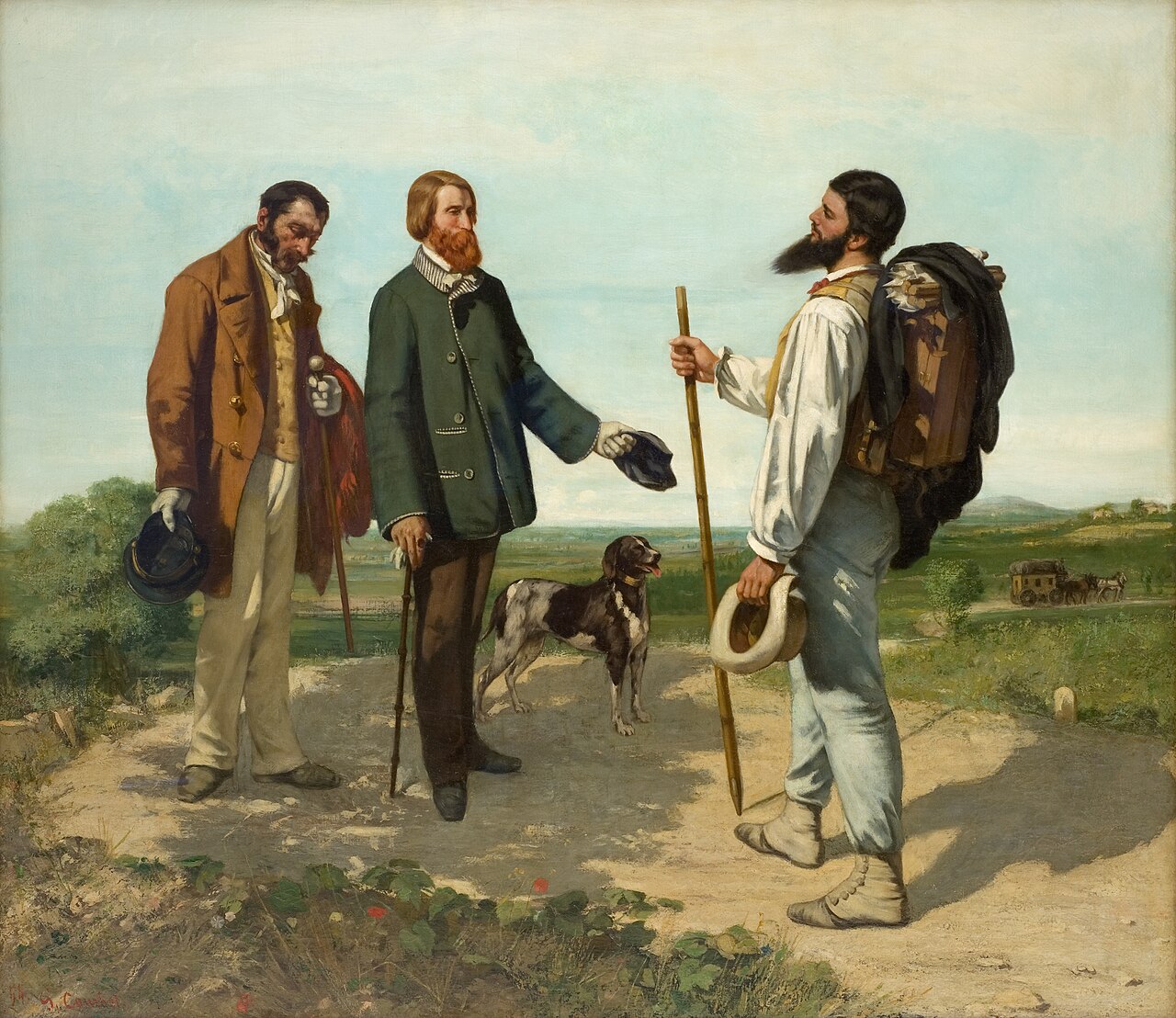
Foto: Gustave Courbet · Public domain · Wikimedia Commons
The Meeting (Bonjour, Monsieur Courbet!)
Painted around 1854.
💡 Did you know? Courbet shows himself with self-assurance, greeted on the road by his patron: a monument to the artist's pride.

Foto: Gustave Courbet · Public domain · Wikimedia Commons
The Stone Breakers
Around 1849: two labourers at hard roadwork, a manifesto of Realism.
💡 Did you know? The picture of poor road workers was seen as politically charged; the original burned in the war in 1945.

Public domain · Wikimedia Commons
Young Ladies Beside the Seine
Painted around 1857.
💡 Did you know? Two idle young women on the riverbank, to bourgeois viewers they seemed scandalously languid.

Foto: Gustave Courbet · Public domain · Wikimedia Commons
The Wheat Sifters
Painted around 1854.
💡 Did you know? Courbet's own sisters modelled for the working peasant women.

Foto: Gustave Courbet · Public domain · Wikimedia Commons
The Wounded Man
Painted around 1844.
💡 Did you know? X-rays revealed that beneath the wounded man Courbet had originally painted himself with a lover.

Foto: Gustave Courbet · Public domain · Wikimedia Commons
Killing a Deer
Painted around 1867.
💡 Did you know? Courbet was a passionate hunter and repeatedly painted animals in the snowy Jura.
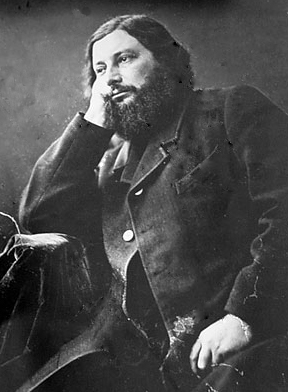
Foto: Nadar · Public domain · Wikimedia Commons
Gustave Courbet
Gustave Courbet (1819 to 1877) was a French painter and founder of Realism who portrayed ordinary people in monumental pictures.
💡 Did you know? Courbet was a rebel in art as in politics: his role in the Paris Commune cost him his freedom and his fortune.
Home · All topics · Legal notice · Privacy · Terms · Contact