

Foto: Editor at Large · CC BY 2.5 · Wikimedia Commons
Show answer
Bun
For the bun the hair is twisted together and pinned at the back of the head.
💡 Did you know? It is the most practical of all styles: which is why ballerinas and surgeons wear it.
9 questions · Fashion & Design
Pinned-up hair was for centuries a sign: of adulthood, of the occasion, of rank. Until the 20th century loose hair on adults was considered improper, so the updo, with all the hair pinned up, became the basis of many styles. The bun is the most practical of them: the hair is twisted together and pinned at the back of the head, which is why ballerinas and surgeons wear it. When the flat knot sits low at the nape it is called a chignon, from the French ‘chignon du cou’, the nape of the neck. The top knot, by contrast, sits high on the head; samurai wore a strict form of it, the chonmage. Around 1960 came the beehive, a high, backcombed, cone-shaped style that returned once more with Amy Winehouse. In the pompadour the top hair is piled high above the forehead; it is named after Madame de Pompadour, and Elvis made it famous for men. For the French twist the hair is rolled up at the side and pinned in place. For something looser, tie a ponytail at the back of the head or choose the half-up style, where only the top hair is drawn back: hair worn down, yet the face kept clear.
Practise for freePurFact brings every card back right before you would forget it. That's how knowledge sticks.
Which hairstyle is this?
Foto: Editor at Large · CC BY 2.5 · Wikimedia Commons
Bun
For the bun the hair is twisted together and pinned at the back of the head.
💡 Did you know? It is the most practical of all styles: which is why ballerinas and surgeons wear it.

Foto: Jenna Drudi · CC BY 3.0 · Wikimedia Commons
Chignon
The chignon is a flat knot of hair sitting low at the nape.
💡 Did you know? The word comes from French ‘chignon du cou’: the nape of the neck.

Foto: IBM_403_Accounting_Machine.jpg: born1945 derivative work: Nicor (talk) · CC BY-SA 2.0 · Wikimedia Commons
Beehive
The beehive is a high, backcombed, cone-shaped style.
💡 Did you know? It appeared in 1960 and returned once more with Amy Winehouse.

Foto: Kimchifan (talk) (Uploads) · CC BY-SA 3.0 · Wikimedia Commons
Pompadour
In the pompadour the top hair is piled high above the forehead.
💡 Did you know? It is named after Madame de Pompadour: Elvis made it famous for men.

Foto: Vox Efx · CC BY 2.0 · Wikimedia Commons
Ponytail
For the ponytail the hair is tied together at the back of the head.
💡 Did you know? The name describes exactly what it looks like.

Foto: Whoisjohngalt · CC BY-SA 4.0 · Wikimedia Commons
Top knot
The top knot sits as a knot high on the head.
💡 Did you know? Samurai wore a strict version of it: the chonmage.
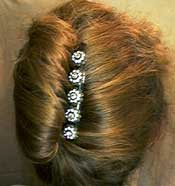
Foto: Byrddesigns at English Wikipedia · Public domain · Wikimedia Commons
French twist
For the French twist the hair is rolled to the side and pinned.
💡 Did you know? The German name ‘banana’ describes the elongated shape at the back.

Foto: Sham Bates · CC BY 3.0 · Wikimedia Commons
Half-up
In the half-up style only the top hair is taken back.
💡 Did you know? It combines loose hair with a clear view of the face.

Foto: Wilhelm Niederastroth · Public domain · Wikimedia Commons
Updo
In an updo the entire hair is pinned up.
💡 Did you know? Until the 20th century, loose hair on adults was considered improper.
Fashion & Design: all topics →
Home · All topics · Legal notice · Privacy · Terms · Contact