
In which year did Heinrich Böll win the Nobel Prize in Literature?
Show answer
1972
He was the first post-war German author to receive it.
💡 Did you know? As president of PEN, Böll campaigned worldwide for persecuted writers.
9 questions · Literature
Heinrich Böll (1917 to 1985) was the moral conscience of the young Federal Republic: in 1972 he became the first post-war German to win the Nobel Prize in Literature. In clear, compassionate prose he wrote about ordinary people, war and its aftermath, and settled scores with church, state and the tabloid press. „The Lost Honour of Katharina Blum“ and „The Clown“ are among his best-known books. Good to know: He was the first post-war German author to receive it. As president of PEN, Böll campaigned worldwide for persecuted writers. Subtitle: „How violence develops and where it can lead“: a reckoning with the sensationalist press. The book grew out of Böll’s feud with the Bild tabloid. A broken artist rails against the church and society of the economic-miracle years. On its publication in 1963 the novel sparked fierce debates. A devout Catholic, he wrestled with his church all his life. His work is seen as a chronicle of West German everyday life from 1945 into the 1980s. In this loose circle the most important post-war authors shaped German literature.
Practise for freePurFact brings every card back right before you would forget it. That's how knowledge sticks.
1972
He was the first post-war German author to receive it.
💡 Did you know? As president of PEN, Böll campaigned worldwide for persecuted writers.
The Lost Honour of Katharina Blum
Subtitle: „How violence develops and where it can lead“: a reckoning with the sensationalist press.
💡 Did you know? The book grew out of Böll’s feud with the Bild tabloid.
The Clown
A broken artist rails against the church and society of the economic-miracle years.
💡 Did you know? On its publication in 1963 the novel sparked fierce debates.
Church and state
A devout Catholic, he wrestled with his church all his life.
💡 Did you know? His work is seen as a chronicle of West German everyday life from 1945 into the 1980s.
Group 47
In this loose circle the most important post-war authors shaped German literature.
💡 Did you know? In 1951 Böll won the group’s coveted prize there with a short story.
rubble literature
It told soberly of the ruined Germany and the returning soldiers.
💡 Did you know? Böll wrote the programmatic „Confession to Rubble Literature“ on the subject.
Billiards at Half-Past Nine
In a single day the story of a family unfolds across the German catastrophe.
💡 Did you know? A native of Cologne, Böll set many works in his home city.
President of PEN
In that role he helped persecuted writers worldwide, such as the Soviet dissident Solzhenitsyn.
💡 Did you know? Böll always understood literature as a moral responsibility too.
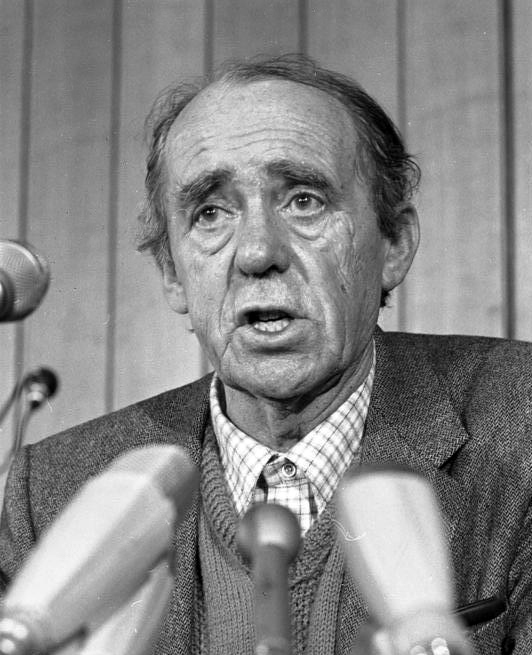
Foto: Hoffmann, Harald · CC BY-SA 3.0 de · Wikimedia Commons
Heinrich Böll
Home · All topics · Legal notice · Privacy · Terms · Contact