Which world did Toulouse-Lautrec capture in his art?
Show answer
the Parisian nightlife
Toulouse-Lautrec captured Parisian nightlife around 1890: cabarets, dance halls and the people of Montmartre.
💡 Did you know? He lived in the midst of this world himself and knew the dancers, singers and brothel women personally.
For what is Toulouse-Lautrec especially important in art history?
Show answer
poster art
Toulouse-Lautrec raised the advertising poster to an art form in its own right; his lithographic posters for the Moulin Rouge are icons to this day.
💡 Did you know? His Moulin Rouge poster made the venue world-famous.
What background did Toulouse-Lautrec come from?
Show answer
old nobility
Toulouse-Lautrec came from one of the oldest noble families in France.
💡 Did you know? His parents were first cousins: the close kinship is thought to be a cause of his bone disease.
What shaped Toulouse-Lautrec's life physically?
Show answer
short stature after leg fractures
Excluded from the life of the nobility, he turned entirely to art.
💡 Did you know? After breaking both legs in his youth, Toulouse-Lautrec's legs stopped growing: he remained short-statured and suffered from it all his life.
In which city did Toulouse-Lautrec live as an artist?
Show answer
Paris
Toulouse-Lautrec lived as an artist in the heart of the Montmartre pleasure district of Paris.
💡 Did you know? He even kept a bed in the brothel and was treated by the women there as one of their own.
How young did Toulouse-Lautrec die?
Show answer
at 36 (1901)
His restless life wore down his health.
💡 Did you know? Ravaged by alcohol, Toulouse-Lautrec died at only 36 in his family's château.
Foto: Henri de Toulouse-Lautrec · Public domain · Wikimedia Commons
Which famous work is shown here?
Show answer
At the Moulin Rouge
Around 1892: a scene from the famous Parisian dance hall.
💡 Did you know? At the edge a ghostly, green-lit woman's face appears: a boldly modern composition.
Foto: Henri de Toulouse-Lautrec · Public domain · Wikimedia Commons
What is this work called?
Show answer
At the Moulin Rouge, The Dance
Painted around 1890.
💡 Did you know? The dancer La Goulue whirls across the floor: Toulouse-Lautrec made her famous.
Foto: Didier Descouens · Public domain · Wikimedia Commons
What is this painting called?
Show answer
La Toilette
Painted around 1889.
💡 Did you know? A woman from behind while dressing: Toulouse-Lautrec showed such everyday moments entirely without pose.
Foto: Henri de Toulouse-Lautrec · Public domain · Wikimedia Commons
Which famous work is shown here?
Show answer
La Blanchisseuse
Painted around 1880.
💡 Did you know? An exhausted young laundress gazes out of the window: a sympathetic picture of a hard life.
Foto: Didier Descouens · Public domain · Wikimedia Commons
What is this work called?
Show answer
In the Salon at the Rue des Moulins
Painted around 1894.
💡 Did you know? Women waiting in a brothel: Toulouse-Lautrec painted them with dignity and without voyeurism.
Foto: Henri de Toulouse-Lautrec · Public domain · Wikimedia Commons
What is this painting called?
Show answer
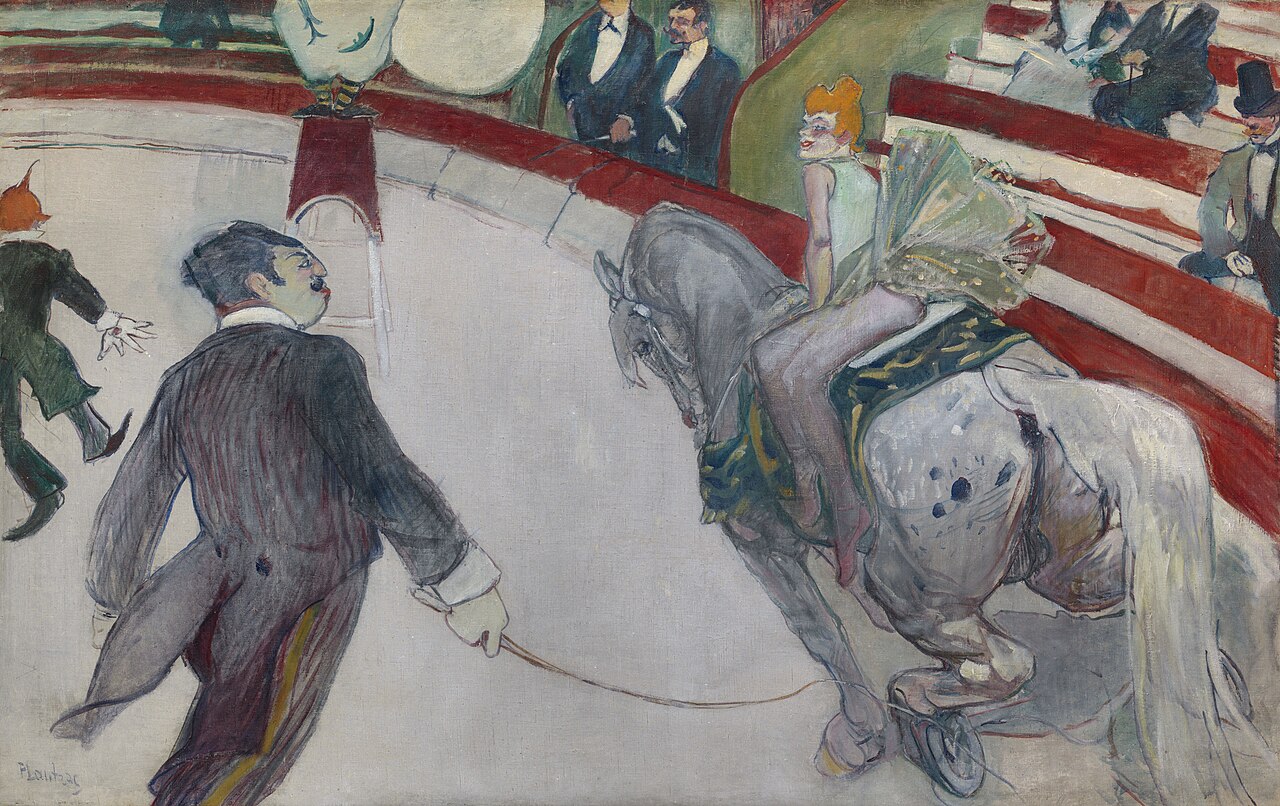
Equestrienne (At the Cirque Fernando)
Painted around 1888.
💡 Did you know? An early masterpiece: the circus fascinated Toulouse-Lautrec all his life.
Foto: Didier Descouens · Public domain · Wikimedia Commons
Which famous work is shown here?
Show answer
Self-portrait in front of a mirror
Painted around 1882.
💡 Did you know? A rare, unflattering look by the artist at himself.
Foto: Henri de Toulouse-Lautrec · Public domain · Wikimedia Commons
What is this work called?
Show answer
The Hangover (Suzanne Valadon)
Painted around 1889.
💡 Did you know? The model was Suzanne Valadon, who herself became an important painter.
Public domain · Wikimedia Commons
What is this painting called?
Show answer
The Artist's Father Driving a Mail-Coach
Painted around 1880.
💡 Did you know? Toulouse-Lautrec's father was an eccentric horse fanatic; the son painted horses masterfully even as a child.
Foto: Henri de Toulouse-Lautrec · Public domain · Wikimedia Commons
Which famous work is shown here?
Show answer
The Rope Dancer
Painted around 1899.
💡 Did you know? The circus performers too Toulouse-Lautrec caught in sweeping lines.
Foto: Henri de Toulouse-Lautrec · Public domain · Wikimedia Commons
What is this work called?
Show answer
Le Lit
Painted around 1892.
💡 Did you know? Two women lie tenderly together: Toulouse-Lautrec painted such intimate scenes as a matter of course.
Foto: Henri de Toulouse-Lautrec · Public domain · Wikimedia Commons
What is this painting called?
Show answer
Moulin Rouge: La Goulue (poster)
Around 1891: the famous poster that made the Moulin Rouge world-famous.
💡 Did you know? This 1891 poster made Toulouse-Lautrec famous overnight and revolutionised the art of advertising.
Foto: Paul Sescau · Public domain · Wikimedia Commons
Which artist is shown here?
Show answer
Henri de Toulouse-Lautrec
Henri de Toulouse-Lautrec (1864 to 1901) was a French painter and printmaker who unforgettably captured the Montmartre nightlife of Paris.
💡 Did you know? Of old noble stock and short-statured, Toulouse-Lautrec found his home among dancers and outsiders and died at only 36.