Foto: Creator: Dmitry Bogdanov · CC BY 3.0 · Wikimedia Commons
Show answer
Triceratops
A bulky plant-eater with three horns and a large bony neck frill. It lived at the same time as T. rex and was one of its possible prey.
💡 Did you know? Its skull, up to 2.5 metres long, is among the largest of any land animal.
Foto: Durbed · CC BY-SA 3.0 · Wikimedia Commons
Show answer
Stegosaurus
Unmistakable for the two rows of large bony plates along its back and the spikes on its tail. This plant-eater lived in the Jurassic of North America.
💡 Did you know? Its brain was only about the size of a walnut: tiny for a nine-metre animal.
Foto: Dmitry Bogdanov · Public domain · Wikimedia Commons
Show answer
Brachiosaurus
A giant long-neck whose front legs were longer than its hind legs: so its neck rose steeply upward like a giraffe's.
💡 Did you know? With its high-held head it could browse leaves more than twelve metres up.
Foto: ДиБгд at Russian Wikipedia · Public domain · Wikimedia Commons
Show answer
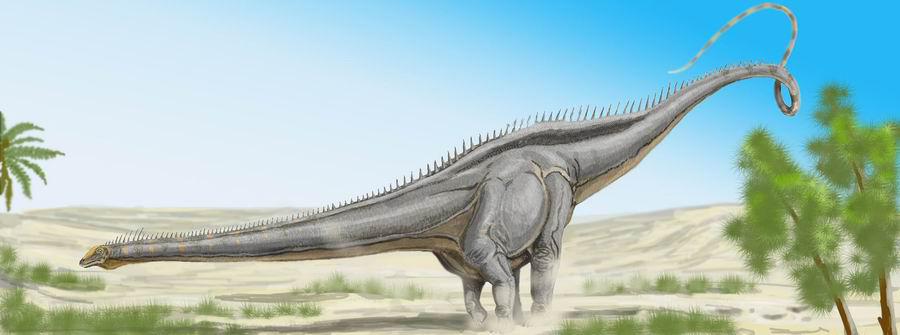
Diplodocus
One of the longest dinosaurs ever: a slender long-neck with an extremely long neck and whip-like tail, up to 27 metres long.
💡 Did you know? It may have been able to crack its tail like a whip: faster than the speed of sound.
Foto: Emily Willoughby (e.deinonychus@gmail.com, http://emilywilloughby.com) · CC BY-SA 3.0 · Wikimedia Commons
Show answer
Ankylosaurus
A living tank: its back and head were covered in bony plates, and its tail ended in a heavy bony club for defence.
💡 Did you know? A blow from its tail club could break an attacker's bones.
Foto: Connor Ashbridge · CC BY-SA 4.0 · Wikimedia Commons
Show answer
Parasaurolophus
A plant-eater with a flat ‘duck bill’ and a long, curved tube-like crest on its head.
💡 Did you know? Through the hollow crest it could probably produce deep, trumpet-like calls.
Foto: DataBase Center for Life Science (DBCLS) · CC BY 4.0 · Wikimedia Commons
Show answer
Pachycephalosaurus
Notable for its extremely thick, dome-shaped skull roof of solid bone, ringed by small bumps.
💡 Did you know? Whether they head-butted like rams is still debated today.