✍️
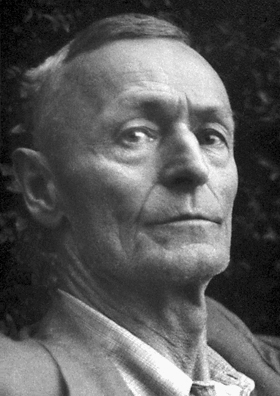
Hermann Hesse
13 questions · Literature
Hermann Hesse, born in 1877 in the Swabian town of Calw to Pietist missionaries, is the great poet of the search for self and was himself an early rebel: at 14 he fled the Protestant seminary at Maulbronn ('a poet or nothing at all'), followed by crises, a suicide attempt, abandoned apprenticeships. A bookseller's apprenticeship in Tübingen led him to literature; the success of 'Peter Camenzind' (1904) made him a freelance writer.
His novels are stations of a single journey inward: 'Beneath the Wheel' (1906) settles accounts with the grinding school drill of his youth. 'Siddhartha' (1922), the 'Indian tale' of a Brahmin's son on the path to enlightenment, draws on the India heritage of the missionary's grandson. 'Steppenwolf' (1927) sends the torn Harry Haller, half man, half wolf, through the 'Magic Theatre': 'Entrance not for everybody. For madmen only.' 'Narcissus and Goldmund' contrasts thinker and sensualist; the late work 'The Glass Bead Game' (1943) invents the scholars' province of Castalia and earned Hesse the 1946 Nobel Prize in Literature.
An opponent of war who wrote against the jingoism of 1914 ('O friends, not these tones!'), Hesse lived from 1919 in the Ticino village of Montagnola, became a Swiss citizen, painted watercolours, tended his garden and answered tens of thousands of letters from searching readers. Psychoanalysis, including sessions with a pupil of C. G. Jung, deeply shaped his work. He died in Montagnola in 1962.
Did you know that in the 1960s and 70s Hesse posthumously became an idol of the American hippie movement? 'Steppenwolf' and 'Siddhartha' became cult books: a rock band named itself after the novel, and Hesse became the century's most-read German-language author.
Practise for free
PurFact brings every card back right before you would forget it. That's how knowledge sticks.