Foto: Daniel Jolivet · CC BY 2.0 · Wikimedia Commons
Show answer
Okapi
A shy forest animal from the Congo that looks like a cross between a zebra and a horse. In fact it is the closest relative of the giraffe.
💡 Did you know? The okapi was only scientifically described in 1901 and was long called the ‘African unicorn’.
Foto: flowcomm · CC BY 2.0 · Wikimedia Commons
Show answer
Cheetah
The fastest land cat in the world, slender with long legs and black ‘tear stripes’ on its face. It hunts gazelles on open grassland.
💡 Did you know? A cheetah accelerates to over 100 km/h in just a few seconds.
Foto: Charles J. Sharp · CC BY-SA 4.0 · Wikimedia Commons
Show answer
Leopard
A powerful big cat with a rosette-shaped spot pattern. The leopard is a secretive loner and an excellent climber.
💡 Did you know? Leopards often haul their prey up trees to keep it safe from lions and hyenas.
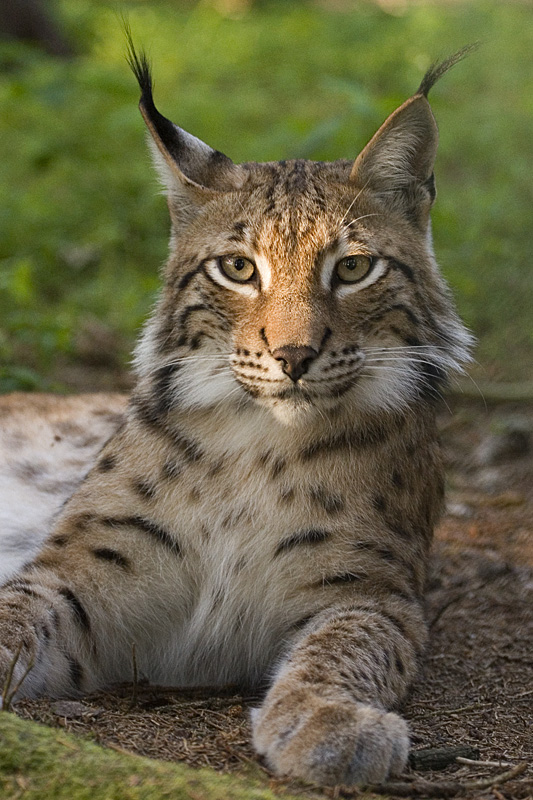
Foto: Bernard Landgraf (User:Baerni) · CC BY-SA 3.0 · Wikimedia Commons
Show answer
Lynx
A medium-sized wild cat with tufted ears and a short tail. The lynx lives in the forests of Europe and Asia.
💡 Did you know? The black tufts on the ears probably improve the lynx's hearing.
Foto: Diego Delso · CC BY-SA 4.0 · Wikimedia Commons
Show answer
Meerkat
A small, sociable predator of Africa's dry regions. Meerkats live in colonies and post sentries.
💡 Did you know? While the group feeds, one meerkat always stands guard and warns of danger.
Foto: Anagoria · CC BY 3.0 · Wikimedia Commons
Show answer
Anteater
A South American mammal with a long snout and bushy tail that feeds on ants and termites. It has no teeth.
💡 Did you know? Its sticky tongue is up to 60 centimetres long and flicks out at lightning speed.
Foto: Mwcolgan8 · Public domain · Wikimedia Commons
Show answer
Armadillo
A small American mammal with a shell of bony plates. When threatened, some species roll up into a ball.
💡 Did you know? The nine-banded armadillo almost always gives birth to four genetically identical young.
Foto: Jsfouche · CC BY-SA 3.0 · Wikimedia Commons
Show answer
Sloth
An extremely slow tree-dweller from the rainforests of Central and South America. It hangs upside down in the branches and eats leaves.
💡 Did you know? Sloths move so little that algae even grow in their fur.
Foto: Piekfrosch at German Wikipedia (Original text: Piekfrosch (Wikipedia-User)) · CC BY-SA 3.0 · Wikimedia Commons
Show answer
Pangolin
The only mammal with armour of true horny scales. It feeds on ants and rolls into a ball when threatened.
💡 Did you know? Pangolins are among the most heavily poached wild animals in the world.
Foto: Faldrian · CC BY-SA 3.0 · Wikimedia Commons
Show answer
Axolotl
A Mexican salamander that stays in its larval stage with external gills for life. It lives only in lakes near Mexico City.
💡 Did you know? The axolotl can fully regrow lost limbs and even parts of its heart.
Foto: Looking glass · CC BY-SA 2.0 · Wikimedia Commons
Show answer
Quokka
A small, cat-sized marsupial from Australia with a rounded face. It lives mainly on Rottnest Island near Perth.
💡 Did you know? Because of its seemingly smiling face, the quokka is called the ‘happiest animal in the world’.
Foto: JJ Harrison (jjharrison89@facebook.com) · CC BY-SA 3.0 · Wikimedia Commons
Show answer
Wombat
A stocky, burrowing marsupial from Australia. Wombats live in extensive underground tunnels.
💡 Did you know? Wombats produce cube-shaped droppings: unique in the entire animal kingdom.
Foto: User:MatthiasKabel · CC BY-SA 3.0 · Wikimedia Commons
Show answer
Coati
A curious raccoon relative of the Americas with a long, mobile snout and a ringed tail. It forages on the ground for insects and fruit.
💡 Did you know? Females roam in large groups with their young, while males mostly live alone.
Foto: zielwasser · CC BY-SA 3.0 · Wikimedia Commons
Show answer
Tapir
An ancient plant-eater with a short trunk, related to horses and rhinos. Tapirs live in the forests of South America and Southeast Asia.
💡 Did you know? Young tapirs wear a spotted and striped camouflage coat that later disappears.