Foto: Tassilo Rau · CC BY-SA 3.0 · Wikimedia Commons
Show answer
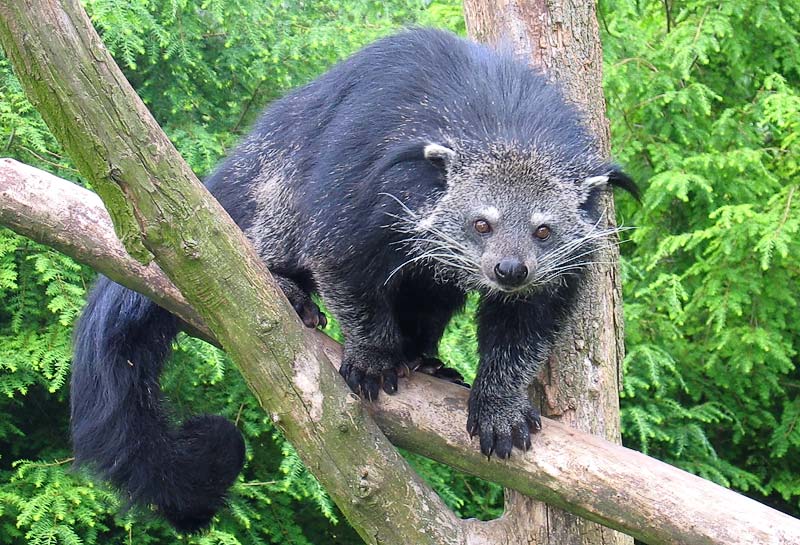
Binturong
A cat-like civet from Southeast Asia with a long prehensile tail that lives in the trees. Curiously, it smells distinctly of popcorn.
💡 Did you know? Its popcorn smell comes from the very molecule that is also produced when corn is roasted.
Foto: Ran Kirlian · CC BY-SA 4.0 · Wikimedia Commons
Show answer
Fossa
The largest predator of Madagascar, slender and cat-like but related to the mongooses. It hunts mainly lemurs in the trees.
💡 Did you know? Despite its cat-like appearance, the fossa is not a cat.
Foto: nomis-simon · CC BY 2.0 · Wikimedia Commons
Show answer
Aye-aye
A nocturnal lemur from Madagascar with huge ears and an extremely long, thin middle finger. It uses it to tap wood and fish out grubs.
💡 Did you know? It is the only primate that finds prey by ‘tap-foraging’: echolocating grubs inside wood.
Foto: Dick Culbert from Gibsons, B.C., Canada · CC BY 2.0 · Wikimedia Commons
Show answer
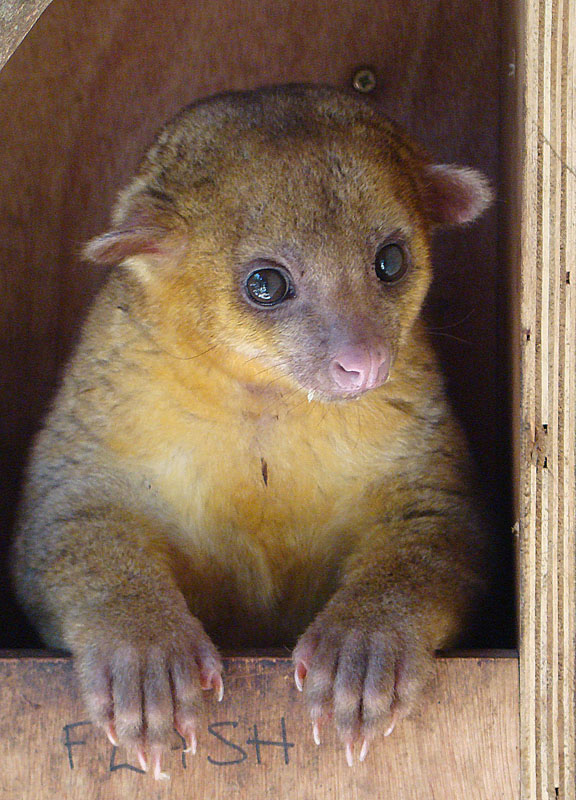
Kinkajou
A tree-dwelling relative of the raccoon from the rainforests of Central and South America, with a prehensile tail. It feeds mainly on fruit and nectar.
💡 Did you know? With its long tongue it laps nectar from flowers: pollinating them in the process.
Foto: Self · CC BY-SA 2.5 · Wikimedia Commons
Show answer
Serval
A slender African wild cat with very long legs and large ears. It hunts rodents in tall grass with spectacular leaps.
💡 Did you know? The serval leaps over two metres high to knock birds out of the air.
Foto: Christiaan Viljoen · CC BY 4.0 · Wikimedia Commons
Show answer
Caracal
A powerful wild cat with striking black ear tufts, found across Africa and Asia. It is a skilled bird-hunter.
💡 Did you know? Caracals knock flushed birds out of the air with a lightning-fast leap.
Foto: Bernard DUPONT from FRANCE · CC BY-SA 2.0 · Wikimedia Commons
Show answer
Rock hyrax
A small, marmot-like mammal of Africa and the Middle East that lives among rocks. Surprisingly, its closest relative is the elephant.
💡 Did you know? Despite its size, the rock hyrax is among the closest living relatives of elephants.
Foto: Andrey Giljov · CC BY-SA 4.0 · Wikimedia Commons
Show answer
Saiga antelope
A steppe antelope of Central Asia with a distinctive, trunk-like nose. It roams the steppe in large herds.
💡 Did you know? The grotesque nose filters out dust in summer and warms the inhaled air in winter.
Foto: Harsha Narasimhamurthy · CC BY 3.0 · Wikimedia Commons
Show answer
Gaur
The largest wild cattle in the world, native to the forests of South and Southeast Asia. Despite its bulk it is a shy plant-eater.
💡 Did you know? A gaur bull can weigh over a tonne.
Foto: Ltshears · CC BY-SA 3.0 · Wikimedia Commons
Show answer
Takin
A massive hoofed animal of the Himalayas that looks like a mix of goat, wildebeest and cattle. It lives in mountain forests and bamboo thickets.
💡 Did you know? The takin is the national animal of Bhutan.
Foto: Rufus46 · CC BY-SA 3.0 · Wikimedia Commons
Show answer
Markhor
A large wild goat from the mountains of Central Asia with spectacularly twisted horns. It climbs steep rock faces with ease.
💡 Did you know? The corkscrew-like horns can grow over a metre long.
Foto: By Aaron Logan · CC BY 1.0 · Wikimedia Commons
Show answer
Gerenuk
An East African gazelle with an extremely long neck. It stands on its hind legs to browse leaves from tall bushes.
💡 Did you know? Its name means ‘giraffe-necked’ in Somali.
Foto: Dan Harville · CC BY-SA 4.0 · Wikimedia Commons
Show answer
Dik-dik
One of the smallest antelopes in the world, barely larger than a hare, from East Africa. Pairs live faithfully together in fixed territories.
💡 Did you know? Its name imitates the alarm ‘dik-dik’ call it makes when startled.
Foto: David Dennis · CC BY-SA 2.0 · Wikimedia Commons
Show answer
Proboscis monkey
A monkey of the swamps of Borneo whose males carry a huge, drooping nose. It is an excellent swimmer.
💡 Did you know? The male's large nose amplifies its calls and impresses the females.
Foto: ((brian)) from Sebastopol, CA, USA · CC BY 2.0 · Wikimedia Commons
Show answer
Mandrill
The largest monkey in the world, from the rainforests of Central Africa, with a brilliantly blue-and-red face. It lives in huge groups.
💡 Did you know? The vivid facial colours are strongest in high-ranking males.
Foto: Stefan Kraft · CC BY-SA 3.0 · Wikimedia Commons
Show answer
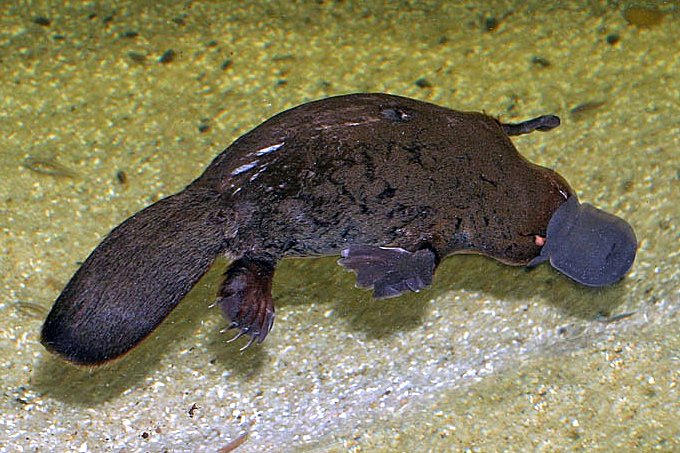
Platypus
An egg-laying mammal from Australia with a duck's bill, a beaver's tail and an otter's feet. It hunts underwater with its eyes closed.
💡 Did you know? The males carry venomous spurs on their hind legs: a rarity among mammals.