Foto: Giles Laurent · CC BY-SA 4.0 · Wikimedia Commons
Show answer
Lion
The ‘king of beasts’ is the only cat that lives in prides, mostly in the savannahs of Africa. Males sport a striking mane.
💡 Did you know? A lion's roar can be heard up to eight kilometres away.
Foto: Charles J. Sharp · CC BY-SA 4.0 · Wikimedia Commons
Show answer
Tiger
The largest living cat, unmistakable for its striped coat. Tigers are solitary and live in the forests of Asia.
💡 Did you know? Each tiger's stripe pattern is unique: like a fingerprint.
Foto: Martin Mecnarowski (http://www.photomecan.eu/) · CC BY-SA 3.0 · Wikimedia Commons
Show answer
Red fox
An adaptable predator with reddish fur and a bushy tail. The fox today even lives in cities.
💡 Did you know? Foxes can hear a mouse rustling under snow and then dive in headfirst.
Foto: Joanne Goldby · CC BY 2.0 · Wikimedia Commons
Show answer
Spotted hyena
A powerful predator of the African savannah that lives in clans and is known for its giggling ‘laugh’. Hyenas are tireless hunters and skilled scavengers.
💡 Did you know? The spotted hyena's ‘laugh’ is no joke but a sign of excitement: usually during squabbles over food.
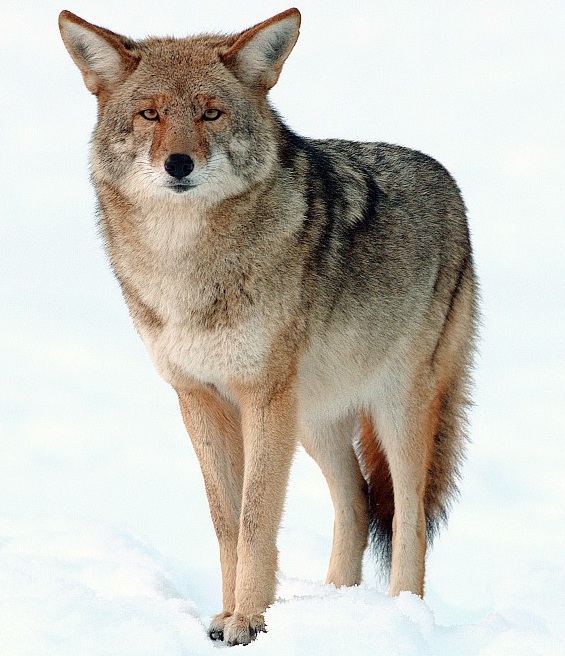
Foto: Yathin S Krishnappa · CC BY-SA 3.0 · Wikimedia Commons
Show answer
Coyote
An adaptable wild dog of North America, smaller than the wolf. Its howling, yipping chorus is one of the classic sounds of the prairie.
💡 Did you know? Despite hunting, coyotes keep spreading: today they even live in the middle of big cities like Los Angeles.
Foto: Steve from washington, dc, usa · CC BY-SA 2.0 · Wikimedia Commons
Show answer
Howler monkey
A monkey of the rainforests of Central and South America, named for its deafening calls. Whole troops roar in chorus through the forest at dawn.
💡 Did you know? The howler monkey is among the loudest land animals: its call carries for over three kilometres.
Foto: William Warby from London, England · CC BY 2.0 · Wikimedia Commons
Show answer
Gibbon
A small, tailless ape of the forests of Southeast Asia that swings through the treetops. Pairs sing loud, melodic duets.
💡 Did you know? Gibbon pairs mark their territory with their songs; the duets can be heard for kilometres.
Foto: Robert Pittman · Public domain · Wikimedia Commons
Show answer
Killer whale
The largest member of the dolphin family, unmistakable for its black-and-white markings. Orcas hunt in close-knit family groups and communicate with whistles and clicks.
💡 Did you know? Each orca family has its own ‘dialect’ of calls that the young learn from their mother.
Foto: derivative work: Victorrocha (talk · contribs) Crotalus_cerastes_mesquite_springs_CA.JPG: Tigerhawkvok (talk · contribs) · CC BY-SA 3.0 · Wikimedia Commons
Show answer
Rattlesnake
An American venomous snake with a horny rattle at the tip of its tail. When threatened it buzzes the rattle to warn intruders off.
💡 Did you know? The rattle gains a segment with every skin shed: but it can't reliably reveal the snake's age.
Foto: Iric · CC BY-SA 2.5 · Wikimedia Commons
Show answer
Common toad
A stout, warty toad found across Europe. In the breeding season the animals migrate in numbers to their spawning ponds.
💡 Did you know? Common toads return each year with determination to the very pond where they themselves hatched.
Foto: Bruce Marlin · CC BY-SA 2.5 · Wikimedia Commons
Show answer
Cicada
An insect whose males produce a piercing, shrilling drone on hot days. In southern countries their song is the sound of summer.
💡 Did you know? Cicadas make their noise with special drum-like organs on the abdomen: not by rubbing their wings like crickets.