Foto: Frank Schulenburg · CC BY-SA 4.0 · Wikimedia Commons
Show answer
Cat
A popular pet and skilled hunter, domesticated thousands of years ago. Cats are active at dusk and very clean.
💡 Did you know? A cat's purr lies in a frequency range that is even said to promote healing.
Foto: C voehr · CC BY-SA 4.0 · Wikimedia Commons
Show answer
Dog
Humanity's oldest companion, bred from the wolf and found in countless breeds. Dogs are seen as loyal and quick to learn.
💡 Did you know? A dog's sense of smell is up to a million times keener than a human's.
Foto: Ikiwaner · CC BY-SA 3.0 · Wikimedia Commons
Show answer
Cow
A ruminant farm animal that has provided milk, meat and labour for thousands of years. Cows live in herds and graze in pastures.
💡 Did you know? A cow has four stomachs and brings its food back up several times to chew the cud.
Foto: Alvesgaspar · CC BY-SA 4.0 · Wikimedia Commons
Show answer
Horse
A noble flight animal that humans have ridden and harnessed for thousands of years. Horses are very social and communicate through body language.
💡 Did you know? Horses can sleep standing up because their legs can lock into place like a stay.
Foto: Georg Mittenecker · CC BY-SA 2.5 · Wikimedia Commons
Show answer
Sheep
A gentle herd animal kept mainly for its wool. Sheep follow one another closely and feel safe in the group.
💡 Did you know? Sheep can recognise the faces of fellow sheep and humans for years.
Foto: kallerna · CC BY-SA 4.0 · Wikimedia Commons
Show answer
Pig
A clever omnivorous farm animal with an excellent sense of smell. Pigs wallow in mud to cool down.
💡 Did you know? Pigs are considered one of the most intelligent farm animals: smarter than many a dog.
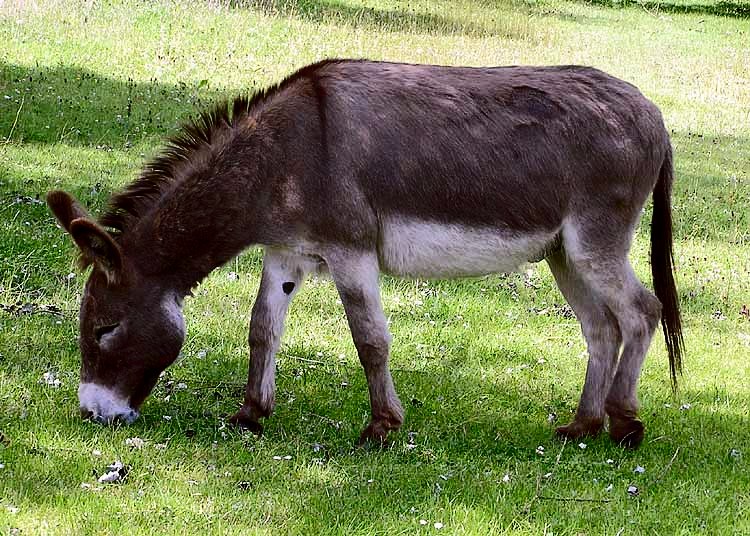
Foto: Adrian Pingstone · Public domain · Wikimedia Commons
Show answer
Donkey
A patient, sure-footed pack animal related to the horse. Donkeys are clever and only seemingly stubborn.
💡 Did you know? A donkey's loud ‘hee-haw’ bray can be heard for kilometres.
Foto: Kuebi = Armin Kübelbeck · CC BY-SA 3.0 · Wikimedia Commons
Show answer
Goat
A curious, climbing-loving farm animal domesticated very early. Goats eat almost any plant and are very undemanding.
💡 Did you know? Goats climb astonishingly well and even stand in trees to reach leaves.
Foto: Charlie Jackson · CC BY 2.0 · Wikimedia Commons
Show answer
Frog
An amphibian that lives both in water and on land and makes long leaps. Frogs begin life as tadpoles.
💡 Did you know? Many frogs also breathe through their skin and must therefore stay moist.
Foto: User:Mas3cf · CC BY-SA 4.0 · Wikimedia Commons
Show answer
Wolf
The wild ancestor of the domestic dog, a pack hunter with strong social behaviour. Wolves are returning to many regions of Europe.
💡 Did you know? Wolf packs communicate over long distances with their howls.
Foto: Muhammad Mahdi Karim · GFDL 1.2 · Wikimedia Commons
Show answer
Elephant
The largest living land animal, recognisable by its trunk and tusks. Elephants live in close-knit herds led by an old female.
💡 Did you know? With its trunk an elephant can lift a tree trunk or pick up a single peanut.
Foto: Lviatour · CC BY-SA 3.0 · Wikimedia Commons
Show answer
Red deer
A large deer of Europe's forests whose males carry impressive antlers. During the rut the stags bellow loudly.
💡 Did you know? By the deep, powerful bellow, the females recognise the strongest stags.
Foto: Charles J. Sharp · CC BY-SA 4.0 · Wikimedia Commons
Show answer
Humpback whale
A large baleen whale known for spectacular breaches and long, melodic ‘songs’. It migrates thousands of kilometres each year.
💡 Did you know? The males' songs can last for hours and change from year to year.
Foto: Roberto Zanon · CC BY-SA 3.0 · Wikimedia Commons
Show answer
Cricket
An insect whose males call on warm summer evenings with a chirping song. The sound is made by rubbing the wings together.
💡 Did you know? The chirping rate roughly indicates the air temperature; the warmer it is, the faster they chirp.