

Foto: Eugen Staab · Public domain · Wikimedia Commons
Show answer
Wheat
Wheat is the world's most-grown bread cereal.
💡 Did you know? It yields the classic white-flour dough.
12 questions · Nature
They are unremarkable stalks, and yet the survival of humankind rests on them: cereals provide much of the world's calories and have accompanied us since the Stone Age from the field through the mill to the plate. Whether as bread, porridge, pasta or beer, hardly a day passes without a grain. This pack lets you recognise the most important cereals by ear and kernel: versatile wheat and hardy rye for dark bread, awned barley for beer and panicled oats for breakfast flakes, maize with its golden cobs and rice as the staple of half of Asia, small-grained millet and rustic spelt, the pseudocereal buckwheat, really related to flowers, and protein-rich quinoa from the Andes, as well as the ancient wheat emmer and triticale, a cross of wheat and rye: recognise them by their ears and grains and look at every roadside field with new eyes. For what waves so unremarkably in the wind is in truth the result of thousands of years of cultivation and the basis of almost every meal in the world, from the morning slice of bread to the evening bowl of rice.
Practise for freePurFact brings every card back right before you would forget it. That's how knowledge sticks.
Which cereal is this?
Foto: Eugen Staab · Public domain · Wikimedia Commons
Wheat
Wheat is the world's most-grown bread cereal.
💡 Did you know? It yields the classic white-flour dough.

Foto: LSDSL · CC BY-SA 3.0 · Wikimedia Commons
Rye
Rye thrives even on poor, cold soils.
💡 Did you know? It gives dark bread its hearty flavour.

Foto: Cliff from Arlington, Virginia, USA · CC BY 2.0 · Wikimedia Commons
Barley
Barley is easy to spot by its long awns.
💡 Did you know? It is the key raw material for brewing beer.

Foto: Christian Fischer · CC BY-SA 3.0 · Wikimedia Commons
Oats
Oats bear a loose panicle, not a spike.
💡 Did you know? As rolled oats it is a popular breakfast.

Foto: H. Zell · CC BY-SA 3.0 · Wikimedia Commons
Maize
Maize forms thick cobs with many yellow kernels.
💡 Did you know? It originally comes from Central America.

Foto: China News Service · CC BY 3.0 · Wikimedia Commons
Rice
Rice is the staple food for half of humanity.
💡 Did you know? It usually grows in flooded paddies.

Public domain · Wikimedia Commons
Millet
Millet covers many small-grained, gluten-free cereals.
💡 Did you know? It is among the oldest cultivated crops.
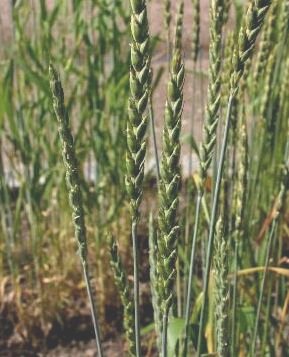
Foto: Ranveig · CC BY-SA 3.0 · Wikimedia Commons
Spelt
Spelt is an ancient relative of wheat.
💡 Did you know? Harvested unripe, its grain is called ‘Grünkern’.

Foto: Dalgial · CC BY-SA 3.0 · Wikimedia Commons
Buckwheat
Buckwheat is not a true cereal at all (a pseudocereal).
💡 Did you know? Its grains are three-sided.

Foto: User:MarkusHagenlocher · CC BY-SA 3.0 · Wikimedia Commons
Quinoa
Quinoa comes from the Andes and is a pseudocereal.
💡 Did you know? It supplies all essential amino acids.

Public domain · Wikimedia Commons
Emmer
Emmer is an ancient wheat from the Neolithic.
💡 Did you know? It is being rediscovered as an ‘ancient grain’.

Foto: MarkusHagenlocher · CC BY-SA 3.0 · Wikimedia Commons
Triticale
Triticale is a cross of wheat and rye.
💡 Did you know? It combines the yield and hardiness of both.
Home · All topics · Legal notice · Privacy · Terms · Contact