

Foto: Wolf170278 · CC0 · Wikimedia Commons
Show answer
Cumulus
Cumulus is the white fair-weather cloud with a flat base and cauliflower top.
💡 Did you know? Its flat base marks exactly the condensation level.
12 questions · Nature
The sky as a picture book: every cloud shape hints at what the weather is planning. Recognise the puffy cumulus and the towering cumulonimbus, feather-light cirrus and fine-grained cirrocumulus, the grey stratus blanket and the coarse rolls of stratocumulus, the mackerel patches of altocumulus and the rain-laden nimbostratus: plus the lens-shaped lenticular cloud over mountains, pouch-like mammatus, silvery noctilucent clouds and the man-made contrail. Good to know: Cumulus is the white fair-weather cloud with a flat base and cauliflower top. Its flat base marks exactly the condensation level. Cumulonimbus is the thunderstorm tower with an anvil-shaped top. It is the only cloud reaching through all three levels. Cirrus clouds are thin, feathery streaks of pure ice crystals. They sit so high that they never bring rain. Cirrocumulus forms fine, grainy cloudlets like sand ripples on a beach. Sailors called this sky a ‘mackerel sky’. Stratus is a low, uniformly grey blanket without structure.
Practise for freePurFact brings every card back right before you would forget it. That's how knowledge sticks.
Which cloud is this?
Foto: Wolf170278 · CC0 · Wikimedia Commons
Cumulus
Cumulus is the white fair-weather cloud with a flat base and cauliflower top.
💡 Did you know? Its flat base marks exactly the condensation level.

Foto: Uli Feuermeister · CC BY-SA 3.0 · Wikimedia Commons
Cumulonimbus
Cumulonimbus is the thunderstorm tower with an anvil-shaped top.
💡 Did you know? It is the only cloud reaching through all three levels.

Foto: PiccoloNamek · CC BY-SA 3.0 · Wikimedia Commons
Cirrus
Cirrus clouds are thin, feathery streaks of pure ice crystals.
💡 Did you know? They sit so high that they never bring rain.

Foto: Photographer: Simon Eugster --Simon · CC BY-SA 3.0 · Wikimedia Commons
Cirrocumulus
Cirrocumulus forms fine, grainy cloudlets like sand ripples on a beach.
💡 Did you know? Sailors called this sky a ‘mackerel sky’.

Foto: Simon A. Eugster · CC BY-SA 3.0 · Wikimedia Commons
Stratus
Stratus is a low, uniformly grey blanket without structure.
💡 Did you know? When it touches the ground we call it fog.

Foto: Simon A. Eugster · CC BY-SA 3.0 · Wikimedia Commons
Stratocumulus
Stratocumulus consists of coarse, dark rolls or patches with bright gaps.
💡 Did you know? It is the most common cloud on Earth.

Foto: LivingShadow · CC BY-SA 3.0 · Wikimedia Commons
Altocumulus
Altocumulus shows regular white patches at the middle level.
💡 Did you know? These are popularly known as a mackerel sky.

Foto: LivingShadow · CC BY-SA 3.0 · Wikimedia Commons
Nimbostratus
Nimbostratus is a thick, dark grey rain layer without visible outlines.
💡 Did you know? It delivers the classic hours-long steady rain.
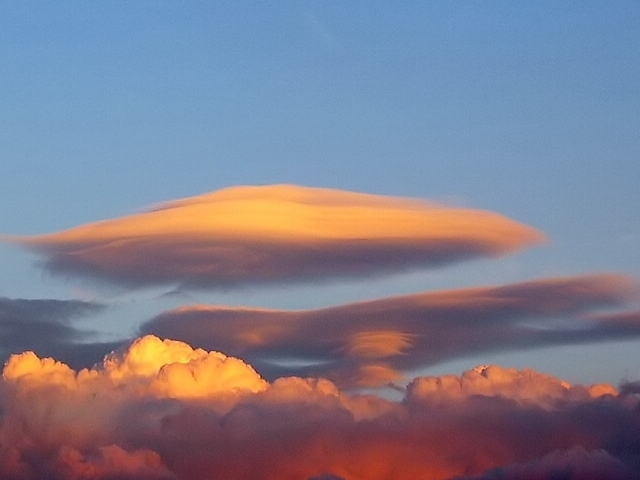
Foto: Sunfly 14:20, 1 September 2007 (UTC) · CC BY-SA 3.0 · Wikimedia Commons
Lenticular cloud
The lenticular cloud is a smooth lens hanging almost motionless over mountains.
💡 Did you know? Its UFO shape still prompts sightings of strange craft.

Foto: Sascha1405 · CC BY-SA 4.0 · Wikimedia Commons
Mammatus
Mammatus are pouch-like bulges on the underside of a cloud.
💡 Did you know? They often hang beneath the anvil of a departing thunderstorm.

Foto: Martin Koitmäe [1] · CC BY-SA 4.0 · Wikimedia Commons
Noctilucent cloud
Noctilucent clouds shimmer silvery blue at around 80 kilometres altitude.
💡 Did you know? They are the highest clouds of all and visible only at twilight.

Foto: NASA / Jim Ross · Public domain · Wikimedia Commons
Contrail
Contrails are narrow, straight ice clouds behind aircraft.
💡 Did you know? If they linger, the upper air is humid: often a sign of an approaching low.
Home · All topics · Legal notice · Privacy · Terms · Contact