

Foto: Afrank99 · CC BY-SA 2.5 · Wikimedia Commons
Show answer
Resistor
The resistor limits current flow and carries coloured rings as a value code.
💡 Did you know? The colour bands reveal its value.
12 questions · Technology
Tiny but indispensable: on every circuit board these components work together to make technology run. Recognise the resistor, capacitor, transistor, LED, diode, battery, coil, relay, fuse, circuit board, microchip and switch by their looks. Good to know: The resistor limits current flow and carries coloured rings as a value code. The colour bands reveal its value. The capacitor briefly stores electric charge. It smooths voltages in circuits. The transistor switches and amplifies electrical signals. Billions of them sit in every chip. The LED is a diode that emits light when current flows. It is more efficient than a light bulb. The diode lets current pass in only one direction. A ring marks the blocking direction. The battery stores energy chemically and supplies direct current. It has a plus and a minus terminal. The coil is a wound wire that creates a magnetic field. It stores energy in a magnetic field. The relay is an electrically operated switch for larger currents. A small current switches a large one.
Practise for freePurFact brings every card back right before you would forget it. That's how knowledge sticks.
Which component is this?
Foto: Afrank99 · CC BY-SA 2.5 · Wikimedia Commons
Resistor
The resistor limits current flow and carries coloured rings as a value code.
💡 Did you know? The colour bands reveal its value.

Foto: Elcap · CC0 · Wikimedia Commons
Capacitor
The capacitor briefly stores electric charge.
💡 Did you know? It smooths voltages in circuits.

Foto: Benedikt.Seidl · Public domain · Wikimedia Commons
Transistor
The transistor switches and amplifies electrical signals.
💡 Did you know? Billions of them sit in every chip.

Foto: Grapetonix · CC BY 3.0 · Wikimedia Commons
LED
The LED is a diode that emits light when current flows.
💡 Did you know? It is more efficient than a light bulb.

Foto: Mister rf · CC BY-SA 4.0 · Wikimedia Commons
Diode
The diode lets current pass in only one direction.
💡 Did you know? A ring marks the blocking direction.
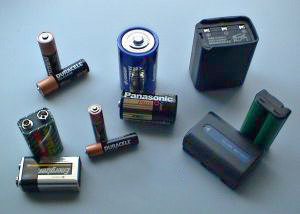
Foto: en:User:Brianiac · Public domain · Wikimedia Commons
Battery
The battery stores energy chemically and supplies direct current.
💡 Did you know? It has a plus and a minus terminal.

Foto: Miguel · CC BY-SA 3.0 · Wikimedia Commons
Coil
The coil is a wound wire that creates a magnetic field.
💡 Did you know? It stores energy in a magnetic field.

Foto: Retired electrician · CC0 · Wikimedia Commons
Relay
The relay is an electrically operated switch for larger currents.
💡 Did you know? A small current switches a large one.

Foto: André Karwath aka Aka · CC BY-SA 2.5 · Wikimedia Commons
Fuse
The fuse breaks the circuit when the current is too high.
💡 Did you know? A thin wire melts through in the process.

Foto: Ulfbastel · Public domain · Wikimedia Commons
Circuit board
The circuit board holds components and links them via printed tracks.
💡 Did you know? It is usually coated green.

Foto: Die prepared by Matt Britt w:User:Matt Britt = w:User:Uberpenguin = w:User:Uberpenguin~enwiki = https://web.archive.org/web/20080605030548/http://mattb.alwayssleeping.com/ https://web.archive.org/web/20140607040627/http://www.alwayssleeping.com:80/images/486/ https://web.archive.org/web/*/http://alwayssleeping.com/images/cleanroom/* photo taken by Matt Gibbs (matt[AT]alwayssleeping{dot}com) · CC BY-SA 3.0 · Wikimedia Commons
Microchip
The microchip packs tiny circuits into a black case with many legs.
💡 Did you know? It is the brain of computers.
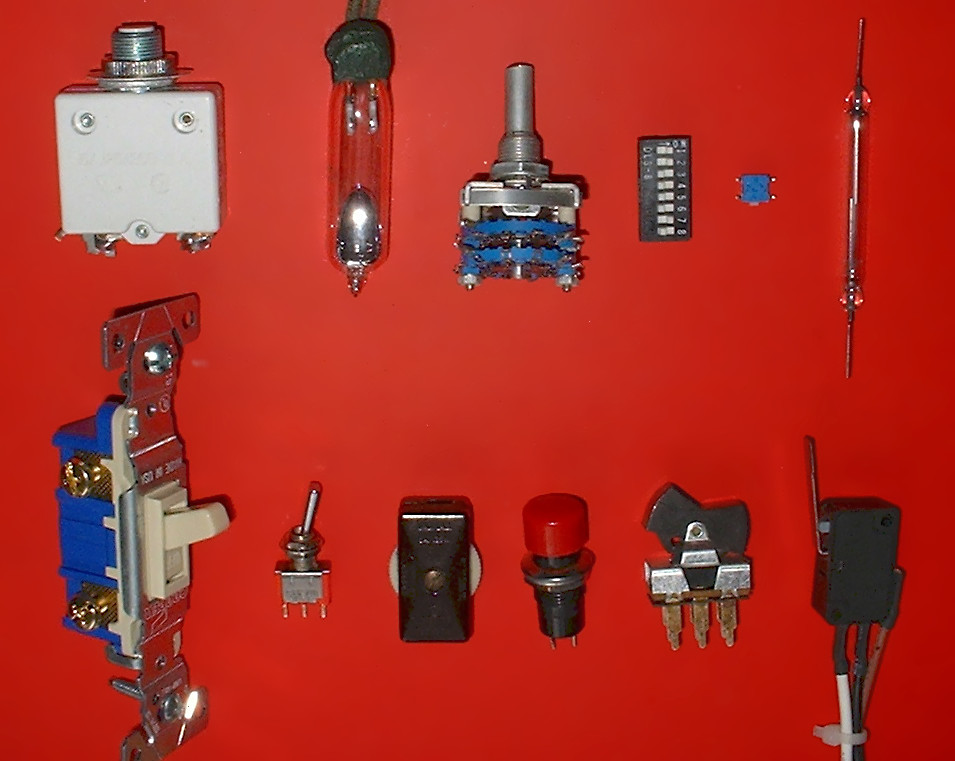
Foto: en:User:ArnoldReinhold · CC BY-SA 3.0 · Wikimedia Commons
Switch
The switch opens or closes a circuit by hand.
💡 Did you know? The light switch is the best-known example.
Home · All topics · Legal notice · Privacy · Terms · Contact