
Foto: Variated by -- Peter Steinberg · Public domain · Wikimedia Commons
Show answer
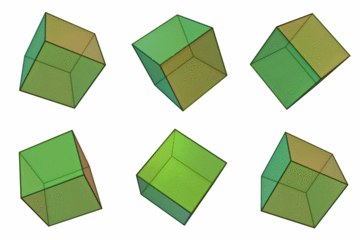
Cube
The cube has six equal square faces and twelve edges of equal length.
💡 Did you know? It is one of the five Platonic solids.
12 questions · Maths & Logic
From the simple sphere to the many-faced icosahedron: these solids appear in dice games, architecture and nature. Recognise the cube, sphere, cylinder, cone, pyramid, cuboid, prism, tetrahedron, octahedron, dodecahedron, icosahedron and torus by their shape. Good to know: The cube has six equal square faces and twelve edges of equal length. It is one of the five Platonic solids. The sphere is uniformly round: every point is equally far from the centre. For a given volume it has the smallest surface. The cylinder has two round ends and a curved side surface. A tin can is an everyday example. The cone tapers from a round base to a point. An ice-cream cone has this shape. The pyramid has a polygonal base and triangular sides meeting at an apex. The Egyptian pyramids are square-based. The cuboid is a box with six rectangular faces. A shoebox is a cuboid. The prism has two equal, parallel bases connected by rectangles. A glass prism splits light into colours. The tetrahedron is made of four equilateral triangles.
Practise for freePurFact brings every card back right before you would forget it. That's how knowledge sticks.
Which geometric solid is this?
Foto: Variated by -- Peter Steinberg · Public domain · Wikimedia Commons
Cube
The cube has six equal square faces and twelve edges of equal length.
💡 Did you know? It is one of the five Platonic solids.

Foto: Pearson Scott Foresman · Public domain · Wikimedia Commons
Sphere
The sphere is uniformly round: every point is equally far from the centre.
💡 Did you know? For a given volume it has the smallest surface.

Foto: Pearson Scott Foresman · Public domain · Wikimedia Commons
Cylinder
The cylinder has two round ends and a curved side surface.
💡 Did you know? A tin can is an everyday example.
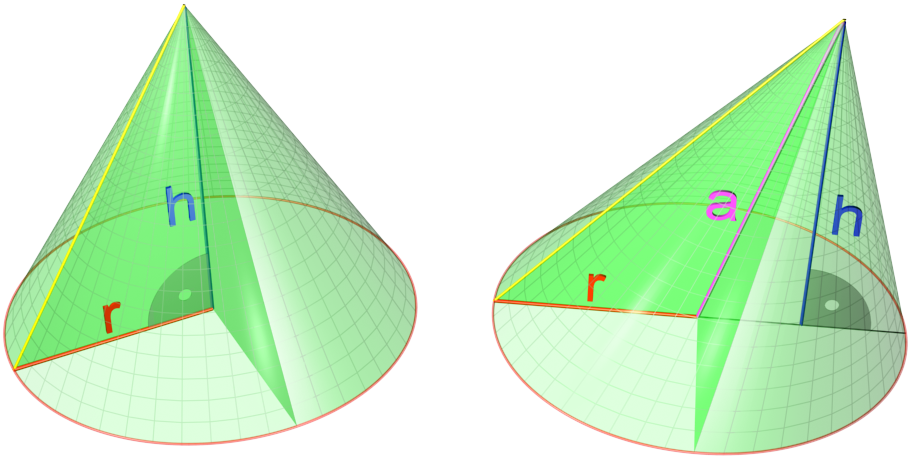
Foto: DemonDeLuxe (Dominique Toussaint) · CC BY-SA 3.0 · Wikimedia Commons
Cone
The cone tapers from a round base to a point.
💡 Did you know? An ice-cream cone has this shape.

Grafik: SG0039 · CC0 · Wikimedia Commons
Pyramid
The pyramid has a polygonal base and triangular sides meeting at an apex.
💡 Did you know? The Egyptian pyramids are square-based.

Foto: Tomruen · CC BY-SA 4.0 · Wikimedia Commons
Cuboid
The cuboid is a box with six rectangular faces.
💡 Did you know? A shoebox is a cuboid.

Foto: Tom Ruen (talk) · Public domain · Wikimedia Commons
Prism
The prism has two equal, parallel bases connected by rectangles.
💡 Did you know? A glass prism splits light into colours.
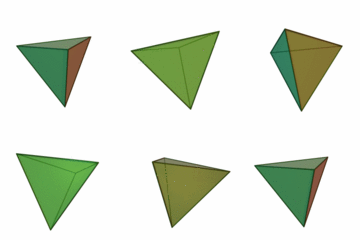
Foto: Variated by -- Peter Steinberg · CC BY-SA 3.0 · Wikimedia Commons
Tetrahedron
The tetrahedron is made of four equilateral triangles.
💡 Did you know? It is the simplest Platonic solid.

Foto: Peter Steinberg · CC BY-SA 3.0 · Wikimedia Commons
Octahedron
The octahedron has eight triangular faces and looks like two pyramids joined.
💡 Did you know? A diamond can be cut in this shape.

Foto: Variated by -- Peter Steinberg, · CC BY-SA 3.0 · Wikimedia Commons
Dodecahedron
The dodecahedron is built from twelve pentagons.
💡 Did you know? As a die it has twelve sides.
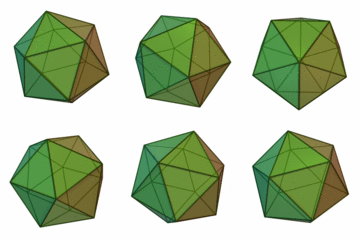
Foto: Variated by -- Peter Steinberg · CC BY-SA 3.0 · Wikimedia Commons
Icosahedron
The icosahedron consists of twenty equilateral triangles.
💡 Did you know? It is the twenty-sided role-playing die.

Foto: WatchduckYou can name the author as "T. Piesk", "Tilman Piesk" or "Watchduck". · CC BY 4.0 · Wikimedia Commons
Torus
The torus is a ring-shaped solid: like a doughnut or tyre.
💡 Did you know? It has a hole in the middle.
Home · All topics · Legal notice · Privacy · Terms · Contact