

Foto: SoetaertAlexander · CC BY-SA 4.0 · Wikimedia Commons
Show answer
Scallop
The scallop has a ribbed, fan-shaped shell.
💡 Did you know? It is the symbol of the Camino de Santiago.
14 questions · Nature
Works of art in lime, formed from two shell halves: each clam has its own shape. Recognise the scallop, oyster, mussel, cockle, Venus clam, razor clam, soft-shell clam, pen shell, giant clam, carpet shell, trough shell, pearl oyster, ark clam and freshwater pearl mussel by the shape and pattern of their shells. Good to know: The scallop has a ribbed, fan-shaped shell. It is the symbol of the Camino de Santiago. The oyster has a rough, irregular shell and lives cemented in place. A pearl can form inside it. The mussel has a smooth, blue-black, elongated shell. It anchors to rocks with fine threads. The cockle is rounded and strongly ribbed; from the side it looks heart-shaped. It burrows into the sand of tidal flats. The Venus clam has a solid, often finely patterned, heart-shaped shell. Many species are popular edible clams. The razor clam has a long, narrow shell like a straight razor. It can dig into the sand astonishingly fast. The soft-shell clam sits deep in tidal mud and always gapes open a little at one end.
Practise for freePurFact brings every card back right before you would forget it. That's how knowledge sticks.
Which shell is this?
Foto: SoetaertAlexander · CC BY-SA 4.0 · Wikimedia Commons
Scallop
The scallop has a ribbed, fan-shaped shell.
💡 Did you know? It is the symbol of the Camino de Santiago.

Foto: W.carter · CC BY-SA 4.0 · Wikimedia Commons
Oyster
The oyster has a rough, irregular shell and lives cemented in place.
💡 Did you know? A pearl can form inside it.
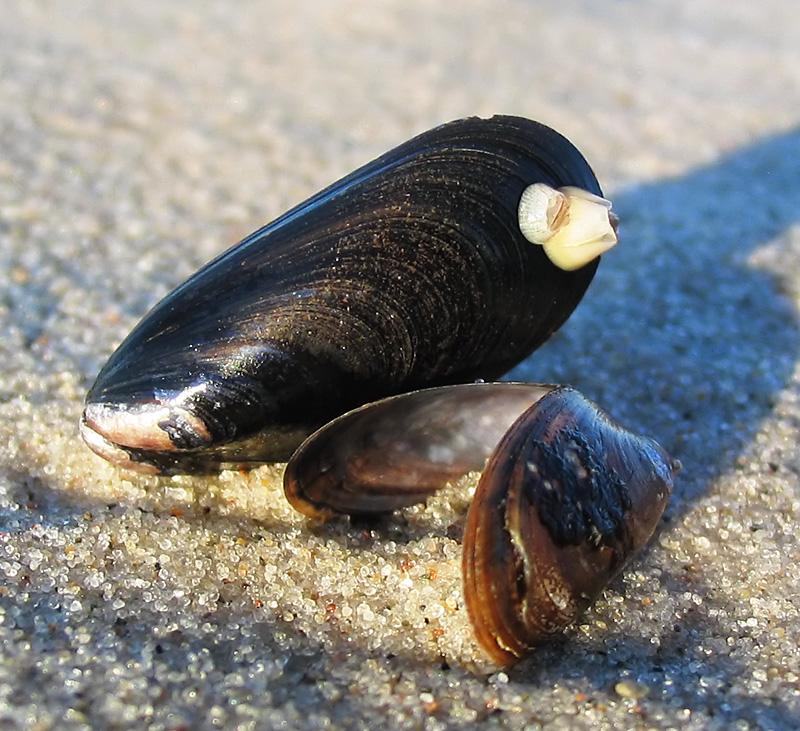
Foto: Benutzer:Darkone · CC BY-SA 2.0 · Wikimedia Commons
Mussel
The mussel has a smooth, blue-black, elongated shell.
💡 Did you know? It anchors to rocks with fine threads.

Foto: Féron Benjamin · CC BY-SA 2.0 · Wikimedia Commons
Cockle
The cockle is rounded and strongly ribbed; from the side it looks heart-shaped.
💡 Did you know? It burrows into the sand of tidal flats.

Foto: Bricktop · CC BY 2.5 · Wikimedia Commons
Venus clam
The Venus clam has a solid, often finely patterned, heart-shaped shell.
💡 Did you know? Many species are popular edible clams.

Foto: Hans Hillewaert · CC BY-SA 4.0 · Wikimedia Commons
Razor clam
The razor clam has a long, narrow shell like a straight razor.
💡 Did you know? It can dig into the sand astonishingly fast.

Foto: 4028mdk09 · CC BY-SA 3.0 · Wikimedia Commons
Soft-shell clam
The soft-shell clam sits deep in tidal mud and always gapes open a little at one end.
💡 Did you know? It breathes and feeds from above through a long siphon.

Foto: H. Zell · CC BY-SA 3.0 · Wikimedia Commons
Pen shell
The pen shell is one of the largest bivalves and stands upright, fan-shaped, in the seabed.
💡 Did you know? Its anchoring threads were once woven into precious ‘sea silk’.

Foto: H. Zell · CC BY-SA 3.0 · Wikimedia Commons
Giant clam
The giant clam is the largest living bivalve and can grow over a metre wide.
💡 Did you know? Algae live in its mantle and help feed it.

Foto: H. Zell · CC BY-SA 3.0 · Wikimedia Commons
Carpet shell
The carpet shell has a solid, lattice-patterned shell.
💡 Did you know? In southern Europe it is a popular edible clam (vongole).

Foto: H. Zell · CC BY-SA 3.0 · Wikimedia Commons
Trough shell
The trough shell has a smooth, triangular-oval shell and lives in coastal sand.
💡 Did you know? After storms its shells often litter the beach in masses.

Foto: James St. John · CC BY 2.0 · Wikimedia Commons
Pearl oyster
The pearl oyster forms shimmering nacre inside and can grow real pearls.
💡 Did you know? Most cultured pearls come from Pinctada species.

Foto: H. Zell · CC BY-SA 3.0 · Wikimedia Commons
Ark clam
The ark clam has a box-shaped shell with a long, straight hinge.
💡 Did you know? Its name alludes to the shape of Noah's ark.

Foto: Tom Meijer · CC BY-SA 3.0 · Wikimedia Commons
Freshwater pearl mussel
The freshwater pearl mussel lives in clean, cold rivers and can live over 100 years.
💡 Did you know? It is strictly protected and has become extremely rare.
Home · All topics · Legal notice · Privacy · Terms · Contact