Foto: Asurnipal · CC BY-SA 4.0 · Wikimedia Commons
Show answer
Death's-head hawkmoth
The death's-head hawkmoth is a large moth with a skull-like marking on its back. It flies from Africa to Europe.
💡 Did you know? It raids beehives to steal honey: a 'squeak' is thought to calm the bees.
Foto: Jerzy Strzelecki · CC BY-SA 3.0 · Wikimedia Commons
Show answer
Hummingbird hawk-moth
The hummingbird hawk-moth hovers by day like a tiny hummingbird, sipping nectar in flight with a long proboscis. It is a migrant.
💡 Did you know? Because of its hovering flight it is often mistaken for a real hummingbird.
Foto: hamon jp · CC BY-SA 3.0 · Wikimedia Commons
Show answer
Swallowtail
The swallowtail is one of the most striking native butterflies, with 'tails' on its hindwings. Its caterpillars live on umbellifers like carrot and fennel.
💡 Did you know? When threatened the caterpillar everts an orange, foul-smelling 'osmeterium' behind its head.
Foto: Rosenzweig (talk) · CC BY-SA 3.0 · Wikimedia Commons
Show answer
Purple emperor
In the purple emperor the males' wings shimmer blue-violet depending on the light. It lives in woodlands around willows and poplars.
💡 Did you know? Rather than flowers it prefers dung, carrion or damp ground to take up minerals.
Foto: Bautsch · CC0 · Wikimedia Commons
Show answer
Mourning cloak
The Camberwell beauty is a dark butterfly with a cream border. It overwinters as an adult and so appears very early in the year.
💡 Did you know? It can live for several months: unusually long for a butterfly.
Foto: Ivar Leidus · CC BY-SA 4.0 · Wikimedia Commons
Show answer
Common blue
The common blue is one of the most frequent small blues. The males shine blue, the females are mostly brownish.
💡 Did you know? Its caterpillars often live in close company with ants, which protect them.
Foto: Soebe · CC BY-SA 3.0 · Wikimedia Commons
Show answer
Scorpionfly
In the male scorpionfly the rear end curves up like a scorpion's: but it is quite harmless. It feeds mainly on dead insects.
💡 Did you know? The male often offers a 'nuptial gift' of food to court the female.
Foto: Richard Bartz, Munich aka Makro Freak Image:MFB.jpg · CC BY-SA 2.5 · Wikimedia Commons
Show answer
Mayfly
As adults, mayflies live very briefly: sometimes only a day. Their larvae, by contrast, grow in water for years.
💡 Did you know? They are the only insects that moult once more after they already have working wings.
Foto: pjt56 · CC BY-SA 3.0 · Wikimedia Commons
Show answer
Caddisfly
Caddisflies look like small moths. Their larvae build a protective 'case' underwater from grains of sand or bits of plant.
💡 Did you know? They are seen as indicators of clean water: where they live, the water is usually healthy.
Foto: James K. Lindsey · CC BY-SA 3.0 · Wikimedia Commons
Show answer
Water strider
The water strider skims across the surface of ponds and streams without sinking. It preys on insects that fall into the water.
💡 Did you know? Fine, water-repellent hairs on its legs let it 'stand' on the surface tension.
Foto: Reitter_Dytiscus_u.a..jpg: Reitter (1845-1920): "Fauna Germanica: Die Käfer des deutschen Reiches" 1909. derivative work: B kimmel (talk) · Public domain · Wikimedia Commons
Show answer
Great diving beetle
The great diving beetle is a large, predatory water beetle with a yellow rim. It hunts tadpoles, insects and even small fish.
💡 Did you know? To breathe it carries a bubble of air under its wing cases down to the bottom.
Foto: Please report references to kulacgmx.at. · CC BY-SA 3.0 · Wikimedia Commons
Show answer
Tiger beetle
The green tiger beetle is a swift, metallic-green hunter on sunny sandy paths. It runs and flies extremely fast.
💡 Did you know? Relative to its body size it is one of the fastest runners in the insect world.
Foto: Hectonichus · CC BY-SA 3.0 · Wikimedia Commons
Show answer
Rhinoceros beetle
The male rhinoceros beetle bears an upward-curving 'horn'. The plump larvae develop in rotting wood or compost heaps.
💡 Did you know? Relative to its weight it is one of the strongest animals in the world.
Foto: Factumquintus · CC BY-SA 3.0 · Wikimedia Commons
Show answer
Rose chafer
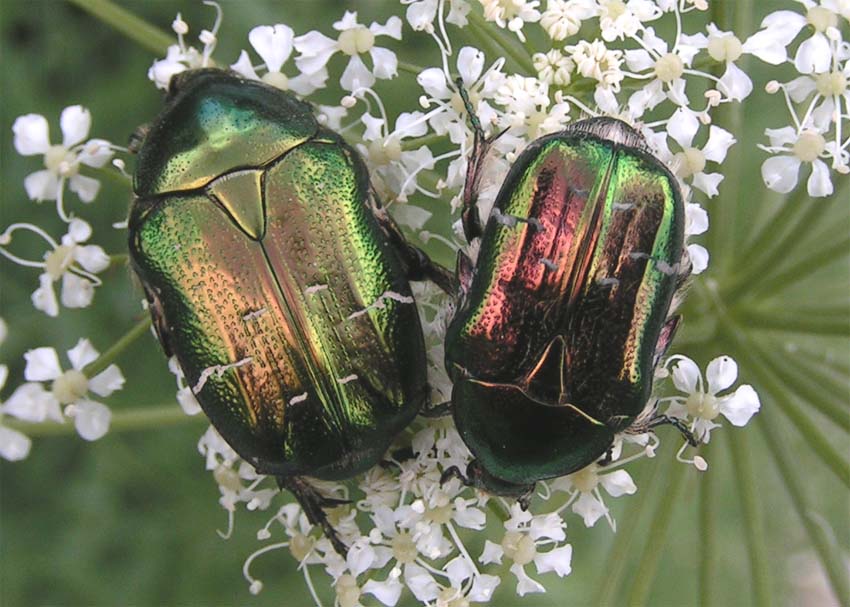
The rose chafer gleams metallic green and likes to sit on flowers, eating pollen. Its larvae live in compost and rotting wood.
💡 Did you know? It flies without opening its wing cases: the wings emerge from the sides.
Foto: The original uploader was Soebe at German Wikipedia. · CC BY-SA 3.0 · Wikimedia Commons
Show answer
Musk beetle
The musk beetle is a long, metallic green-gold longhorn beetle with very long antennae. It lives on old willows.
💡 Did you know? When threatened it gives off a musky scent: hence its name.
Foto: ArtMechanic · CC BY-SA 3.0 · Wikimedia Commons
Show answer
Oil beetle
The black oil beetle is bulky, glossy and flightless. When threatened it exudes a toxic, yellowish oil from its joints.
💡 Did you know? Its larvae cling to wild bees and are carried into their nests.
Foto: Accipiter (R. Altenkamp, Berlin) · CC BY 3.0 · Wikimedia Commons
Show answer
European hornet
The hornet is the largest native wasp, but far more peaceful than its reputation. It hunts other insects and is legally protected.
💡 Did you know? Despite its size, its sting is no more dangerous than that of an ordinary wasp.
Foto: Alvesgaspar · CC BY-SA 3.0 · Wikimedia Commons
Show answer
Violet carpenter bee
The violet carpenter bee is a large, dark, shimmering wild bee. It gnaws its nesting tunnels into rotting wood.
💡 Did you know? As one of Europe's largest bees, it hums especially loudly in flight.
Foto: Claudio Gratton, University of Wisconsin · Attribution · Wikimedia Commons
Show answer
Aphid
Aphids suck plant sap and multiply at a tremendous rate. Large colonies can seriously weaken plants.
💡 Did you know? Ants 'milk' aphids and defend them to get at their sweet honeydew.
Foto: Bruce Marlin · CC BY-SA 2.5 · Wikimedia Commons
Show answer
Cicada
Cicadas produce their loud chirping on hot days. In southern Europe their song is part of summer.
💡 Did you know? Some cicada species live for many years as larvae underground before emerging all at once.
Foto: Cevokreb · CC BY-SA 3.0 · Wikimedia Commons
Show answer
Mole cricket
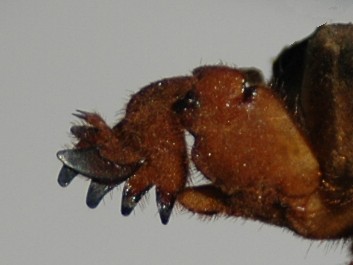
The mole cricket digs tunnels with its powerful forelegs, much like a mole. It spends almost its whole life underground.
💡 Did you know? Its burrows act like a funnel, amplifying its purring song.
Foto: James K. Lindsey · CC BY-SA 3.0 · Wikimedia Commons
Show answer
Water scorpion
The water scorpion is a predatory water bug whose grasping forelegs recall a scorpion. It lurks motionless in the mud.
💡 Did you know? Its 'tail' is not a sting but a breathing tube for taking air from the surface.