Foto: Andreas Trepte · CC BY-SA 2.5 · Wikimedia Commons
Show answer
Honey bee
Honey bees live in large colonies with a queen, make honey and pollinate countless plants. A single colony can number tens of thousands.
💡 Did you know? With their 'waggle dance' bees tell each other where a good food source lies.
Foto: Ivar Leidus · CC BY-SA 4.0 · Wikimedia Commons
Show answer
Bumblebee
Bumblebees are furry, good-natured relatives of honey bees. Their thick coat lets them fly in the cold and pollinate early in the year.
💡 Did you know? They can 'warm up' their flight muscles and stay active even at low temperatures.
Foto: User:Fir0002 · GFDL 1.2 · Wikimedia Commons
Show answer
Wasp
The German wasp builds nests from a papery mass and feeds its larvae on insects. In late summer the adults love sweet things.
💡 Did you know? Unlike bees, wasps can sting repeatedly because their sting has no barbs.
Foto: James K. Lindsey · CC BY-SA 3.0 · Wikimedia Commons
Show answer
Seven-spot ladybird
The seven-spot ladybird is recognised by its red wings with seven black spots. Seen as a lucky charm, it is a useful eater of aphids.
💡 Did you know? When threatened it releases a bitter yellow fluid to deter predators.
Foto: Richard Bartz, Munich Makro Freak · CC BY-SA 2.5 · Wikimedia Commons
Show answer
Red wood ant
Red wood ants build large mounds of needles and twigs and live in huge colonies. They are protected because they keep the forest healthy.
💡 Did you know? In defence they spray formic acid: its sharp smell often hangs over the nest.
Foto: USDAgov · CC BY 2.0 · Wikimedia Commons
Show answer
Housefly
The housefly is one of humanity's most common companions. It cannot chew solid food but liquefies it with saliva and sucks it up.
💡 Did you know? Its compound eyes are made of thousands of tiny lenses: which is why it's so hard to catch.
Foto: Peter J. DeVries · CC BY-SA 3.0 · Wikimedia Commons
Show answer
Mosquito
Only the females bite: they need blood to form eggs. Their larvae develop in water.
💡 Did you know? Mosquitoes find us partly by the carbon dioxide we breathe out and by body odour.
Foto: André Karwath aka Aka · CC BY-SA 2.5 · Wikimedia Commons
Show answer
Dragonfly
Dragonflies are lightning-fast aerial hunters that catch other insects in flight. Their larvae live in water for years before emerging.
💡 Did you know? Dragonflies can fly backwards and hover: moving their four wings independently.
Foto: Morbakka · CC BY-SA 4.0 · Wikimedia Commons
Show answer
European peacock
The peacock butterfly bears a large 'eye spot' on each wing to startle predators.
💡 Did you know? By rubbing its wings together it can make a hissing sound in defence.
Foto: Arieswings · CC BY-SA 4.0 · Wikimedia Commons
Show answer
Common brimstone
The bright yellow brimstone is often the first butterfly of spring. It overwinters as an adult: even under snow.
💡 Did you know? Thanks to natural 'antifreeze' it survives temperatures well below freezing.
Foto: Christian Fischer · CC BY-SA 4.0 · Wikimedia Commons
Show answer
Red admiral
The red admiral is a migratory butterfly with black, red and white markings. Many fly to southern Europe in autumn.
💡 Did you know? Some red admirals travel thousands of kilometres on migration.
Foto: Johannes Robalotoff · CC BY-SA 3.0 de · Wikimedia Commons
Show answer
Painted lady
The painted lady is one of the most far-travelled butterflies, found almost worldwide. Its caterpillars like to feed on thistles.
💡 Did you know? In some years painted ladies migrate in huge swarms from Africa to northern Europe.
Foto: Quartl · CC BY-SA 3.0 · Wikimedia Commons
Show answer
Large white
The large white is a white butterfly whose caterpillars devour cabbage plants: so gardeners dislike it. It is very common.
💡 Did you know? The green-yellow caterpillars are toxic to many birds because they take up mustard oils from cabbages.
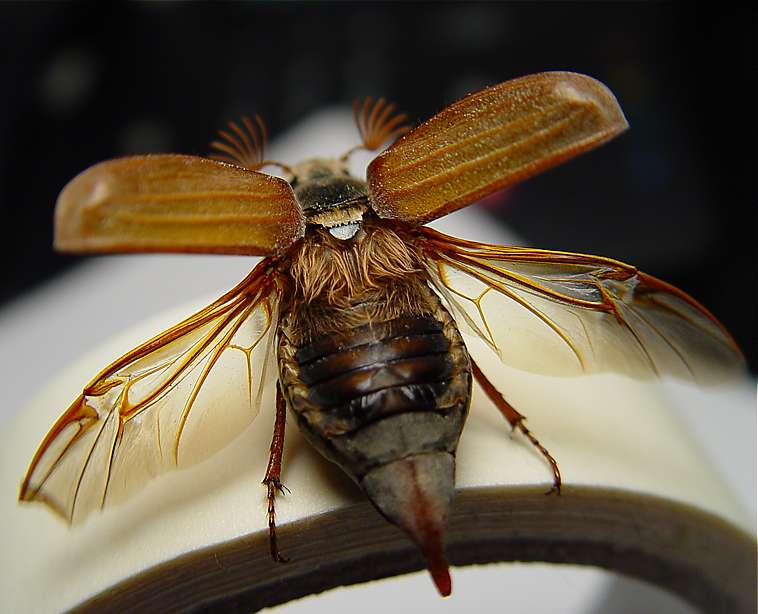
Foto: Rasbak · CC BY-SA 3.0 · Wikimedia Commons
Show answer
Cockchafer
The cockchafer swarms in spring and was once so common it stripped whole trees bare. Its grubs live in the soil for years.
💡 Did you know? Old children's songs and Wilhelm Busch's 'Max and Moritz' made the cockchafer famous.
Foto: J.F. Gaffard · CC BY-SA 3.0 · Wikimedia Commons
Show answer
Stag beetle
The stag beetle is Europe's largest beetle. The males' 'antlers' are enlarged jaws they use to fight over females.
💡 Did you know? Its larvae develop for up to eight years in the rotting wood of old oaks.
Foto: Diego Delso · CC BY-SA 4.0 · Wikimedia Commons
Show answer
Firebug
Firebugs stand out with their red-and-black markings and often sit in groups on sunny walls and trees. They are harmless.
💡 Did you know? Their bold warning colours signal to predators: 'I taste bad.'
Foto: Johannes Robalotoff · CC BY-SA 4.0 · Wikimedia Commons
Show answer
Great green bush-cricket
The great green bush-cricket is a large green katydid. On warm summer evenings the males 'chirp' for hours.
💡 Did you know? It makes the sound by rubbing its wings together; its 'ears' are on the front legs.
Foto: Maksim · CC BY-SA 3.0 · Wikimedia Commons
Show answer
Field cricket
The field cricket lives in self-dug burrows in dry meadows. The males lure with loud chirping from the burrow entrance.
💡 Did you know? When threatened it darts backwards into its burrow in a flash.
Foto: Eugene Zelenko · CC BY-SA 4.0 · Wikimedia Commons
Show answer
Common earwig
The earwig has striking pincers on its rear, used for defence and grasping prey. It is nocturnal and harmless.
💡 Did you know? Its name comes from an old superstition: it does not actually crawl into ears.
Foto: Didier Descouens · CC BY-SA 4.0 · Wikimedia Commons
Show answer
Green lacewing
The delicate green lacewing has transparent, veined wings and golden eyes. Its larvae devour large numbers of aphids.
💡 Did you know? It likes to overwinter in houses, turning reddish-brown as it does so.
Foto: Alvesgaspar · CC BY-SA 3.0 · Wikimedia Commons
Show answer
European mantis
The praying mantis holds its raptorial forelegs as if in prayer: hence the name. It snaps at prey in a flash.
💡 Did you know? The female sometimes eats the male after (or even during) mating.
Foto: ArtMechanic · CC BY-SA 3.0 · Wikimedia Commons
Show answer
Hoverfly
Hoverflies mimic wasps with their yellow-and-black markings but are completely harmless and cannot sting. They often hover in mid-air.
💡 Did you know? As adults they pollinate flowers, while their larvae eat aphids.