🧠
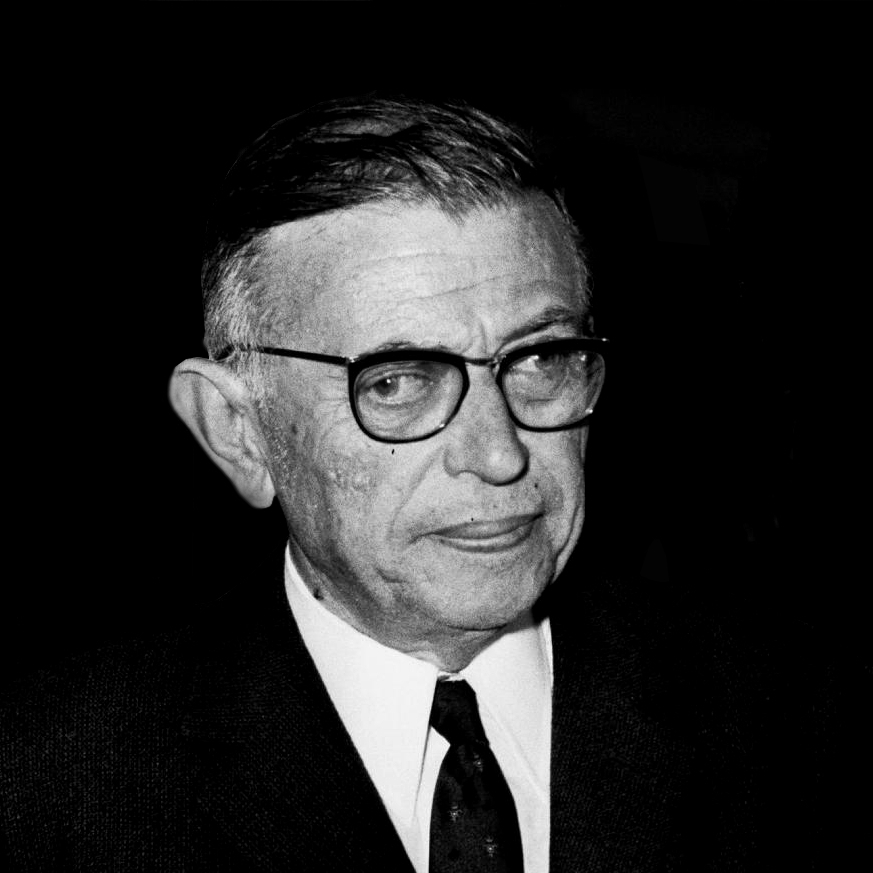
Jean-Paul Sartre
13 questions · Philosophy
Jean-Paul Sartre, born in Paris in 1905, was philosopher, novelist, playwright and political activist in one: the very archetype of the French intellectual. At the elite École normale supérieure he met Simone de Beauvoir in 1929: the beginning of a legendary, unconventional partnership without marriage or shared apartment, but with a lifelong intellectual pact. As a prisoner of war Sartre read Heidegger and afterwards wrote his philosophical masterwork, 'Being and Nothingness' (1943).
His core thesis, popularised in the lecture 'Existentialism Is a Humanism': existence precedes essence. There is no given human nature: first man exists, then he makes himself what he is. So man is radically free, 'condemned to be free': even not choosing is a choice. Whoever hides behind roles and constraints lives in 'mauvaise foi', bad faith. Famous is the line from his play 'No Exit': 'Hell is other people': meaning the petrifying gaze with which others pin us down. He excelled as a writer too: the novel 'Nausea' and plays like 'The Flies' carried his philosophy onto stage and bestseller lists.
After the war Sartre was the star of Saint-Germain-des-Prés and politically engaged on every front: against colonialism and the Vietnam War, for a time close to communism, which drove him into his rupture with Camus; some of his political judgements, notably his long indulgence of the Soviet Union, are considered grave misjudgements today.
In 1964 he did what no one before him had dared: he declined the Nobel Prize in Literature: a writer must not allow himself 'to be turned into an institution'. Did you know that some 50,000 people followed his funeral procession through Paris in 1980? He lies next to Simone de Beauvoir in the Montparnasse Cemetery.
Practise for free
PurFact brings every card back right before you would forget it. That's how knowledge sticks.