
In which town on the Lower Rhine was Joseph Goebbels born in 1897?
Show answer
Rheydt
Rheydt is now part of Mönchengladbach. Goebbels grew up in a strictly Catholic working-class family.
11 questions · History
Joseph Goebbels, born in Rheydt in the Rhineland in 1897, was the propagandist of National Socialism: the man who shaped Hitler's image and carried hatred into every living room. Because of a deformed foot he was spared military service and studied instead; in 1921 he received a doctorate in German literature in Heidelberg. Unsuccessful as a writer and journalist, he found his stage in the Nazi Party. Gauleiter in Berlin from 1926, he fought for the capital with street brawls and his newspaper “Der Angriff”. In 1933 he took over the newly created Propaganda Ministry and from then on controlled the press, radio, film and culture. At the book burning on Berlin's Opernplatz he gave the speech, and the cheap “people's receiver” radio brought his messages into millions of homes. He was a driving force behind the November pogrom of 1938. After the defeat at Stalingrad, in February 1943 he proclaimed “total war” in the Sportpalast. His almost daily diaries are today one of the most important sources on the Nazi leadership. In his will Hitler named him Reich Chancellor: Goebbels held the post for one day. On 1 May 1945 he and his wife Magda had their six children poisoned in the Führerbunker and then took their own lives.
Practise for freePurFact brings every card back right before you would forget it. That's how knowledge sticks.
Rheydt
Rheydt is now part of Mönchengladbach. Goebbels grew up in a strictly Catholic working-class family.
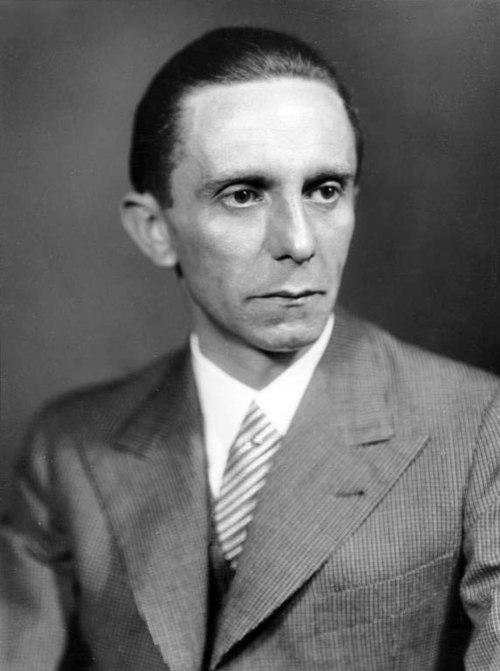
Foto: Heinrich Hoffmann (Bundesarchiv, Bild 146-1968-101-20A) · CC BY-SA 3.0 de · Wikimedia Commons
Joseph Goebbels
Portrait by Heinrich Hoffmann, Hitler's personal photographer.
German literature
His thesis dealt with the Romantic playwright Wilhelm von Schütz. His supervisor, Max von Waldberg, was of Jewish descent.
Berlin
The party was weak in the capital at the time; Goebbels relied on provocation, brawls and his newspaper “Der Angriff”.
the Propaganda Ministry
Through the Reich Chamber of Culture it also decided who was allowed to work as an artist, journalist or musician at all.
Opernplatz
Students burned about 20,000 books there, including works by Heinrich Heine, Erich Kästner and Sigmund Freud.
💡 Did you know? Today an underground, empty library by Micha Ullman on Bebelplatz commemorates the event.
the Volksempfänger
It cost 76 Reichsmarks; people nicknamed it “Goebbels' snout”.
💡 Did you know? From 1939 listening to foreign stations was banned and could be punished with prison.
total war
The speech came shortly after the defeat at Stalingrad. The audience had been carefully selected and the cheering staged for the newsreel.
a diary
The roughly 7,000 surviving pages are a key source on the Nazi leadership: though written with a later publication in mind.
Reich Chancellor
Goebbels held it for just one day; Grand Admiral Karl Dönitz became Reich President.
six
The children were between four and twelve years old; on 1 May 1945 they were sedated and poisoned with cyanide.
Home · All topics · Legal notice · Privacy · Terms · Contact