PurFact

Joseph Haydn

14 questions · Music

Joseph Haydn, born in 1732 to a wheelwright in the Lower Austrian village of Rohrau, began as a choirboy at St Stephen's Cathedral in Vienna and after his voice broke, spent years scraping by as a freelance musician. His fortune turned in 1761, when he entered the service of the Hungarian princely family Esterházy, whom he served as Kapellmeister for almost three decades. At the magnificent but remote Eszterháza palace he was, in his own words, 'cut off from the world' and for that very reason 'forced to become original'. What came of it shaped music history: Haydn developed the symphony and the string quartet into their classical forms, earning him the title 'father of the symphony'. He wrote 104 numbered symphonies, often laced with wit and surprises: in the 'Surprise Symphony' a sudden bang jolts dozing listeners awake, and in the 'Farewell Symphony' the musicians leave the stage one by one; a musical hint to the prince that his orchestra was overdue for a holiday. In old age Haydn became an international star: two journeys to London in the 1790s brought him triumphs and the twelve 'London Symphonies'. Back in Vienna he wrote his great oratorios 'The Creation' and 'The Seasons', as well as the 'Emperor's Hymn': whose melody is today the German national anthem. Mozart was his close friend and dedicated six string quartets to him; the young Beethoven studied under him. Did you know that Viennese Classicism would be hard to imagine without Haydn? He died in Vienna in 1809, at a ripe old age, while Napoleon's troops were bombarding the city: the French emperor posted a guard of honour outside his house.

Practise for free

PurFact brings every card back right before you would forget it. That's how knowledge sticks.

All questions with answers

Which musical era does Joseph Haydn belong to?

Show answer

Viennese Classicism

With Mozart and Beethoven he forms the trio of Viennese Classicism and he was the eldest of the three.

💡 Did you know? Haydn is called the „father of the symphony“ and of the string quartet: he decisively shaped the forms of Viennese Classicism.

Which honorary title does Haydn bear for his role in shaping an orchestral genre?

Show answer

father of the symphony

He also brought the string quartet to its classical form.

💡 Did you know? His musicians affectionately called him 'Papa Haydn'.

How many numbered symphonies did Haydn write?

Show answer

104

More than twice as many as Mozart and more than ten times as many as Beethoven.

💡 Did you know? With 104 symphonies, Haydn wrote more than any other great composer: no wonder after nearly 30 years in a prince's service.

Which princely family did Haydn serve as Kapellmeister for almost three decades?

Show answer

Esterházy

At the remote Eszterháza palace he was, as he put it, 'forced to become original'.

💡 Did you know? For almost three decades Haydn was Kapellmeister to the Esterházy princes: isolated in the country, but with his own orchestra to experiment on.

What is Haydn's symphony called that jolts dozing listeners awake with a sudden bang?

Show answer

Surprise Symphony

Symphony No. 94: in German it's known as the symphony 'mit dem Paukenschlag' (with the drum stroke).

💡 Did you know? The sudden loud drum stroke was, so the popular anecdote goes, meant to startle dozing listeners in London's concert halls.

In which Haydn symphony do the musicians leave the stage one by one?

Show answer

Farewell Symphony

A musical hint to the prince to finally grant his orchestra a holiday and he took it.

💡 Did you know? In the „Farewell“ Symphony the musicians blow out their candles one by one and leave the stage: Haydn's polite hint to the prince to finally grant the players leave.

What are Haydn's two great late oratorios called?

Show answer

The Creation and The Seasons

'The Creation' (1798) was modelled on Handel's oratorios, which Haydn had heard in London.

💡 Did you know? Haydn wrote his two great late oratorios modelled on Handel's oratorios, which he had heard in London.

Which present-day national anthem goes back to Haydn's 'Emperor's Hymn'?

Show answer

the German anthem

His 1797 'Gott erhalte Franz den Kaiser' later became the Deutschlandlied with Hoffmann von Fallersleben's lyrics.

💡 Did you know? The melody of the German national anthem comes from Haydn's „Emperor's Hymn“: originally a hymn to the Austrian emperor.

In which city did the elderly Haydn celebrate his greatest triumphs in the 1790s?

Show answer

London

The twelve 'London Symphonies' were written for his two visits to England.

💡 Did you know? Oxford University awarded him an honorary doctorate.

Which younger composer was Haydn's close friend and dedicated six string quartets to him?

Show answer

Wolfgang Amadeus Mozart

The young Beethoven, in turn, studied under Haydn.

💡 Did you know? The older Haydn and the young Mozart sincerely admired each other: Mozart dedicated six of his finest string quartets to Haydn.

Where did young Joseph Haydn begin his musical career as a choirboy?

Show answer

St Stephen's Cathedral

He was born in 1732 in Rohrau, Lower Austria, the son of a wheelwright.

💡 Did you know? As a choirboy at St Stephen's in Vienna, the young Haydn got his first musical training: until his voice broke and cost him the position.

In which year did Haydn die, while Napoleon's troops were bombarding Vienna?

Show answer

1809

Napoleon posted a guard of honour outside Haydn's house.

💡 Did you know? During the bombardment Haydn reassured his household: 'Don't be afraid: where Haydn is, nothing can happen.'

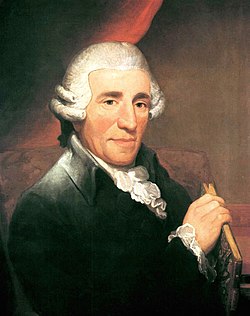
Joseph Haydn

Foto: Thomas Hardy · Public domain · Wikimedia Commons

Which composer is shown here?

Show answer

Joseph Haydn

Joseph Haydn was an Austrian composer of the Viennese Classical era, regarded as the „father of the symphony“ and the string quartet.

💡 Did you know? The melody of today's German national anthem comes from his „Emperor's Hymn“.

Joseph Haydn

Foto: Thomas Hardy · Public domain · Wikimedia Commons

Which piece is playing?

Show answer

Surprise Symphony

In the gentle second movement a sudden loud chord bursts out: Haydn's musical joke.

💡 Did you know? Haydn supposedly wanted to jolt awake dozing listeners.

How PurFact works

Practise for free

More on this topic

Music: all topics →