
In which city was Beethoven born in 1770?
Show answer
Bonn
At 21 he moved to Vienna, where he remained until his death.
💡 Did you know? Beethoven's father tried to market him as a „second Mozart“, even lying to make him seem younger.
17 questions · Music
Ludwig van Beethoven was born in Bonn in 1770, where his father (not always gently) tried to drill him into a second Mozart. At 21 the young piano virtuoso moved to Vienna, sent off by a patron with the famous words that he should receive 'Mozart's spirit from Haydn's hands'. He did indeed study with Joseph Haydn, and he took Vienna's salons by storm, as a pianist of untamed temperament and a composer who shattered every convention. Then the unthinkable: around 1798, Beethoven (of all people, a musician) began to lose his hearing. In the 'Heiligenstadt Testament' of 1802 he confessed his despair, and his resolve to live on for his art. Out of that crisis grew music of unprecedented force: the 'Eroica', first dedicated to Napoleon until Beethoven furiously scratched out the dedication when Napoleon crowned himself emperor; the Fifth Symphony with its famous 'da-da-da-daaa' fate motif; piano sonatas like the 'Moonlight Sonata'; the piano piece 'Für Elise'; and his only opera, 'Fidelio', a hymn to freedom. By the end Beethoven was almost completely deaf and it was precisely then that he wrote his Ninth Symphony, the first symphony ever to bring a choir into its finale: Schiller's 'Ode to Joy', today the anthem of Europe. At the 1824 premiere, the deaf composer had to be turned around so he could see the thunderous applause he could not hear. Did you know that with his nine symphonies Beethoven built the bridge from Viennese Classicism to Romanticism? When he died in Vienna in 1827, some 20,000 people lined the route of his funeral procession: a state funeral in all but name, for a composer who changed music forever.
Practise for freePurFact brings every card back right before you would forget it. That's how knowledge sticks.
Bonn
At 21 he moved to Vienna, where he remained until his death.
💡 Did you know? Beethoven's father tried to market him as a „second Mozart“, even lying to make him seem younger.
Classicism and Romanticism
He brought Classicism to its summit while opening the door to Romanticism.
💡 Did you know? Beethoven burst the classical forms and opened the door to Romanticism: each of his symphonies was a revolution.
deafness
His hearing loss began around 1798; he wrote his last works almost completely deaf.
💡 Did you know? He communicated using conversation books: about 140 of them survive.
Heiligenstadt Testament
Written in the Viennese suburb of Heiligenstadt, addressed to his brothers: but never sent.
💡 Did you know? In the „Heiligenstadt Testament“ the 31-year-old confessed despair over his deafness and thoughts of suicide: yet resolved to go on living.
nine
The legendary number haunted his successors: Brahms, Bruckner, Dvořák and Mahler all wrestled with the 'curse of the ninth'.
💡 Did you know? Beethoven's nine symphonies set such a standard that later composers like Brahms dreaded the comparison.
Ode to Joy
It was the first time a choir entered a symphony. The melody is now the anthem of Europe.
💡 Did you know? The choral finale „Ode to Joy“ is today the anthem of the European Union: by then Beethoven was already completely deaf.
the Fifth Symphony
'Thus fate knocks at the door,' Beethoven reportedly said of the opening motif: though the anecdote is disputed.
💡 Did you know? The „da-da-da-dum“ is seen as the „fate motif“: in the Second World War it stood (as the Morse for „V“) for Allied victory.
Napoleon
When Napoleon crowned himself emperor, Beethoven scratched out the dedication so furiously that he tore a hole in the title page.
💡 Did you know? Beethoven first dedicated the „Eroica“ to Napoleon: when Napoleon crowned himself emperor, he angrily tore out the dedication.
Fidelio
A rescue opera: Leonore, disguised as 'Fidelio', frees her husband from a political prison.
💡 Did you know? Beethoven agonised over his only opera „Fidelio“ so much that he revised it three times and wrote four different overtures.
Für Elise
Who 'Elise' was remains a mystery: possibly a misreading of 'Therese'.
💡 Did you know? The 'Moonlight Sonata' likewise didn't get its nickname from Beethoven himself.
Joseph Haydn
A patron sent him off to receive 'Mozart's spirit from Haydn's hands'.
💡 Did you know? Beethoven was dissatisfied with Haydn's teaching and secretly took extra lessons from other teachers.
around 20,000
Among the torchbearers was Franz Schubert, who died only a year later.
💡 Did you know? At Beethoven's funeral in Vienna in 1827, an estimated 20,000 people lined the streets: schools were closed.
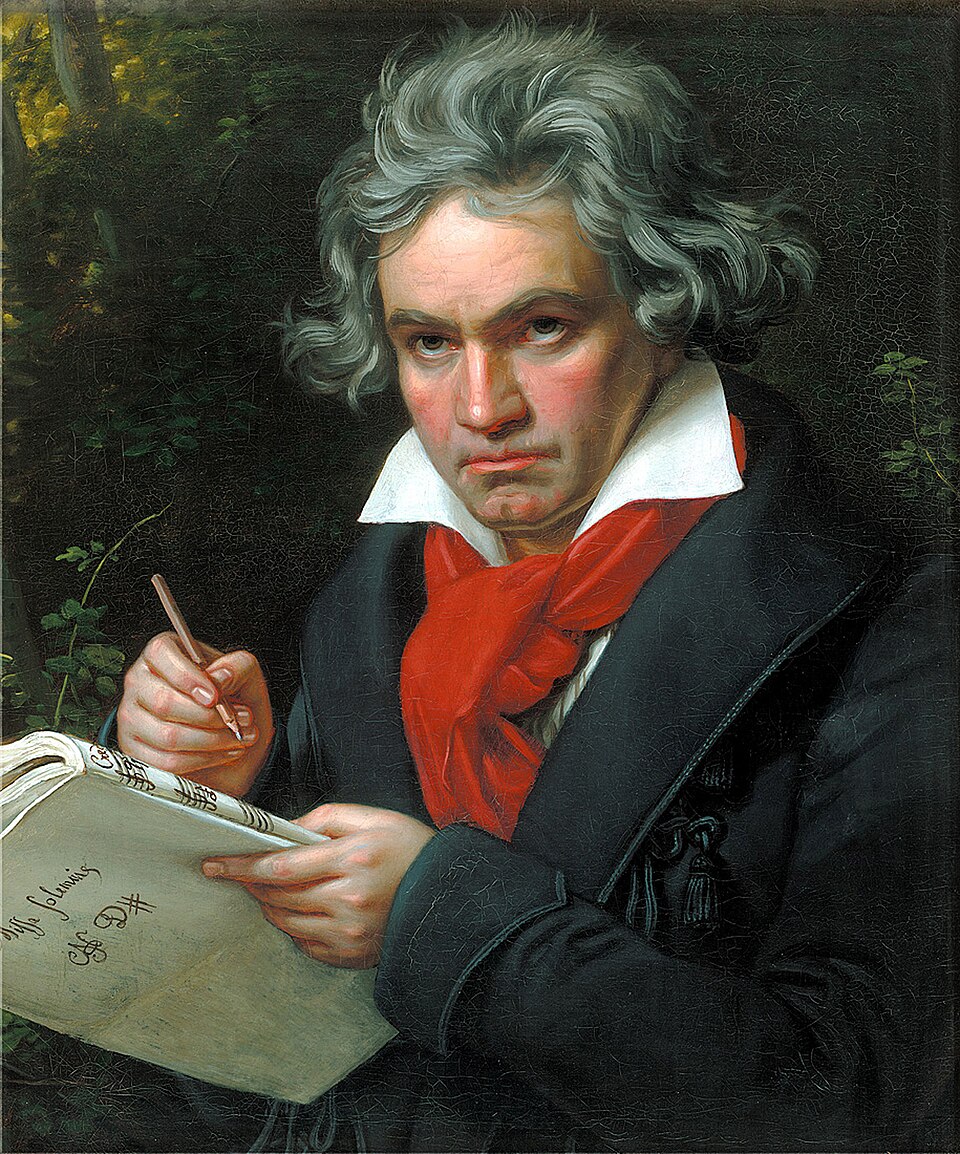
Foto: Joseph Karl Stieler · Public domain · Wikimedia Commons
Ludwig van Beethoven
Ludwig van Beethoven was a German composer who bridged Viennese Classicism and Romanticism and changed the symphony forever.
💡 Did you know? He wrote his most famous works, including the 9th Symphony, when already almost completely deaf.

Foto: Joseph Karl Stieler · Public domain · Wikimedia Commons
Für Elise
Beethoven's best-known piano miniature, a bagatelle in A minor. Unpublished in his lifetime, it appeared only in 1867 and who ‘Elise’ was remains a mystery.
💡 Did you know? Some scholars read the dedication as ‘Für Therese’ (Therese Malfatti): a misreading of the manuscript.
Foto: Joseph Karl Stieler · Public domain · Wikimedia Commons
Moonlight Sonata
The first movement (Adagio sostenuto), with its gently rocking triplets, is among the most famous in all piano music. The nickname ‘Moonlight’ came from critic Ludwig Rellstab.
💡 Did you know? Beethoven titled it ‘Sonata quasi una fantasia’: a sonata almost like a fantasy.
Foto: Joseph Karl Stieler · Public domain · Wikimedia Commons
Symphony No. 5
Its four opening notes (‘short-short-short-long’) are among the most famous in music. Beethoven reportedly described them as ‘fate knocking at the door.’
💡 Did you know? In WWII the motif stood for the Morse letter ‘V’ for Victory: three short signals and one long.
Foto: Joseph Karl Stieler · Public domain · Wikimedia Commons
Ode to Joy (Symphony No. 9)
The joy theme from the finale of the Ninth (set to Schiller's ode) is today the anthem of Europe.
💡 Did you know? By the 1824 premiere Beethoven was completely deaf and had to be turned around to see the cheering audience.
Home · All topics · Legal notice · Privacy · Terms · Contact