🧠
Michel Foucault
13 questions · Philosophy
Michel Foucault, born in Poitiers in 1926, the son of a surgeon, was meant to become a doctor like his father and instead became the thinker who laid medicine, psychiatry and the prison itself on the dissecting table. After studies at the elite École normale supérieure in Paris and posts in Uppsala, Warsaw and Hamburg, 'Madness and Civilization' made his name in 1961: a history of how reason excluded and locked away 'madness'.
Foucault's lifelong theme is the relation of knowledge and power. He first called his method 'archaeology', later 'genealogy': he excavates the hidden orders that determine what an epoch can think and say at all. His most famous book, 'Discipline and Punish' (1975), traces the shift from the public spectacle of torture to the modern disciplinary society that shapes people through surveillance, normalisation and examination; its emblem is Bentham's 'Panopticon', the circular prison with the invisible watchman at its centre: whoever believes himself watched, watches himself. For Foucault, power is not merely prohibition from above but a productive network that generates knowledge, institutions and even our images of ourselves. In his last years he worked on a multi-volume history of sexuality.
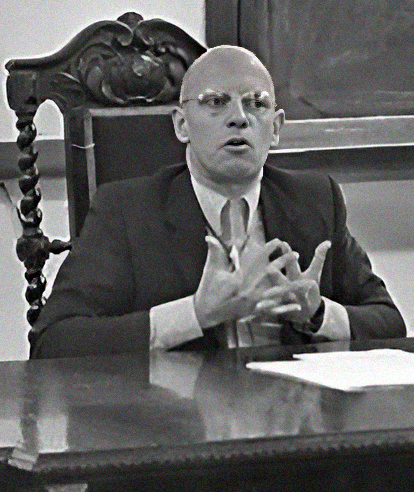
In 1970 Foucault was appointed to the Collège de France, to a chair he himself named 'History of Systems of Thought'. The shaven-headed professor with the wire-rimmed glasses became an icon: politically engaged for prisoners and the marginalised, celebrated and contested: critics accuse him of relativism, and his initial enthusiasm for the Iranian revolution of 1978 to 1979 counts as a misjudgement.
Did you know that Foucault is one of the most cited authors in the humanities and social sciences worldwide? He died in Paris in 1984 of complications from AIDS: one of the first prominent figures in France to do so.
Practise for free
PurFact brings every card back right before you would forget it. That's how knowledge sticks.