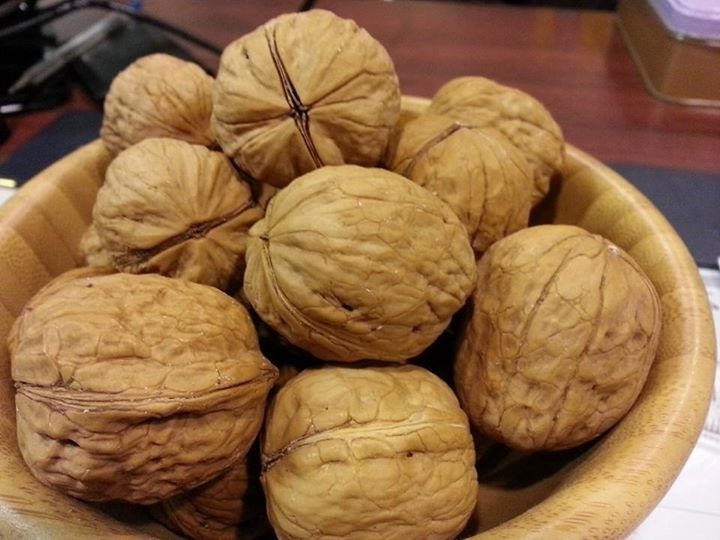
Foto: Boteojoe200 · CC BY-SA 3.0 · Wikimedia Commons
Show answer
Walnut
The walnut sits in a hard, wrinkled shell and its kernel resembles a small brain. It is rich in healthy omega-3 fats.
💡 Did you know? Because of its shape, the walnut was once thought to be ‘good for the brain’.
Foto: Ivar Leidus · CC BY-SA 4.0 · Wikimedia Commons
Show answer
Hazelnut
The hazelnut grows on the hazel shrub, cradled in a leafy husk. It is the classic nut in chocolate-hazelnut spread and pralines.
💡 Did you know? A large share of the world crop comes from Turkey.
Foto: שרה גולד · CC BY 2.5 · Wikimedia Commons
Show answer
Almond
The almond is botanically the seed of a stone fruit, related to peach and apricot. It is eaten sweet, salted or as marzipan.
💡 Did you know? Bitter almonds contain cyanide and may be used only in tiny amounts.
Foto: David E Mead · CC0 · Wikimedia Commons
Show answer
Peanut
The peanut is not a true nut but a legume: related to peas and beans. Its pods ripen underground.
💡 Did you know? Peanuts are pressed for oil and made into peanut butter.
Foto: Bdieu · CC BY 3.0 · Wikimedia Commons
Show answer
Cashew
The kidney-shaped cashew grows on the outside of a fleshy ‘cashew apple’. Its shell contains irritants, so it is never sold truly raw.
💡 Did you know? ‘Raw’ cashews in shops have still been gently heated.
Foto: https://www.flickr.com/people/marcodisce/ · CC BY-SA 2.0 · Wikimedia Commons
Show answer
Pistachio
The pistachio splits its shell open by itself when ripe, revealing a green kernel coloured by chlorophyll.
💡 Did you know? The half-open shell is sometimes called a ‘smiling’ pistachio.
Foto: P. S. Sena, edited by User:RoRo · CC BY-SA 4.0 · Wikimedia Commons
Show answer
Brazil nut
Brazil nuts sit like orange segments, dozens at a time, inside a heavy woody pod. The trees grow wild in the Amazon rainforest.
💡 Did you know? They naturally accumulate high amounts of the trace element selenium.
Foto: tomeppy · CC BY 2.0 · Wikimedia Commons
Show answer
Macadamia
The macadamia is round, creamy and counts among the world's most expensive nuts. Its shell is extremely hard.
💡 Did you know? It originally comes from Australia.
Foto: François Nguyen · CC BY 2.0 · Wikimedia Commons
Show answer
Pecan
The pecan looks like an elongated walnut and tastes milder and sweeter. It stars in American pecan pie.
💡 Did you know? Pecan trees are native to the southern USA and Mexico.
Foto: Magnus Manske · CC BY-SA 3.0 · Wikimedia Commons
Show answer
Chestnut
The sweet chestnut (marron) sits in a spiny husk and is eaten roasted. Unlike most nuts it is starchy and low in fat.
💡 Did you know? Not to be confused with the poisonous horse chestnut!
Foto: Robert Wetzlmayr · Public domain · Wikimedia Commons
Show answer
Coconut
The coconut is the fruit of the coconut palm. Inside, white flesh surrounds the sweet coconut water.
💡 Did you know? Botanically the coconut is a drupe, not a true nut.
Foto: Quellenangabe und Beleg an burgkirsch(at)web.de erbeten. · CC BY-SA 2.0 de · Wikimedia Commons
Show answer
Pine nut
Pine nuts are the small, elongated seeds from the cones of the stone pine. They belong in pesto and are often toasted.
💡 Did you know? Harvesting them from the cones is laborious: hence the high price.