🧠
Pythagoras
12 questions · Philosophy
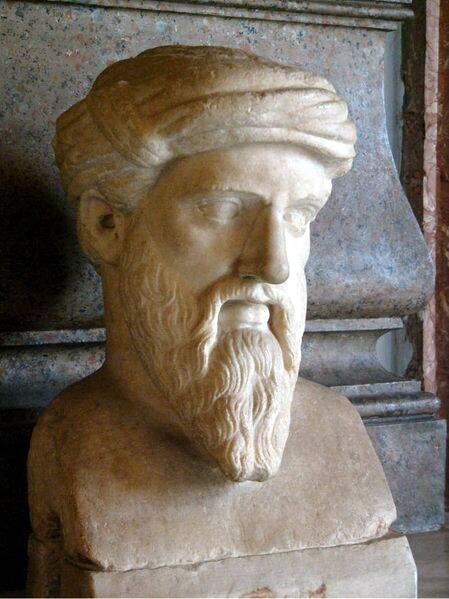
Pythagoras, born around 570 BC on the Greek island of Samos, is one of antiquity's most enigmatic figures: everyone knows his name from maths class: yet the man himself left not a single line, and legends swirled around him even in ancient times. Around 530 BC he left Samos, supposedly out of distaste for the tyrant Polycrates, and emigrated to Croton in southern Italy. There he founded a community that was school, religious order and lifestyle reform in one: the Pythagoreans shared their property, practised silence, examined their conscience every evening and revered number.
For that is the core of Pythagorean teaching: 'All is number.' The world is ordered by mathematical ratios: audible in music, where Pythagoras is said to have discovered that harmonious intervals correspond to simple ratios of string lengths: 2:1 gives the octave, 3:2 the fifth. From this idea grew the notion of a 'harmony of the spheres', a music of the heavenly bodies. The famous Pythagorean theorem about the squares on a right-angled triangle had long been known in practice to Babylonians and Egyptians: but the link with his name, and the fame of its proof, stuck to him.
His teaching also included the transmigration of souls: the immortal soul is reborn into new bodies: which is why the Pythagoreans ate no meat. One anecdote has Pythagoras begging a man to stop beating a dog: in its whimpering he claimed to recognise the voice of a departed friend.
Did you know that the word 'philosophy' itself is said to go back to Pythagoras? He refused to be called 'wise', preferring to be merely a 'lover of wisdom': philosophos. He died around 500 BC in Metapontum; his number mysticism echoed through Plato into modern science.
Practise for free
PurFact brings every card back right before you would forget it. That's how knowledge sticks.