Foto: Veganbaking.net from USA · CC BY-SA 2.0 · Wikimedia Commons
Show answer
Parsnip
The parsnip is a pale root vegetable with a sweet, spicy taste similar to the carrot. It suits soups, purées and stews.
💡 Did you know? Before the potato, the parsnip was an important staple food in Europe.
Foto: Picasa user Seedambassadors · CC BY-SA 3.0 · Wikimedia Commons
Show answer
Swede
The rutabaga (swede) is a large yellowish root with a mild cabbage flavour. It stores for a long time and is made into stew or purée.
💡 Did you know? In times of hardship such as the 'turnip winter' of 1916/17 it was often the only available staple food.
Foto: Dietmar Rabich · CC BY-SA 4.0 · Wikimedia Commons
Show answer
Chard
Chard is a leafy vegetable with large green leaves and often colourful stalks. The leaves and stalks are cooked separately.
💡 Did you know? It is closely related to the beetroot but forms no root bulb.
Foto: Lupus~huwiki · CC BY-SA 4.0 · Wikimedia Commons
Show answer
Jerusalem artichoke
The Jerusalem artichoke is a knobbly root with a nutty, sweet taste, related to the sunflower. It is eaten raw or cooked like potatoes.
💡 Did you know? Its yellow flowers look like small sunflowers.
Foto: Benreis · CC BY-SA 4.0 · Wikimedia Commons
Show answer
Salsify
Black salsify is a long, dark root with a fine, asparagus-like taste. Under its black skin it is white.
💡 Did you know? It is also called 'winter asparagus' because it is harvested in winter.
Foto: Toby Hudson · CC BY-SA 3.0 · Wikimedia Commons
Show answer
Artichoke
The artichoke is a large thistle flower whose fleshy leaf bases and heart are eaten. It is boiled and the leaves are pulled off one by one.
💡 Did you know? If not harvested, the bud opens into a large purple flower.
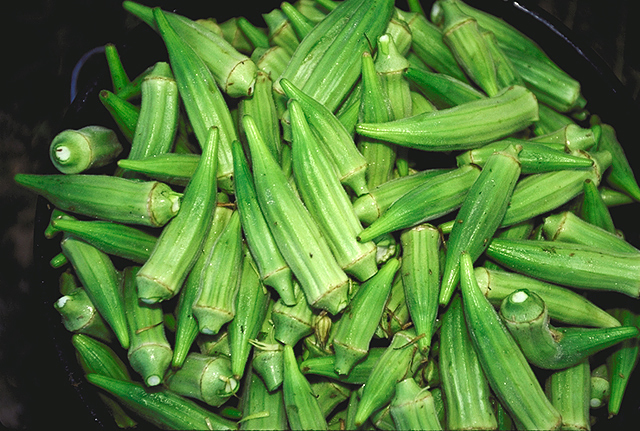
Foto: Bill Tarpenning · Public domain · Wikimedia Commons
Show answer
Okra
Okra is a green, elongated pod with a slimy interior, popular in African, Indian and South American cooking. It is steamed or fried.
💡 Did you know? Its natural mucilage is used to thicken soups and stews.
Foto: Karl-Heinz Wellmann · CC BY-SA 3.0 · Wikimedia Commons
Show answer
Pak choi
Bok choy is an Asian leafy cabbage with white stalks and dark green leaves. It tastes mild and is often stir-fried quickly in a wok.
💡 Did you know? Unlike classic cabbage it forms no firm head.
Foto: Bayartai · CC0 · Wikimedia Commons
Show answer
Napa cabbage
Napa cabbage forms an elongated, pale head of tender, mild leaves. It is eaten raw as salad or cooked.
💡 Did you know? Fermented napa cabbage becomes the Korean dish kimchi.
Foto: Rasbak · CC BY-SA 3.0 · Wikimedia Commons
Show answer
Kale
Kale is a hardy leafy cabbage with strongly curled dark green leaves. It is especially rich in vitamins and a northern German winter dish.
💡 Did you know? After the first frost it tastes milder and sweeter: it then converts starch into sugar.
Foto: Ayla87 · CC BY 3.0 · Wikimedia Commons
Show answer
Savoy cabbage
Savoy cabbage has a loose head with wavy, tender leaves. It tastes milder than white cabbage and is easy to stuff.
💡 Did you know? Its crinkled leaves are especially good as a wrapper for cabbage rolls.
Foto: Rasbak · CC BY-SA 3.0 · Wikimedia Commons
Show answer
Kohlrabi
Kohlrabi forms a round, above-ground bulb with a mild-sweet, cabbage-like taste. It is eaten raw or cooked.
💡 Did you know? The young leaves are also edible and even richer in vitamins than the bulb.
Foto: Schlaghecken Josef · CC BY-SA 4.0 · Wikimedia Commons
Show answer
Arugula
Arugula (rocket) has narrow, jagged leaves with a spicy, peppery, nutty taste. It is used as a salad or on pizza.
💡 Did you know? Its pungency comes from mustard oils, as in its relatives mustard and radish.
Foto: Bff · CC BY-SA 4.0 · Wikimedia Commons
Show answer
Chicory
Chicory forms firm, pale-yellow shoots with a slightly bitter taste. It is eaten as salad or baked au gratin.
💡 Did you know? It is grown in the dark: only then do the leaves stay pale and mild instead of green and bitter.
Foto: Asier Sarasua Garmendia, Assar · CC BY-SA 3.0 · Wikimedia Commons
Show answer
Endive
Endive is an autumn leaf salad with a slightly bitter taste and curly or broad leaves. It stores well.
💡 Did you know? It is closely related to chicory: both belong to the chicory family.
Foto: Llez · CC BY-SA 3.0 · Wikimedia Commons
Show answer
Sweet potato
The sweet potato is a sweetish tuber with mostly orange flesh. Despite the name it is not related to the potato.
💡 Did you know? Botanically it belongs to the morning-glory family, whereas the potato belongs to the nightshades.
Foto: Filo gèn' · CC BY-SA 4.0 · Wikimedia Commons
Show answer
Ginger
Ginger is a hot, spicy root tuber used for cooking, for tea and as a remedy. It comes from Southeast Asia.
💡 Did you know? It is said to help against nausea and travel sickness.
Foto: Jamain · CC BY-SA 3.0 · Wikimedia Commons
Show answer
Celeriac
Celeriac is a large, white root bulb with a strong, savoury aroma. It is a key ingredient in soup greens and stocks.
💡 Did you know? Dried, ground celery is used to make the well-known celery salt.
Foto: Rasbak · CC BY-SA 3.0 · Wikimedia Commons
Show answer
Snow pea
The snow pea is eaten together with its tender, flat pod, before the peas inside are fully formed. It tastes crunchy and sweet.
💡 Did you know? Unlike ordinary peas, the pod lacks the tough parchment layer: which is why it is edible.
Foto: Ivar Leidus · CC BY-SA 4.0 · Wikimedia Commons
Show answer
Romanesco
Romanesco is a light-green cabbage whose florets grow in striking, pointed spirals. It tastes milder and nuttier than cauliflower.
💡 Did you know? Its florets form a natural fractal pattern that repeats itself at ever smaller scales.
Foto: Rainer Zenz · CC BY-SA 3.0 · Wikimedia Commons
Show answer
Pointed cabbage
Pointed cabbage has a loose, cone-shaped head with tender, mild leaves. It cooks faster than firm white cabbage.
💡 Did you know? It is an early, more tender relative of white cabbage, ready as soon as early summer.
Foto: User:MarkusHagenlocher · CC BY-SA 3.0 · Wikimedia Commons
Show answer
Parsley root
Hamburg parsley is a pale, tapering root with a strong, parsley-like flavour. It seasons soups and stews.
💡 Did you know? It looks very like the parsnip but tastes markedly more aromatic and is more slender.