📐
Walter Gropius
11 questions · Art
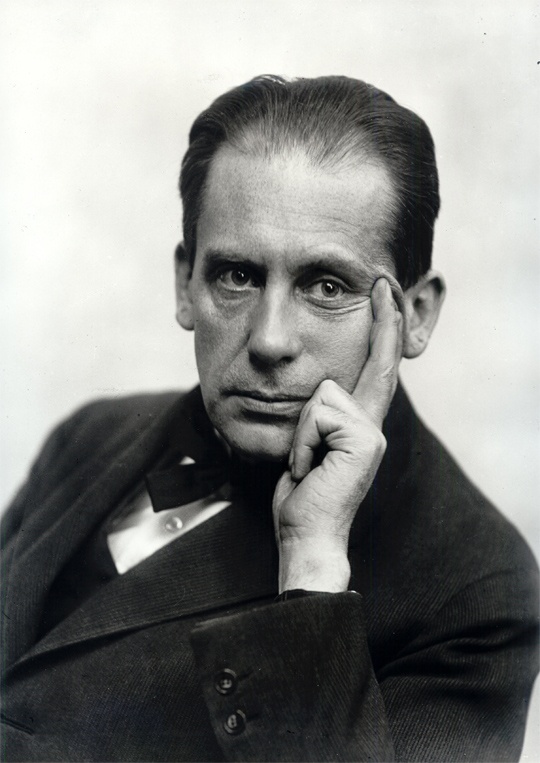
Walter Gropius was born in Berlin in 1883 into a family of builders, and yet he could barely draw. He had others prepare his plans and saw himself all his life mainly as an ideas man and organiser. From 1908 he trained in Peter Behrens’s office in Berlin, where the young Mies van der Rohe was working at the same time. In 1911, with Adolf Meyer, he built the Fagus Factory in Alfeld, a plant making shoe lasts, whose glass corners have no supporting columns. It is regarded as one of the first modern buildings.
In the First World War he served on the Western Front. As early as 1915, Henry van de Velde had recommended him as his successor in Weimar, and in 1919 Gropius founded the Bauhaus there, a school where art and craft were to come together again. Its manifesto bore a woodcut by Lyonel Feininger, a radiant cathedral. In his private life he plunged into a stormy marriage with Alma Mahler, the composer’s widow, who soon left him for the writer Franz Werfel.
In 1934 he fled the Nazis to England and three years later moved on to America. At Harvard University he led the teaching of architecture and shaped a whole generation of architects. In later life he helped design the Pan Am Building, which pushes across Park Avenue right behind Grand Central Terminal and outraged many New Yorkers. Gropius died in Boston in 1969, a few weeks before Mies van der Rohe.
Practise for free
PurFact brings every card back right before you would forget it. That's how knowledge sticks.