🎨
Wassily Kandinsky
19 questions · Art
Wassily Kandinsky is born in 1866 in Moscow and at first follows a quite different path: he studies law and economics and becomes a university lecturer. Only at thirty does he give up this secure career to become a painter: legend has it after a painting by Monet deeply shook him, even though at first he could not make out the subject at all. It is precisely this experience (that colour and form alone can have an effect) that becomes the core of his life's work.
Kandinsky becomes a pioneer of abstract painting. He is convinced that art need not depict anything but, like music, can speak directly to the soul: colours and forms as pure sounds, without any recognisable object. Around 1910 he paints some of the first wholly non-representational pictures in art history. In his book "Concerning the Spiritual in Art" he sets out this new vision in theory.
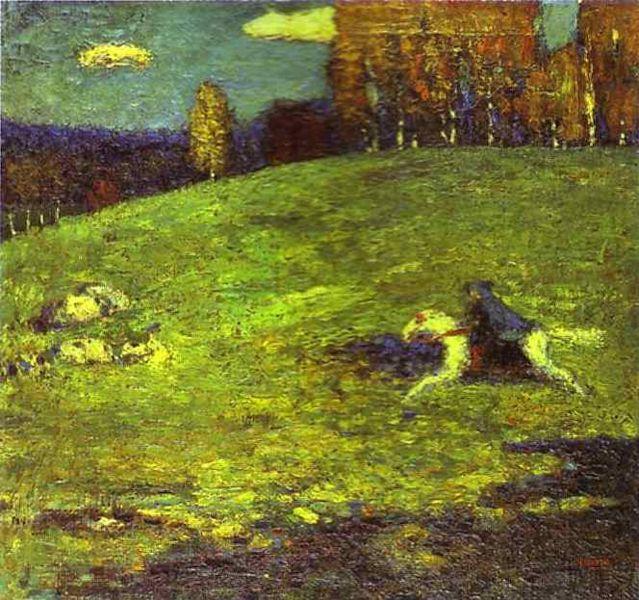
In Munich, Kandinsky and friends found the artists' group "Der Blaue Reiter" (The Blue Rider), a centre of the avant-garde. Later he teaches at the famous "Bauhaus", the most influential art and design school of modernism, where his forms grow stricter and more geometric: circles, triangles and lines in finely balanced compositions.
When the Nazis close the Bauhaus and condemn modern art as "degenerate", Kandinsky emigrates to France, where he dies in 1944. He is regarded as one of the fathers of abstract art. Did you know that Kandinsky could supposedly hear colours as sounds (a phenomenon called synaesthesia) so that painting was for him almost like composing music?
Kandinsky, pioneer of abstract painting and co-founder of ‘The Blue Rider’, wanted colours and forms to sound like music. His great ‘Compositions’ (‘Composition VI’, ‘Composition VII’, ‘Composition VIII’ and ‘Composition X’) form the heart of his work. Add to them ‘Colorful Life’, ‘On White II’, ‘Yellow-Red-Blue’, ‘Several Circles’, ‘Sky Blue’, ‘In Grey’ and ‘Tempered Elan’.
Practise for free
PurFact brings every card back right before you would forget it. That's how knowledge sticks.